

Fireworks
Fireworks AI · Coding
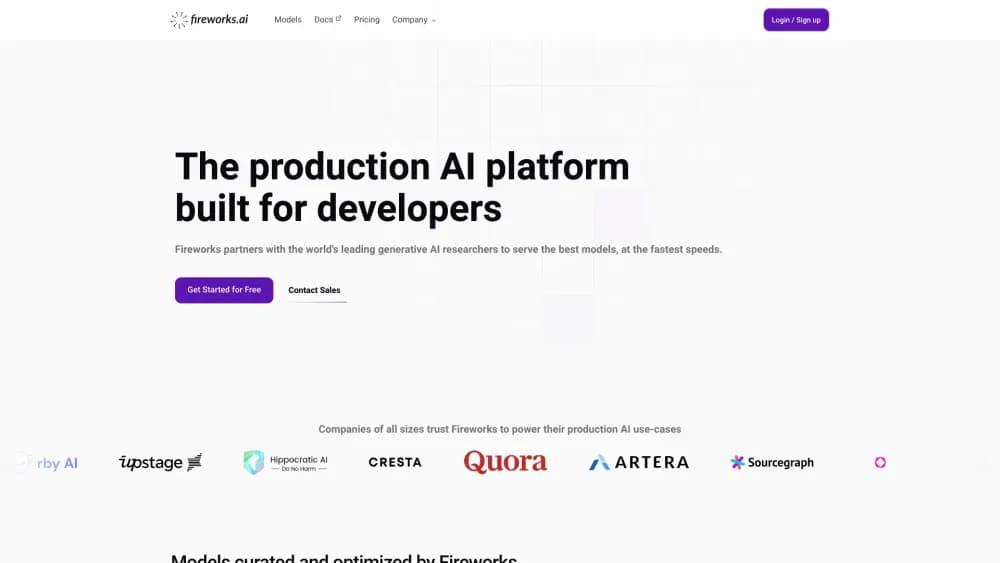
Fireworks AI is a platform for running and training open AI models, with serverless inference, dedicated GPU deployments, and fine-tuning in one place.
About Fireworks
What Is Fireworks AI
Fireworks AI is a platform for building with open models. It runs production inference for models like Llama, DeepSeek, Qwen, and Kimi, and it also handles training when you need a model tuned to your own data. The team that built PyTorch at Meta started the company, and its inference engine, FireAttention, is built to serve models quickly without giving up output quality.
The problem it solves is the gap between grabbing a model off a hub and running it for real users. A single GPU and an open script get you a demo. Serving the same model to thousands of people with low latency, predictable cost, and autoscaling is a different job. Fireworks handles that layer, so you point an API call at a model and let the platform manage the hardware underneath.
Two limits shape when it fits. This is a developer platform, not a chat app you open in a browser, so you need code to use it. And the open models it serves may not match a closed frontier model on every task, which matters if your product leans on the absolute best reasoning. For teams shipping AI features on a budget and a timeline, those tradeoffs usually land the right way.
Getting Started
- Create an account at app.fireworks.ai and generate an API key in the dashboard settings.
- Pick a model from the catalog. Start with Serverless to test a few options with pay-per-token pricing before committing to anything.
- Send your first request. Fireworks offers an OpenAI compatible endpoint, so you can reuse existing OpenAI or Anthropic SDK code by changing the base URL and key.
- Move to a deployment when you need more control. On-demand deployments run on dedicated GPUs with autoscaling, and reserved capacity guarantees throughput.
- Fine-tune a model if off-the-shelf quality falls short, then deploy the result to the same infrastructure.
Product Information
A quick look at Fireworks's pricing, supported platforms, and performance.
Best for
The users, tasks, and scenarios where this tool fits best.
Users
- Developers and ML engineers
- Startup teams shipping AI features
- Enterprises with data and compliance needs
Tasks
- Running an open model in production
- Fine-tuning on your own data
- Building an agent that calls tools
- Migrating off a closed model API
Scenarios
- Prototyping before you commit to GPUs
- Handling uneven traffic
- Cutting the cost of a high-volume feature
Key features
Fast Serverless Inference
Serverless runs popular open models with pay-per-token billing and no infrastructure to manage. Fireworks offers Standard, Priority, and Fast paths, so you can trade cost against latency depending on the request. The OpenAI compatible endpoint means existing code often works with a changed base URL. It's the quickest way to test a model before you invest in a deployment.
Dedicated GPU Deployments
When a shared endpoint isn't enough, on-demand deployments run your model on dedicated GPUs with fast autoscaling and short cold starts. You can tune a deployment for speed or throughput and serve multi-region. Reserved capacity goes further, guaranteeing throughput and higher quotas, and it gets you new hardware first. This is the layer production workloads settle into once usage is steady.
Fine-Tuning and Training
Fireworks handles supervised fine-tuning and reinforcement fine-tuning for models up to a trillion parameters and beyond. You can take a guided path where you describe the task and review a plan, configure a run yourself, or write your own training logic on the platform's GPUs. Every checkpoint deploys to production in seconds, which keeps the loop from training to serving short.
Multi-Modal Model Support
The catalog covers text, vision, audio, image, and embedding models, so you can analyze documents, generate images, and build retrieval on one platform. Vision models read images and documents, embeddings and reranking power search and context retrieval, and batch inference runs large async jobs at lower cost. For multi-model systems, that range comes from a single account and API.
Function Calling and Structured Outputs
Function calling connects a model to your tools and APIs, so it can look up data or trigger an action instead of only chatting. Structured outputs return reliable JSON that matches a schema you define, which is what agentic workflows need to move results around without parsing errors. Both run through the same endpoint, so you don't bolt on a second service to add tools.
FireAttention Inference Engine
FireAttention is the serving engine under the platform, tuned for throughput and latency while keeping model quality. Fireworks built it rather than relying on a general-purpose stack, and it's the reason the platform can serve open models fast enough for interactive products. For you, that shows up as lower latency and a lower cost per token on the same hardware.
Pros and cons
Pros
- One place for serverless inference, dedicated deployments, and fine-tuning, so you aren't stitching together separate services.
- OpenAI and Anthropic compatible endpoints let you reuse existing SDK code and swap models with small changes.
- Pay-per-token serverless billing with no minimum spend makes early testing cheap before you commit to GPUs.
- Broad model catalog spanning text, vision, audio, image, and embeddings under one API.
- SOC 2 and HIPAA coverage plus reserved capacity suit teams with compliance and throughput requirements.
Cons
- It's a developer platform with no consumer chat interface, so non-coders can't use it directly.
- Open models may trail closed frontier models on the hardest reasoning or niche tasks.
- Cost can climb quickly at high volume, so you need to watch usage and set spend limits.
- Self-serve billing is prepaid credits, which adds a step before you make your first call.
Frequently asked questions
Fireworks AI serves and trains open AI models for production. You use it to run models like Llama, DeepSeek, and Qwen behind a fast API, fine-tune them on your own data, and scale them on dedicated GPUs.
Related content
Explore related tools, skills, and articles for Fireworks.
Fireworks Alternatives

Base Code
Base44 (Wix) · Coding · ProductivityBase Code is a shared cloud development environment from Base44. Teammates describe changes to an existing GitHub codebase in chat, preview them live and send them back as pull requests.

Google EmbeddingGemma 2
Google DeepMind · Writing · Image · CodingGoogle EmbeddingGemma 2 is a 740M-parameter open model that turns text, code, images, audio, and video frames into vectors in one 768-dimension space, running on phones and laptops.

GitGlow
GitGlow · Coding · ProductivityGitGlow is a local-first desktop Git client that lets independent developers review their own code and their AI agents' changes in one place before shipping.