

Fish Speech
Fish Audio · Voice & Language · Video
Fish Speech is Fish Audio's open source text to speech model, now shipped as Drama 3, with 10 to 30 second voice cloning, 83 languages, and inline emotion tags.
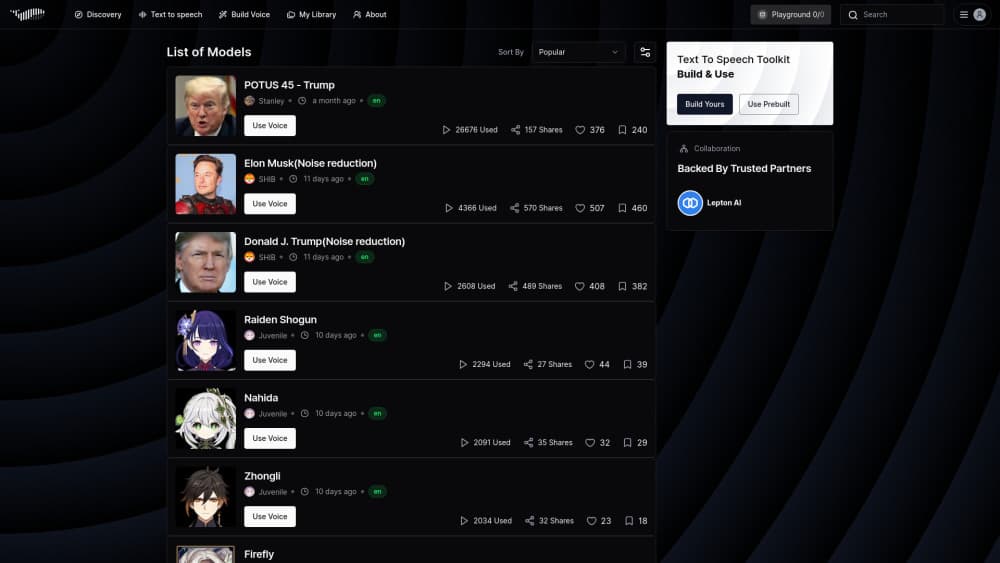
About Fish Speech
What Is Fish Speech
Fish Speech is an open source text to speech model from Fish Audio, the company behind the fish.audio platform. The name covers two things that ship together: the model weights on Hugging Face and the codebase on GitHub, plus the hosted service that runs the same models behind a web app and an API. Sign up and it behaves like any AI voice generator. Download the weights and it becomes infrastructure you control.
The model line has moved fast. Fish Speech 1.x and OpenAudio S1 established the pitch: clone a voice from a short sample, control tone with plain language. S2 and S2.1 Pro pushed accuracy and streaming. Drama 3, released on October 13, 2026, is the current flagship at 35B parameters with 3B active per token, and it adds local audio editing and multi turn direction on top of the earlier strengths.
What it fixes is the gap between open and polished. Most open source TTS projects sound flat next to commercial voice tools, and most commercial tools won't let you run them offline. Fish Speech closes both ends: the weights are downloadable under the Fish Audio Community License, which allows commercial use for companies under $500,000 in annual revenue, and the hosted plans start free.
The limits matter too. Self hosting wants an NVIDIA GPU and some patience with Python environments. Cloning quality tracks the cleanliness of your reference clip, so a noisy phone recording gives you a noisy clone. And most benchmark numbers come from Fish Audio's own testing, with Artificial Analysis as the main independent check.
Getting Started
- Open fish.audio and sign up for a free account. The free tier covers about 7 minutes of generated audio a month, enough to judge whether the voices fit your project.
- Pick a voice from the library or clone one. For a clone, upload 10 to 30 seconds of clean speech with no music or room noise behind it.
- Paste your script into the text box and drop in direction tags where the delivery should shift, for example [whisper] before a line or [laughing] after it.
- Generate, listen, then adjust the tags rather than rewriting the text. Short tag edits change more than a reworded sentence.
- For self hosting, clone the GitHub repo, install the environment, pull the weights from Hugging Face, and start the WebUI or the API server on a machine with a modern NVIDIA card.
Product Information
A quick look at Fish Speech's pricing, supported platforms, and performance.
Best for
The users, tasks, and scenarios where this tool fits best.
Users
- YouTube creators and podcasters
- Game developers and animators
- Developers building voice features
- Localization teams
Tasks
- Dubbing a video into another language
- Drafting character dialogue for a game scene
- Turning a blog post into an audio version
- Adding a voice layer to an app prototype
Scenarios
- Testing an idea before paying for studio time
- Running a channel in several markets at once
- Shipping a demo on a deadline
Key features
Voice Cloning From a Short Sample
Ten to 30 seconds of reference audio is enough to reproduce a timbre, and Fish Audio advertises 15 seconds on the marketing side. The clone carries accent, pitch, and speaking rhythm rather than just a rough impression. Clean mono audio recorded close to the mic gives the best result, and background music is the fastest way to ruin a clone.
Inline Direction Tags
You control delivery with bracketed instructions written where the mood changes: [whispering], [angry], [sighing], [laughing], [pause]. Drama 3 responds to free-form direction too, so [barely holding it together, forcing a smile] works as a tag. Paired tags such as emphasis brackets let you direct a few words inside a line instead of the whole sentence. This is the feature that separates the model from older TTS engines, which expected you to set speed and pitch and hope.
Wide Language Coverage
Drama 3 speaks 83 languages, up from the 13 that Fish Speech 1.5 handled. That puts it among the widest multilingual TTS models available for download. The important part is cross-language cloning: you clone a voice once and generate in another language while keeping the speaker identity. Direction tags can be written in whatever language you think in, and the model still applies them to the target line.
Multi Speaker Scene Generation
A single text can hold several characters, marked with speaker IDs, and the model generates the whole exchange in one pass. For audio drama, game cutscenes, or training videos with two hosts, that removes the generate, stitch, and re-time loop that made multi-voice work tedious.
Local Editing and Multi Turn Revision
Drama 3 lets you edit a finished take the way you edit a document. Replace one word and the surrounding timbre and transitions stay intact, which saves regenerating a five minute clip over a single mistake. Multi turn revision works the other way: tell the model the last take should be gentler or sadder and it regenerates with that context instead of starting cold.
Open Weights You Can Self Host
The codebase and weights are public, and the community license allows commercial use below $500,000 in annual revenue. That makes Fish Speech a real option for teams with privacy constraints or predictable volume, since local inference has no per character cost. You trade that for GPU hardware, setup time, and the upkeep of a Python stack.
Low Latency Streaming API
The hosted API streams audio as it generates, with first audio around 100 ms and a real time factor of 0.195 on an H200 in Fish Audio's own measurements. Text to speech, speech to text, and a voice agent endpoint sit behind the same key. For conversational products, that latency is the difference between an assistant that interrupts and one that waits.
Pros and cons
Pros
- Voice cloning works from a short reference clip, so you don't need a recording session to get a usable voice.
- Emotion and pacing are controlled with plain language tags instead of parameter sliders, which is far quicker to iterate on.
- The free tier plus open weights give you two cheap ways to evaluate it before paying anything.
- 83 languages with cross-language cloning covers most localization work with one voice identity.
- Streaming latency and an open API make it viable inside a real product, not just for one-off files.
Cons
- Self hosting requires an NVIDIA GPU and comfort with Python environments, which rules out casual users.
- Clone quality depends heavily on the reference audio, so noisy source clips produce muddy results and there's no cleanup tool built in.
- The community license caps free commercial use at $500,000 in annual revenue, so larger companies need a commercial agreement.
- Most published benchmarks are vendor run, and the independent comparisons cover pronunciation accuracy rather than emotional range.
Frequently asked questions
Yes. The hosted service has a free tier with roughly 7 minutes of generation a month, and the model weights are free to download and run. Commercial use of the open weights is free for organizations under $500,000 in annual revenue.
Related content
Explore related tools, skills, and articles for Fish Speech.
Fish Speech Alternatives

Foley
Hanamori Labs, LLC · Voice & Language · Productivity · AI AssistantFoley is a voice to-do list that turns a spoken sentence into a filed task, complete with project, date and time, then helps you plan the day around what is already there.

HireKey
HireKey · Voice & Language · Productivity · LeaningHireKey is an AI job search copilot built by a former tech recruiter. It checks role fit, tailors resumes, runs interview practice and tracks every application.

Fluence
Yay Software (Yannick Huchard) · Writing · Voice & Language · ProductivityFluence is an Android app that reads PDFs, EPUBs, Word files and web articles aloud, follows each sentence as it speaks, and answers questions about the text on the phone itself.