

Fluree
Fluree · Coding · Leaning
Fluree is an enterprise AI data platform built on a verifiable knowledge graph database called FlureeDB. It pulls structured and unstructured sources into one governed graph, then lets AI agents, apps, and analysts query that same graph with answers that trace back to the original records. Teams use it as the semantic data layer under GraphRAG and other AI workflows, so outputs stay citable and permissions travel with the data.
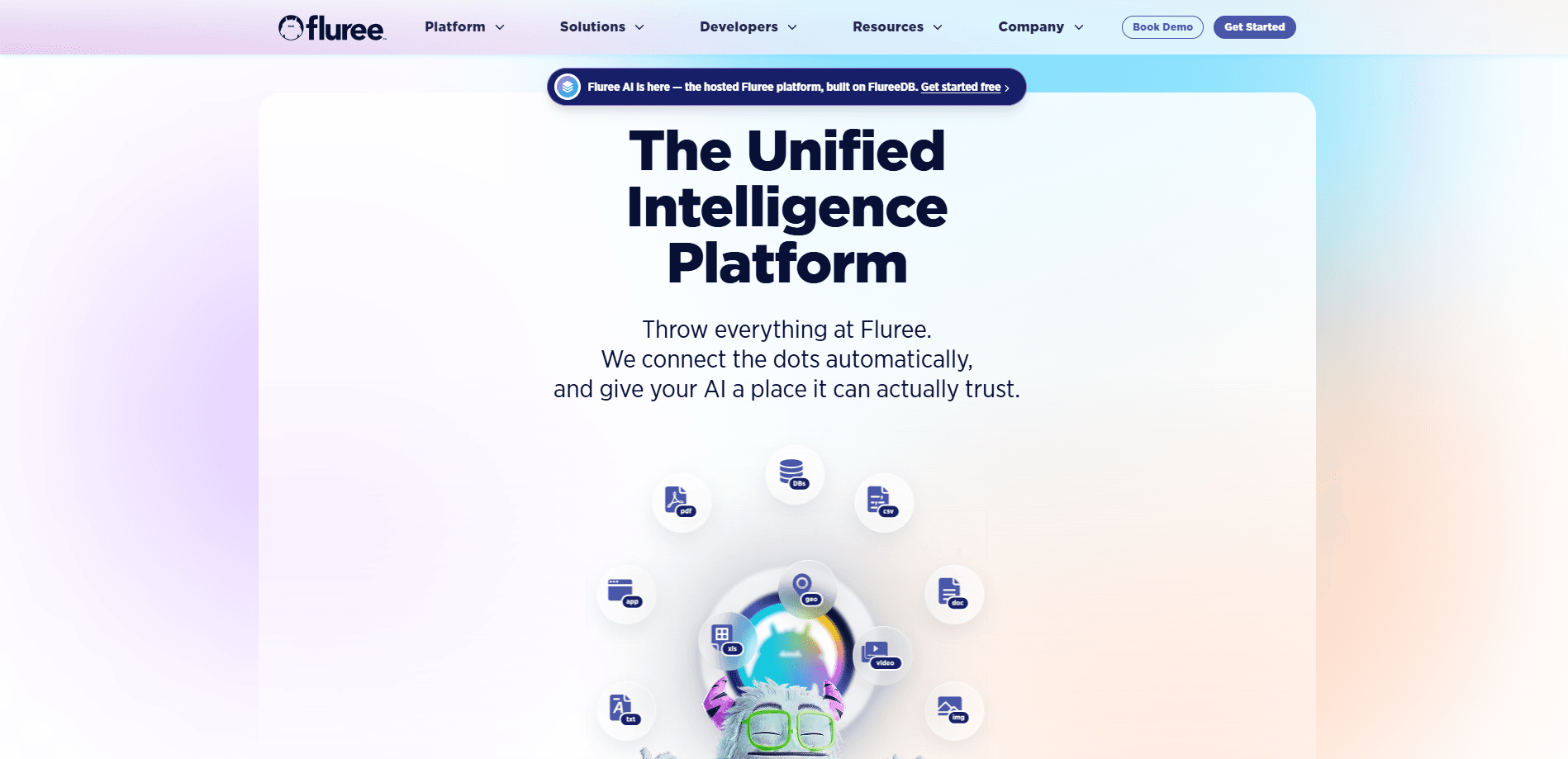
About Fluree
What Is Fluree
Fluree is a semantic, governed data layer that sits underneath your AI stack. Instead of storing plain tables and hoping a bolt-on tool guesses what the columns mean, it stores entities, relationships, and access policy together in a W3C-standard graph. That architecture is what makes AI data governance real instead of aspirational, and it's what makes answers citable and permissions hard to bypass.
The problem it targets is the data layer itself. Enterprise AI usually fails because sources are fragmented, context is missing, and security rules don't follow the data once it leaves a system. Fluree addresses that by grounding models in one knowledge graph the whole organization can build on, with cryptographic lineage behind every change.
The main limitation is audience. Fluree is aimed at enterprises and technical teams, not casual users. You need data engineering or platform know-how to get real value, and the hosted tier runs on a usage-based fuel model that you have to budget for. Small teams with one spreadsheet don't need this. Skip it.
Getting Started
- Pick a deployment path: the hosted Fluree AI platform, a single-tenant stack inside your own AWS account, or self-hosted open-source FlureeDB.
- Start free on Fluree AI or clone the open-source repository from GitHub, and get your first query running, which the company says takes under 30 seconds on the hosted tier.
- Connect your sources through one of the 300+ connectors, or push documents in and let entity resolution merge duplicates into golden records at ingest.
- Set access policies on the graph so every connected agent and app inherits the same rules.
- Query through MCP, REST, or SPARQL from the tool you already use, such as Claude, Cursor, or a custom app.
Product Information
A quick look at Fluree's pricing, supported platforms, and performance.
Best for
The users, tasks, and scenarios where this tool fits best.
Users
- Enterprise data teams
- AI and platform engineers
- Analysts and auditors
- Fortune 500 and public-sector teams
Tasks
- Grounding AI agents in governed data
- Building knowledge graphs
- Unifying structured and unstructured data
- Verifying AI outputs
Scenarios
- Financial services discovery
- Compliance-heavy AI rollouts
- Multi-agent environments
- Migration off proprietary stacks
Key features
Verifiable Knowledge Graph Database
FlureeDB is the core of the platform. It stores entities, relationships, and policy together in an immutable graph, which is the difference between a warehouse of raw rows and a model that understands what those rows mean. Every change carries cryptographic lineage, so you can trace an answer back to where it started.
Governed Access at the Data Layer
Access policies live with the data rather than in a separate system. That means permission rules follow each record as it moves through agents and apps, and they can't be stripped off along the way. For teams in regulated fields, this is often the deciding factor. It matters more than model choice.
Entity Resolution at Ingest
Duplicates get merged into a single golden record as data enters the platform. An incoming "Acme Corp" from a CRM and "Acme Corporation" from billing become one entity, which keeps the graph clean and cuts the manual cleanup analysts usually do later. No spreadsheet surgery required. None.
Native MCP, REST, and SPARQL
Fluree is native to the Model Context Protocol, so Claude, Cursor, and any MCP client can query it as a first-class tool. REST and SPARQL are supported too. You don't have to rip out the tools your team already uses to get connected context. Why does that matter? Because the graph becomes the shared layer every client reads from, not one more destination to copy data into.
300+ Connectors
The hosted Fluree AI platform offers 300+ connectors for pulling in sources, alongside MCP and API access. Broad connectivity matters here because a knowledge graph is only as useful as the number of systems feeding it. A graph with three sources stays thin.
Three Deployment Patterns
The same platform runs hosted and serverless, as a versioned stack inside your own AWS account, or as self-hosted open-source FlureeDB. You pick by how much you want to operate, from nothing at all to everything under your own rules. That flexibility suits both strict-isolation buyers and hands-on engineering teams. Pick one.
Usage-Based Fuel Pricing
Fluree AI starts at $0 with a free fuel allowance, and fuel covers tokens, storage, and compute. It's serverless, so there's zero idle cost. Heavy workloads still mean fuel spending climbs, so budgeting matters. Watch it.
Pros and cons
Pros
- Data, context, and access policy sit together in one graph, so AI answers stay citable and permissions can't be bypassed.
- Native MCP support means existing AI clients like Claude and Cursor plug in without custom glue code.
- Entity resolution at ingest cuts duplicate cleanup and keeps records trustworthy from the start.
- Open-source FlureeDB under a public benefit corporation gives teams a self-hosted path with no lock-in.
- Free tier and serverless billing lower the cost of just trying the platform on real data.
Cons
- Aimed at enterprises and technical teams, so non-technical users will find the setup heavy going.
- Fuel-based usage pricing is hard to predict, and heavy query volume can push costs up quickly.
- Graph and semantic modeling takes real skill, which means onboarding is slower than a simple database.
- Exact launch and update dates aren't published on the site, so the Info table relies on estimates here.
Frequently asked questions
Fluree is used to build a governed knowledge graph that AI systems query for trustworthy, citable context. Teams point it at their data sources, apply access policies, then let agents and apps retrieve connected answers instead of raw rows.
Related content
Explore related tools, skills, and articles for Fluree.
Fluree Alternatives
Forefront
Forefront · CodingForefront is a web platform for building with open-source AI. It lets you fine-tune leading open-source language models on your own data, evaluate how they perform, and run them through an API or export them to host yourself. Developers who want the convenience of a closed-source platform but insist on owning their models and data are the target audience here.

Startkit
StartKit.AI · CodingStartkit is a boilerplate for building AI SaaS and AI wrapper products. Think of it as an AI startup boilerplate with the boring parts already wired up: authentication, Stripe and Lemon Squeezy payments, usage limits, transactional email, and an AI API starter that talks to OpenAI, Anthropic, Groq, or Llama. You clone the repo, set your price, and start on the part of your product that people actually pay for. It's Next.js under React and Tailwind, so most of the boilerplate code already feels familiar.
Testim
Tricentis · CodingTestim is an AI-powered test automation platform for building and running end-to-end tests across web, mobile, and Salesforce applications. It leans on machine learning to keep tests stable when an interface changes, so teams spend less time fixing broken selectors. Not bad for an automated testing tool you can start using today. You create tests by recording actions in a browser, then optionally add JavaScript when you need more control. It's a solid pick for busy QA teams.