

FRAI
FRAI · Other
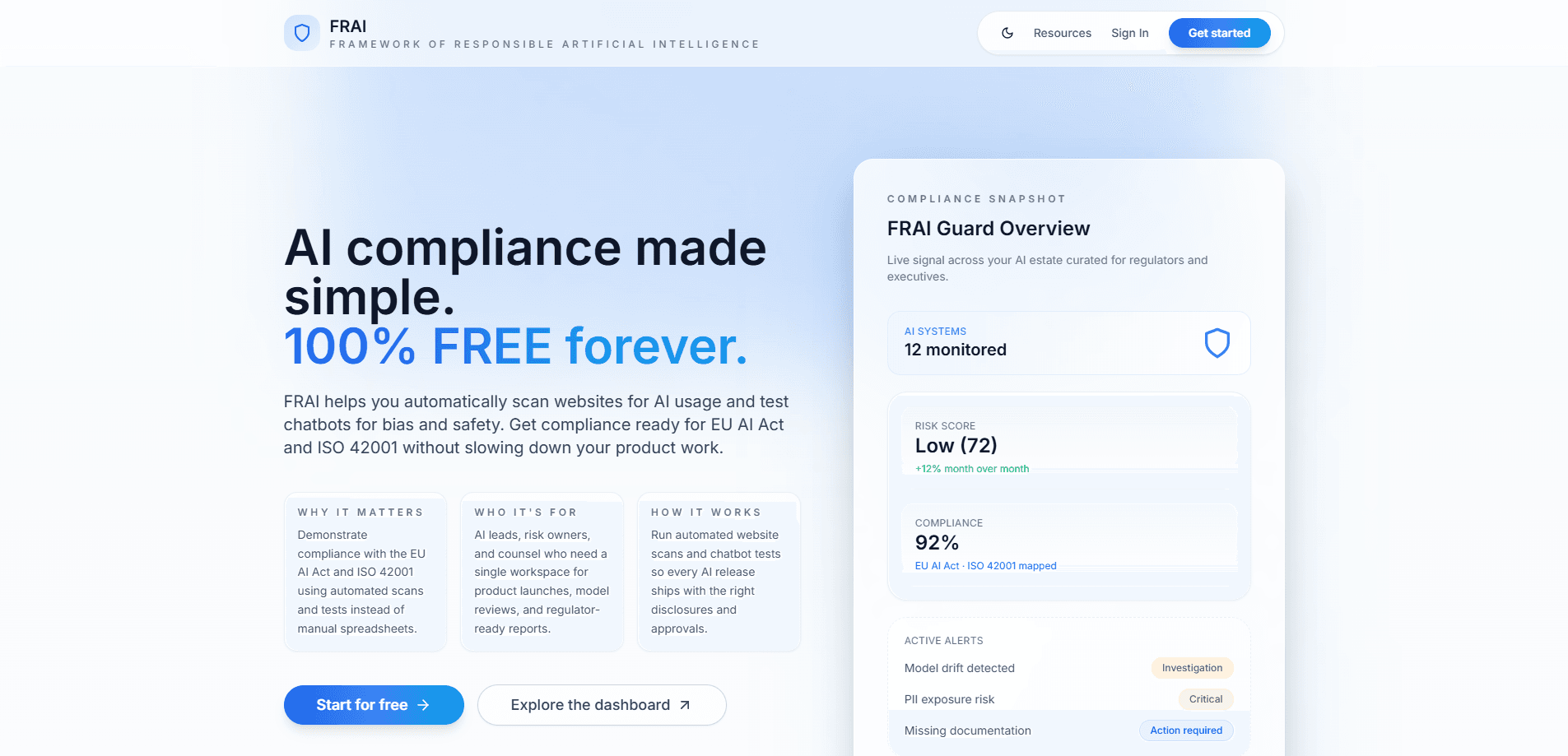
FRAI (Framework of Responsible Artificial Intelligence) checks whether your product actually tells people when AI is involved. Paste a website URL and it finds the chat widgets, AI scripts, and setup code running behind the scenes, then compares what it finds against the disclosure rule in EU AI Act Article 50. That's the whole point of the tool. You can also run the same check inside your codebase through an open-source CLI, or pay for a person to fix the wording for you.
About FRAI
What Is FRAI
FRAI is an AI governance platform built for one narrow, urgent job: proving that your users know when they're dealing with AI. Think of it as an AI compliance tool with a single focus. It scans public web pages for chatbots, AI scripts, and AI setup code, then looks for wording that tells visitors AI is in play. No wording means no passing grade. If it's missing, FRAI says so and shows the exact evidence it used.
The product exists because the EU AI Act Article 50 became enforceable on 2 August 2026. From then on, chat and AI support features have to announce themselves, and AI-generated content has to be labeled. The fines reach up to €15M or 3% of global turnover, which pushes this from a nice-to-have into a real budget line. FRAI isn't legal advice, and it doesn't pretend to be. It's a technical check you can open up and verify line by line, so you can hand the output to a lawyer instead of guessing. As an AI transparency tool, it stays deliberately narrow.
The main limit is what a website scan can see. Anything behind a login, or text that only shows up after a chat window opens, stays invisible to it. For that, you run the gate against your actual codebase or book the paid teardown. That's the catch.
Getting Started
- Open frai.cc and paste the address of the site you want checked. No signup is needed for the free scan.
- Wait a few seconds while FRAI pulls the public pages and lists the chat widgets, AI scripts, and AI setup code it detects.
- Read the result: it shows what AI it found and whether any wording on the page tells people AI is involved.
- For code-level coverage, run
npx frai gate init --cito drop a spec file and a GitHub workflow into your repo, thennpx frai gate check FRAI-SPEC.mdto test the build. - If you'd rather not touch it yourself, book the AI Disclosure Teardown and get the wording written, the gate installed, and an evidence PDF in 48 hours.
Product Information
A quick look at FRAI's pricing, supported platforms, and performance.
Best for
The users, tasks, and scenarios where this tool fits best.
Users
- Solo founders and small product teams
- Legal and compliance leads at mid-size companies
- ML and platform engineers
Tasks
- Auditing a website for missing AI disclosure
- Blocking a release until disclosure is answered
- Producing evidence for a regulator or outside counsel
Scenarios
- A startup shipping an AI support widget before the Article 50 deadline
- A team preparing for an ISO/IEC 42001 or NIST AI RMF review
- A founder who wants the fix handled, not explained
Key features
Free website AI disclosure scan
Paste any public URL and FRAI pulls the pages it can reach, hunting for chat widgets, AI scripts, and AI setup code. It then checks whether the page tells visitors AI is involved. No signup. No cost. The result shows you the exact evidence rather than a vague score.
Open-source CI gate
This is the piece that makes FRAI a real open-source AI compliance option. The CLI adds a spec file and a GitHub workflow with one command, then checks them on every run. The build is blocked until seven responsible-AI questions, disclosure included, get answered with real numbers, names, and mechanisms. It's deterministic. No model guessing involved. The same input always gives the same verdict.
Article 50 mapping
FRAI frames each finding against the specific Article 50 rules: chatbots and AI agents must say they're AI, and AI-generated or manipulated content must be labeled. So you see which part of the rule applies to what FRAI found. Not just a pass or fail.
Multi-framework evidence
The platform maps systems to the EU AI Act, the NIST AI Risk Management Framework, and ISO/IEC 42001. Evidence is gathered once and reused across all three. That saves teams the usual chore of rebuilding the same paperwork for each standard.
AI Disclosure Teardown
For €249, a person reviews your product, writes the exact disclosure wording you need, installs the gate in your CI, and hands you an evidence PDF plus a 30-minute walkthrough call. A human does the work. It lands in 48 hours. If nothing needs fixing, you pay nothing.
Chatbot testing
Beyond the website scan, FRAI tests chatbots for bias and safety. So the disclosure check sits inside a wider responsible-AI review rather than standing alone. That matters when a compliance lead needs one place to point regulators toward.
Pros and cons
Pros
- The free scan needs no account. You can check a live site in under a minute.
- The CLI is MIT licensed and open source, which means engineers can read and verify every check.
- The CI gate fails the build on missing disclosure, so the rule stays enforced after the first fix.
- Evidence is collected once and reused for the EU AI Act, NIST AI RMF, and ISO/IEC 42001.
Cons
- A website scan can't see anything behind a login or text that appears only after a chat window opens, so app-level AI needs the CLI or a teardown.
- It gives technical findings, not legal advice, so you still need a lawyer for interpretation.
- The paid teardown runs €249 per product. That adds up for teams running several sites.
Frequently asked questions
It looks at the public pages of your website. It hunts for chat widgets, AI scripts, and AI setup code, then searches for wording that tells people AI is involved. You get a list of exactly what it found and what the rule asks for.
Related content
Explore related tools, skills, and articles for FRAI.
FRAI Alternatives
BinkBink
BinkBink · OtherBinkBink is a free online game platform and AI game maker that lets anyone turn a short text description into a playable browser game. You can jump into hundreds of community-made games. Or describe your own idea and play it in seconds, then share it with friends. Want to create your own game? You don't need to code. No engine setup, no download, no hassle.

Audiogen
Audiogen Inc. · OtherAudiogen is an AI music generator built by Audiogen Inc., a small research team that spent about 2.5 years training its own generative music model and designing a web interface around it. Instead of a plain text box, this AI music tool turns the timeline into a beginner-friendly Generative Audio Workstation, or GAW, where inpainting, extending, remixing and stem editing work more like painting on a canvas. The product is still in beta, so access runs through a waitlist or an invite. Paid plans aren't published yet.

Aiml API
AIMLAPI OÜ · OtherAiml API is a unified AI model API that puts more than 1000 models from OpenAI, Google, Anthropic, and others behind one endpoint and one bill. You write code against a single OpenAI-compatible schema, then switch between chat, image, video, and audio models by changing a model string. It suits developers and small teams who want multi-model access without juggling a dozen separate provider accounts, and it removes the usual billing headache that comes with testing several vendors. One key covers it all.