

Freesolo Flash
Freesolo · Coding
Freesolo Flash is a managed post-training service that takes a small language model from your data to a production-ready checkpoint without you touching a GPU. You point an AI coding agent at Flash, describe the task in plain language, approve one fixed quote, and get back a deployable model with weights exported to your repo. It's built for teams that want to run their own fine-tuned small model instead of paying frontier prices for every call. Think of it as fine-tuning small models without the cluster headache.
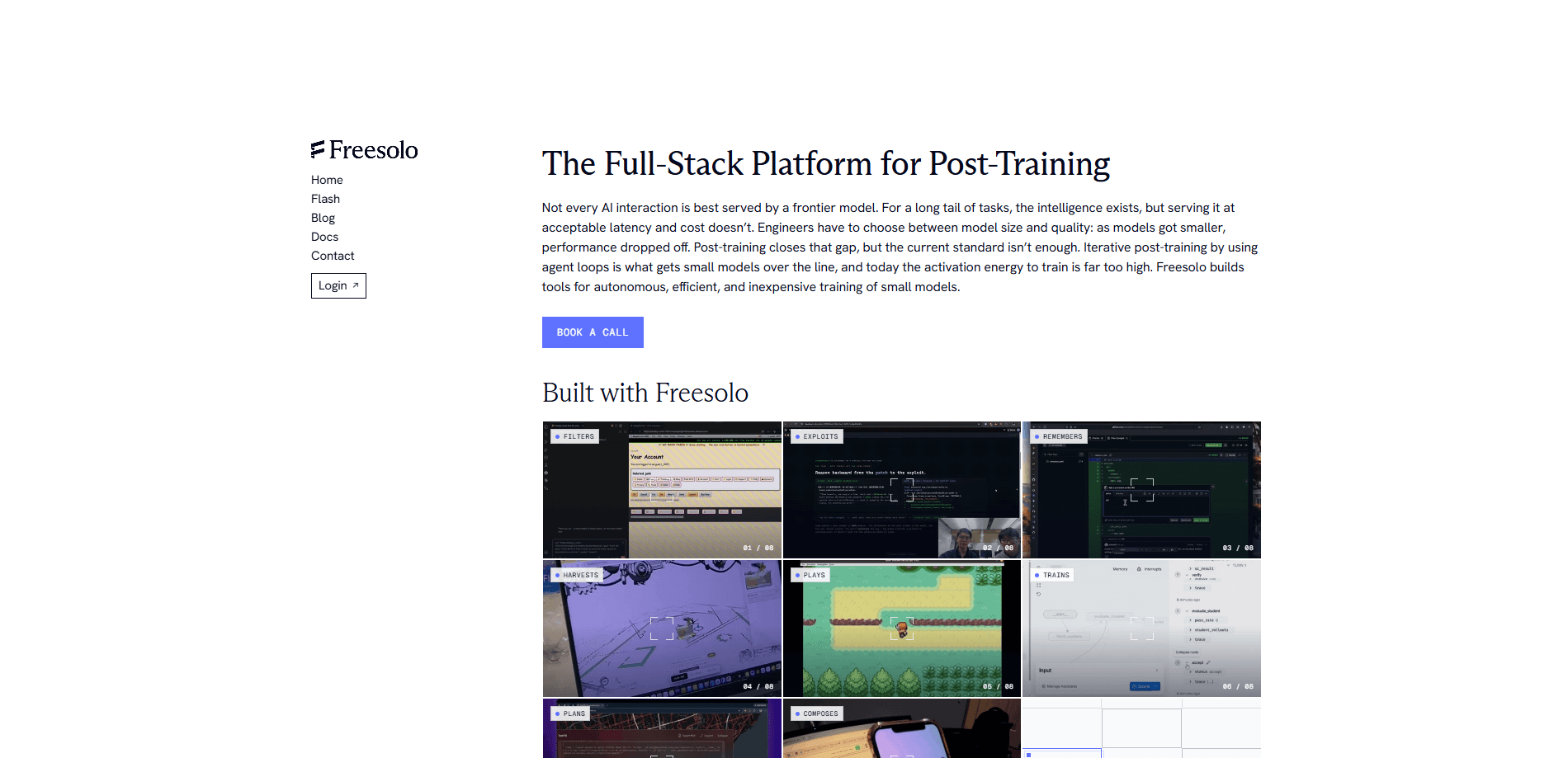
About Freesolo Flash
What Is Freesolo Flash
Freesolo Flash is the managed post-training package from Freesolo, a company that builds tooling for training small models. The pitch is simple: not every AI task needs a frontier model. For a long tail of routine work, the intelligence already exists, but serving it at acceptable latency and cost doesn't. Flash closes that gap by post-training a small model on your own data.
The service is meant to be driven by an AI coding agent such as Claude Code, Cursor, or Codex. You describe the run, the agent points at your data, and Flash handles the training loop, custom kernels, and checkpoints. Freesolo says a tuned sub-10B model can beat a frontier model on your specific task once it has seen enough of your data. That's the whole agent-driven post-training pitch in one line.
The main limitation is scope. Flash is a post-training service, not a general chat product or a no-code app builder. It assumes you already have data, a defined task, and either an engineering team or a coding agent to run the workflow. It's also a fairly young offering, so the library of public examples is thin compared with established fine-tuning platforms. And that's before you get into the harder part: agent-driven post-training still asks you to know what you want.
Getting Started
- Open the Freesolo platform and create a workspace, then connect your data source for the task you want to train on.
- Point your coding agent at Flash and describe the run in natural language: name the model and task, and reference your data.
- Review the single fixed quote and estimated time to completion that Flash returns before anything runs.
- Approve the quote to start the post-training run, which handles training and evaluation on Freesolo's side.
- When the run finishes, export the weights to your repo and deploy them behind an OpenAI-compatible endpoint.
Product Information
A quick look at Freesolo Flash's pricing, supported platforms, and performance.
Best for
The users, tasks, and scenarios where this tool fits best.
Users
- Engineering teams with their own data
- Startups watching inference bills
- ML engineers who want outcomes, not toolchains
Tasks
- Classification and routing
- Domain-specific rewriting
- Cost-sensitive high-volume inference
Scenarios
- You have a task a frontier model handles at 73% and want more
- You need a model you own and can retrain
- You want a fixed budget before committing
Key features
Agent-Driven Workflow
Flash is designed to be operated by a coding agent rather than a browser dashboard. You describe the run to Claude Code, Cursor, or Codex, and the agent assembles the environment and launches training. That keeps the workflow inside the tools engineers already use, and it means the setup steps are conversational rather than a multi-page form.
One Fixed Quote Per Run
Instead of metering by token or GPU hour, Flash returns a single price and an estimated time to completion before anything runs. Freesolo's published example prices a Qwen3-8B SFT plus GRPO run at roughly 30 million tokens for $42, against around $420 to $450 for comparable metered services. You approve the number or you walk away. No surprises later.
Custom Training Kernels
Freesolo treats kernel engineering as a search problem. Each permutation is repeatedly improved through an autoresearch loop to push training throughput, which is what makes the short turnarounds plausible. You don't configure any of this. It's part of what the fixed quote buys.
Weights You Own and Export
Every run returns downloadable weights in standard formats, so you can serve the model anywhere rather than renting it back. Pinned configs and seeds, plus end-to-end checkpointing, mean a run always finishes and can be reproduced later.
Data Isolation
Your training data is encrypted in transit and at rest, and Freesolo states it's never used to train anything but your own model. For teams with sensitive or proprietary data, that's the difference between can't and can. Not a small thing.
Specialization Over Scale
The core bet is that a tuned sub-10B model beats a frontier model on your task. So what does that look like in practice? Freesolo's sample benchmark shows a base model at 56%, SFT at 71%, and GRPO climbing to 89% after 1,000 steps, against a frontier baseline around 73%. Results vary by task, but the direction is the point.
Pros and cons
Pros
- One upfront quote removes the per-token and GPU-hour guesswork from training budgets.
- Agent-native design fits tools like Claude Code, Cursor, and Codex instead of forcing a new UI.
- Exported weights let you serve and retrain the model anywhere you want.
- Data isolation is explicit, which matters for proprietary datasets.
- Freesolo's sample runs show tuned small models beating frontier baselines on narrow tasks.
Cons
- No free plan and a per-run price, so you can't try the service on a toy task for nothing.
- You need existing data and a defined task; Flash won't help you collect or label it.
- It's an early-stage service, so public examples and community write-ups are limited.
- Custom kernels and autoresearch loops are opaque, and there's no way to inspect or reconfigure them.
Frequently asked questions
It runs post-training on a small language model using your data and hands back a deployable model with exported weights. You drive it through a coding agent and approve one fixed quote before training starts.
Related content
Explore related tools, skills, and articles for Freesolo Flash.
Freesolo Flash Alternatives
Forefront
Forefront · CodingForefront is a web platform for building with open-source AI. It lets you fine-tune leading open-source language models on your own data, evaluate how they perform, and run them through an API or export them to host yourself. Developers who want the convenience of a closed-source platform but insist on owning their models and data are the target audience here.

Startkit
StartKit.AI · CodingStartkit is a boilerplate for building AI SaaS and AI wrapper products. Think of it as an AI startup boilerplate with the boring parts already wired up: authentication, Stripe and Lemon Squeezy payments, usage limits, transactional email, and an AI API starter that talks to OpenAI, Anthropic, Groq, or Llama. You clone the repo, set your price, and start on the part of your product that people actually pay for. It's Next.js under React and Tailwind, so most of the boilerplate code already feels familiar.
Testim
Tricentis · CodingTestim is an AI-powered test automation platform for building and running end-to-end tests across web, mobile, and Salesforce applications. It leans on machine learning to keep tests stable when an interface changes, so teams spend less time fixing broken selectors. Not bad for an automated testing tool you can start using today. You create tests by recording actions in a browser, then optionally add JavaScript when you need more control. It's a solid pick for busy QA teams.