

Frontier Model Forum
Frontier Model Forum · Business · Other
The Frontier Model Forum is a nonprofit backed by Amazon, Anthropic, Google, Meta, Microsoft and OpenAI that studies frontier AI safety and funds outside research.
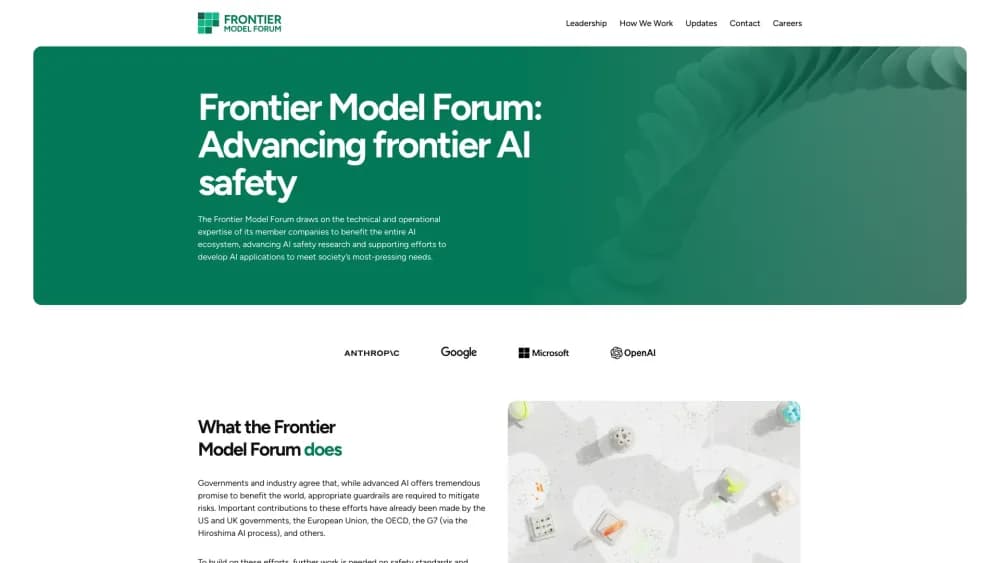
About Frontier Model Forum
What Is Frontier Model Forum
The Frontier Model Forum is an industry-funded nonprofit that works on the risks created by the most capable AI systems. It was set up in July 2023 by Anthropic, Google, Microsoft and OpenAI, and Amazon and Meta joined later. The organization describes itself as a 501(c)(6) body that provides public benefits and does not lobby.
Its work sits in a narrow lane. The forum does not build models, sell software, or certify products. It writes technical guidance, runs workshops, moves threat information between member companies, and pays outside researchers through the AI Safety Fund. If you want to understand how labs talk to each other about catastrophic risk, this is one of the few public windows into that conversation.
The limit is built into the structure. Members fund the organization and sit on its operating board, so the forum can recommend practices but cannot enforce them. Nothing it publishes binds a member company to a specific safety threshold.
Getting Started
- Read the mission and scope pages to see how the forum defines a frontier AI model, which is broader than simply the current best model.
- Browse the technical reports, starting with the Frontier Capability Assessments report if you care about CBRN risks and cyber risk.
- Check the membership criteria if your company wants to join, and note the three-year funding commitment.
- Follow the updates feed for grant announcements and progress reports on the information-sharing agreement.
- Email the membership address for anything the public pages leave unclear.
Product Information
A quick look at Frontier Model Forum's pricing, supported platforms, and performance.
Best for
The users, tasks, and scenarios where this tool fits best.
Users
- Policy analysts and government staff
- AI safety researchers
- Trust and safety teams inside AI companies
Tasks
- Understanding frontier capability assessments
- Finding funded safety research
- Building an internal risk policy
Scenarios
- Preparing a briefing before regulation moves
- Scoping a third-party evaluation
- Tracking how the industry defines dangerous capability
Key features
Frontier Capability Assessments Guidance
The forum publishes a technical report on frontier capability assessments, the tests labs run to find out whether a model could help with chemical, biological, radiological or nuclear weapons, offensive cyber operations, or risky autonomous behavior. The report is a snapshot of current practice rather than a standard. That honesty is useful: you can see where methods converge and where each lab still improvises.
Information-Sharing Agreement
In March 2025 the forum announced a voluntary agreement that lets signatories exchange details about vulnerabilities, threats and capabilities of concern. Members have since shared jailbreak repositories, adversarial input findings and indicators tied to attack attempts. The legal and technical plumbing is designed to protect intellectual property and stay inside antitrust limits, which is the part that makes the arrangement usable at all.
AI Safety Fund Grants
The AI Safety Fund is a pooled commitment of more than $10 million, started in October 2023 with money from the founding labs and philanthropy. It has run two grant rounds, in November 2024 and December 2025, and the forum has managed the fund directly since the Meridian Institute closed in mid 2025. Remaining money now goes to narrow projects that unblock specific research bottlenecks.
Best-Practice and Standards Development
The forum's stated aim is to build shared understanding of threat models, evaluation methods, thresholds and mitigations, and to feed that into AI standards work. Output takes the form of emerging-practice documents rather than formal rules. For a reader, that means you get an early look at what labs consider reasonable, months before any regulator writes it down.
Cross-Sector Convening
Workshops bring together labs, academic groups, civil society and government staff. The forum treats information sharing as its bridge between these groups, and it has said it plans to pilot voluntary sharing with frontier companies outside its membership. Convening is soft power. It matters most when a small lab or a regulator needs a trusted room rather than a press release.
Membership Criteria and Public Accountability
Joining requires evidence of frontier AI capability, a documented safety review process that can delay or suspend deployment, support for outside evaluation, and a three-year funding commitment. Those criteria are published, along with an annual report. The bar is high and the review is peer-based, so the criteria tell you more about who is inside than about how safe any particular model is.
Pros and cons
Pros
- Gives six competing labs a working channel to share threat data, which no single company could set up alone.
- Publishes technical material that would otherwise stay internal, including assessment methods and emerging practice notes.
- Funds independent researchers through the AI Safety Fund, with grantee lists you can check.
- Defines its terms in public, so you can see exactly what counts as a frontier AI model.
- Membership criteria include a safety process that can stop a deployment, not just a statement of intent.
Cons
- Members fund the organization and sit on its board, so recommendations carry no enforcement power.
- Research priorities follow member consensus, which means contested topics such as open-weight release policy get less attention.
- The public output is thin compared with the private work: most shared threat data stays confidential, so outsiders see conclusions without evidence.
- Small labs and independent researchers have no vote, and the three-year funding requirement keeps participation expensive.
Frequently asked questions
It is a nonprofit where the largest AI labs pool research and safety work on frontier models. It publishes guidance, runs workshops and pays outside researchers, but it does not regulate anyone.
Related content
Explore related tools, skills, and articles for Frontier Model Forum.
Frontier Model Forum Alternatives

Knocket
Knocket (Tencent RTC team) · Productivity · Business · ChatbotKnocket is a free live chat and contact page tool that lets visitors message you from your website, app, or a shareable link, with every reply handled from Telegram or one inbox.

shippedit.me
Krawlup · Marketing · Businessshippedit.me now redirects to Krawlup, a web platform that audits SEO, AEO and page speed every week, then hands the fixes to AI coding agents over MCP.

Ayven
Alknoma · Productivity · BusinessAyven is an AI control centre by Alknoma that turns a plain-language goal into a dated plan, hands the work to your people and AI agents, and asks for your approval only when the call is yours.