

Fuse AI
Fuse AI · Coding · Marketing · Business
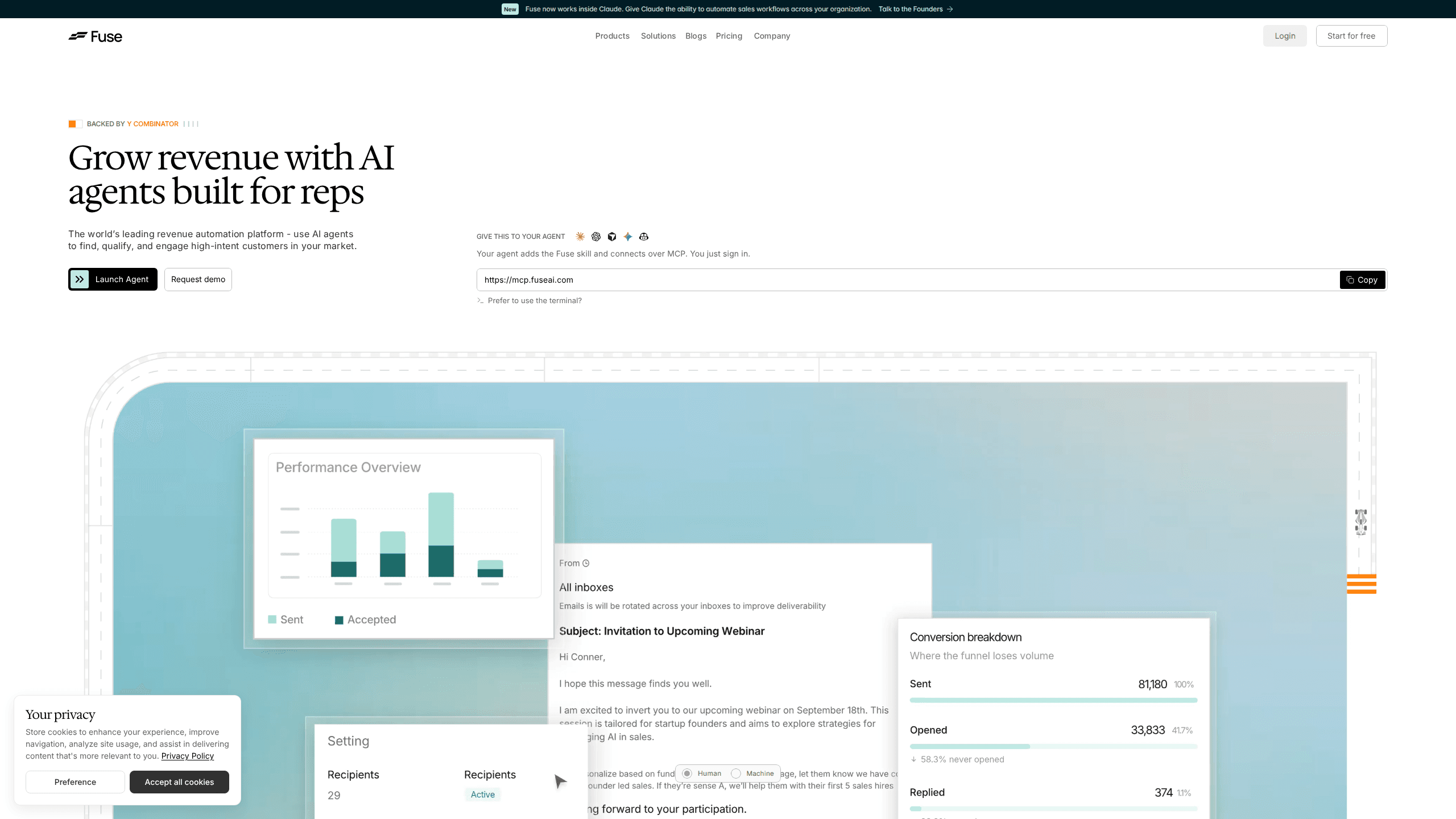
Fuse AI is an agentic sales platform for B2B teams. It combines 850M+ contacts, buying signals, and multi-channel outreach, and connects to AI assistants through an MCP server.
About Fuse AI
What Is Fuse AI
Fuse AI (also written FuseAI) is an AI sales platform built by a Y Combinator W25 company in San Francisco. Instead of stitching together a data provider, an engagement tool, and a CRM connector, teams run prospecting, enrichment, outreach, and signal tracking from one workspace. The pitch is simple: one subscription, one login, fewer tabs.
The product targets outbound teams that spend too much time cleaning lists and too little time talking to buyers. Fuse reports 850M+ contacts and 40M+ companies, with enrichment pulled from more than 40 data providers and accuracy the company puts at 95%. Vendor numbers deserve caution, yet the multi-provider approach is a real difference from single-source databases. For many small teams it takes the place of an AI SDR hire, at least for list building and first-touch emails.
The main limitation is fit. Fuse is built for B2B outbound, so consumer marketing, ecommerce lifecycle work, or inbound-only teams won't get much from it. Pricing also runs on credits, which means heavy users need to watch consumption rather than pay a flat seat fee.
Getting Started
- Create a free workspace at app.fuseai.com and connect your work email.
- Set your ideal customer profile (ICP) so the platform can match accounts and contacts.
- Import a list or let an AI research agent build one from a plain-language prompt.
- Connect a sending inbox, or let Fuse set up and warm one for you.
- Launch a sequence across email, LinkedIn, or the dialer, then review results in the pipeline view.
Product Information
A quick look at Fuse AI's pricing, supported platforms, and performance.
Best for
The users, tasks, and scenarios where this tool fits best.
Users
- Startup founders running their first outbound
- SDR and AE teams
- RevOps and GTM engineers
- Agencies and consultancies
Tasks
- Building an ICP-matched contact list
- Enriching a stale CRM export
- Running multi-channel sequences
- Spotting anonymous website visitors
Scenarios
- A seed-stage company with no SDR hire yet
- A team replacing three point tools
- An enterprise pilot that needs governance
Key features
Live B2B contact database
Fuse exposes 850M+ contacts and 40M+ companies through search and AI prompts. The prospecting module works like standalone sales prospecting software, with filters for role, location, headcount, and industry, and results move straight into a sequence. Coverage is strongest in English-speaking markets, so teams selling into smaller regional markets should test match rates before committing.
Waterfall enrichment across 40+ providers
Instead of trusting one data vendor, Fuse queries multiple providers in order and keeps the first verified result. The company reports 95% data accuracy against 74% for Apollo and 82% for ZoomInfo, and says emails are validated at send time to keep bounce rates near zero. Treat those figures as vendor claims, then run a sample of 100 contacts against your own CRM before you migrate.
Buying signals and visitor identification
The signals layer tracks funding rounds, job changes, hiring activity, competitor engagement, and 20+ other events. These buying intent signals also include website traffic, which Fuse de-anonymizes for about 30% of visitors. Alerts land in Slack or the platform within 24 hours, which is enough for a same-day follow-up but not for real-time chat interception.
Multi-channel engagement
Email, LinkedIn, and a power dialer sit in one sequence builder. Fuse handles inbox setup and warm-up, writes personalized copy in a chosen tone, and stops outreach when someone replies. Parallel dialing lets one rep run several calls at once, a feature that usually costs extra elsewhere.
AI research agents and automations
Agents can research an account, draft an opening message, update the pipeline, or run a multi-step workflow without a human prompt each time. The Team plan removes the cap on research agents and adds a recommendation system that learns from past replies. Custom automation logic is available through the API for teams that outgrow the visual builder.
MCP server and API access
Fuse runs an MCP server for sales teams at mcp.fuseai.com, so assistants such as Claude can search contacts, enrich records, and trigger workflows inside a chat. The REST API covers the same core objects for custom integrations and data sync. This is the feature that separates Fuse from most outbound tools, which still require a browser session for every action.
Enterprise controls
Admins get role-based access, SSO, audit logs, and per-agent cloud isolation. SOC 2 Type I, GDPR, CCPA, and CASA Tier 2 attestations cover the compliance questions security reviews usually raise. Full SOC 2 Type II reporting is not listed on the site, so regulated buyers should ask for the current report.
Pros and cons
Pros
- One workspace for data, signals, outreach, and pipeline updates, which removes duplicate cleanup between tools.
- MCP and API access make it usable from Claude or a custom internal agent, not just the web app.
- Free tier with 24,000 annual credits is enough to test data quality before paying.
- Transparent public pricing, including a $60 Solo plan and a $200 Team plan with five seats.
Cons
- Credit-based billing makes costs hard to predict for high-volume teams.
- Accuracy claims come from the vendor, and independent benchmarks for the 850M contact figure are not public.
- Coverage outside North America and Western Europe is thinner, so regional sellers may see lower match rates.
Frequently asked questions
Fuse AI handles B2B prospecting and outbound in one place. Teams use it to build contact lists, enrich records, track buying signals, and run email, LinkedIn, and phone sequences.
Related content
Explore related tools, skills, and articles for Fuse AI.
Fuse AI Alternatives

Base Code
Base44 (Wix) · Coding · ProductivityBase Code is a shared cloud development environment from Base44. Teammates describe changes to an existing GitHub codebase in chat, preview them live and send them back as pull requests.

Google EmbeddingGemma 2
Google DeepMind · Writing · Image · CodingGoogle EmbeddingGemma 2 is a 740M-parameter open model that turns text, code, images, audio, and video frames into vectors in one 768-dimension space, running on phones and laptops.

GitGlow
GitGlow · Coding · ProductivityGitGlow is a local-first desktop Git client that lets independent developers review their own code and their AI agents' changes in one place before shipping.