

Gamma.AI - DLP solution
Gamma.AI · Other
Gamma.AI is an AI-powered cloud DLP platform that detects and stops sensitive data leaks across SaaS apps like Slack, Gmail, and GitHub, giving security teams one-click protection.
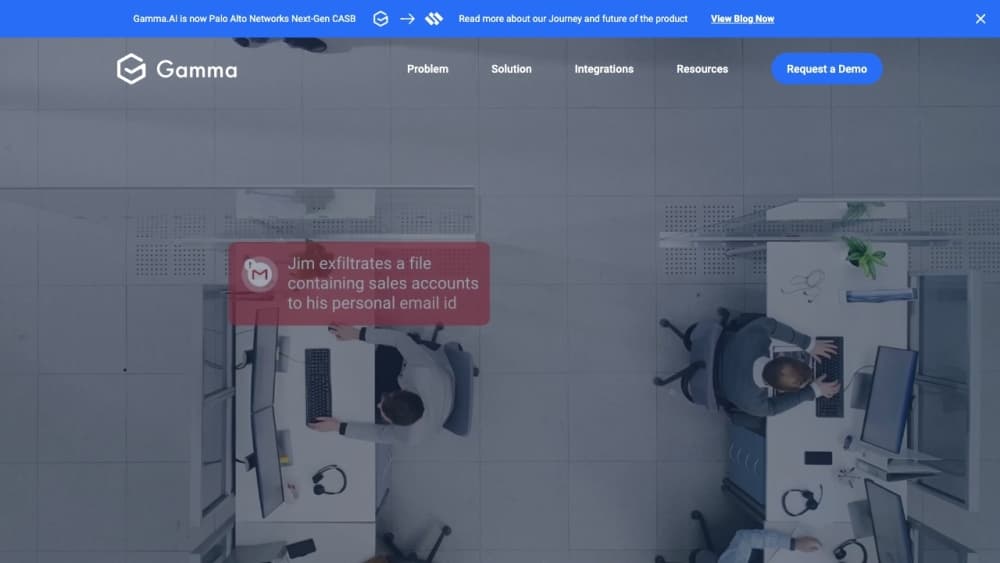
About Gamma.AI - DLP solution
What Is Gamma.AI
Gamma.AI is a cloud data loss prevention (DLP) platform built for the SaaS era. It watches what moves through the apps a team already uses, spots sensitive content as it travels, and steps in before it leaves the company. The pitch is simple: your data perimeter is your people, and the tools they touch need protection.
Traditional DLP was built for networks and endpoints. You installed an agent on a laptop and hoped it caught files on the way out. That model breaks when work moves to Slack, Google Drive, and personal devices, because the data never crosses the firewall you were watching. Gamma.AI targets that gap with a cloud-first approach.
The limit is scope. Gamma.AI protects cloud and communication channels, so it fits companies that run their work in SaaS tools. Teams that need deep endpoint lockdown or full network inspection are not its main audience. It is also an enterprise product sold through a demo, not a self-serve signup.
Getting Started
- Book a demo from the Gamma.AI website. Onboarding is handled by the vendor team rather than a public signup form.
- Connect the SaaS apps you want covered, such as Slack, Gmail, Google Drive, and GitHub, through the platform's integrations.
- Set your data classification and policy rules so the engine knows what counts as sensitive.
- Turn the platform loose to scan cloud data and surface violations, starting in monitor mode before you enforce.
- Review violations in the dashboard and let end users remediate their own alerts, or escalate the serious ones to your security team.
Product Information
A quick look at Gamma.AI - DLP solution's pricing, supported platforms, and performance.
Best for
The users, tasks, and scenarios where this tool fits best.
Users
- Security and IT teams at mid-size companies
- Compliance officers in regulated fields
- Small security teams without deep DLP expertise
Tasks
- Stopping sensitive files leaving over Slack
- Catching accidental Gmail leaks
- Monitoring code leaving over GitHub
Scenarios
- A remote-first team sharing work through personal devices
- A fast rollout under deadline
- A K12 or healthcare organization facing an audit
Key features
Contextual Data Classification
Gamma.AI scans content and decides what is sensitive with deep learning, reporting 99.5% classification accuracy. Context matters here, because a string of numbers means something very different in a medical record than in a shopping list. The engine reads surrounding context to cut down on false alarms that wear out a security team.
One-Click Cloud Deployment
Rolling out DLP used to be a months-long project. Gamma.AI positions the install as one click across applications, devices, and users, which lets a small team protect a large workforce without a device-by-device job. For companies that cannot spare IT cycles, that speed is the deciding factor.
Broad SaaS Integrations
The platform connects to the apps where leaks actually happen, including Slack, Gmail, Google Drive, and GitHub. Coverage is horizontal rather than tied to one vendor, so a company running a mixed stack can watch the whole surface through a single pane. You are not stitching together separate DLP tools per app.
End-User Remediation
When the engine catches a violation, it notifies the employee and lets them fix it, rather than routing every alert to the security desk. That turns each incident into a small training moment and keeps staff in the loop about what counts as sensitive. It also cuts the alert fatigue that makes real threats easy to miss.
Insider Threat Detection
Cloud DLP focuses on the risk that comes from inside, whether that is carelessness or a departing employee moving files. Gamma.AI frames its coverage around the people and communication channels that carry data, so activity that looks normal on a network monitor still gets read in context.
Cloud Data Discovery
Before you can protect data, you have to find it. The platform scans cloud repositories to map where sensitive content lives, then applies policy from there. That discovery step is what lets a team move from a rough guess about exposure to a concrete list of what needs guarding.
Pros and cons
Pros
- Covers the apps where SaaS data actually leaks, including Slack, Gmail, Google Drive, and GitHub, so protection follows the workflow instead of sitting at the network edge.
- Deep-learning classification with a stated 99.5% accuracy target reduces the false positives that make DLP tools noisy.
- One-click deployment keeps rollout fast, which matters for small teams that cannot dedicate months to a security project.
- End-user remediation spreads the workload and turns daily alerts into ongoing awareness training.
- A complimentary risk assessment gives a new buyer a concrete starting point instead of a blank dashboard.
Cons
- Pricing is not published. You have to request a demo and go through sales, which slows any comparison shopping.
- The focus is cloud and communication channels, so endpoint lockdown and full network inspection are not what it is built for.
- A public API is not documented, which limits teams that want to wire DLP signals into their own tooling.
- Independent benchmarks of the accuracy claim are hard to find, so buyers lean on the vendor's own numbers.
Frequently asked questions
Gamma.AI is used to stop sensitive data from leaving a company through the SaaS apps employees use every day. It scans cloud content, classifies what is sensitive, and flags or blocks leaks across tools like Slack, Gmail, Google Drive, and GitHub.
Related content
Explore related tools, skills, and articles for Gamma.AI - DLP solution.
Gamma.AI - DLP solution Alternatives

Odyssey 3
Odyssey · OtherOdyssey-3 is Odyssey's foundation world model. It simulates physics in real time, turns a prompt into an interactive environment, and adapts to robots, cars and games.

JarvisCore
Prescott Data · Coding · Productivity · OtherJarvisCore is an open source Python runtime where AI agents work as equal peers on an agent mesh, claim tasks from a shared ledger, and reach external services through a zero-trust broker.
Clef
Cloudflare · Business · OtherClef is Cloudflare's open-source decision model for Workers AI. It returns calibrated probabilities for typed questions, not generated text, so agents can classify, route, and act fast.