

General Compute
General Compute · Coding
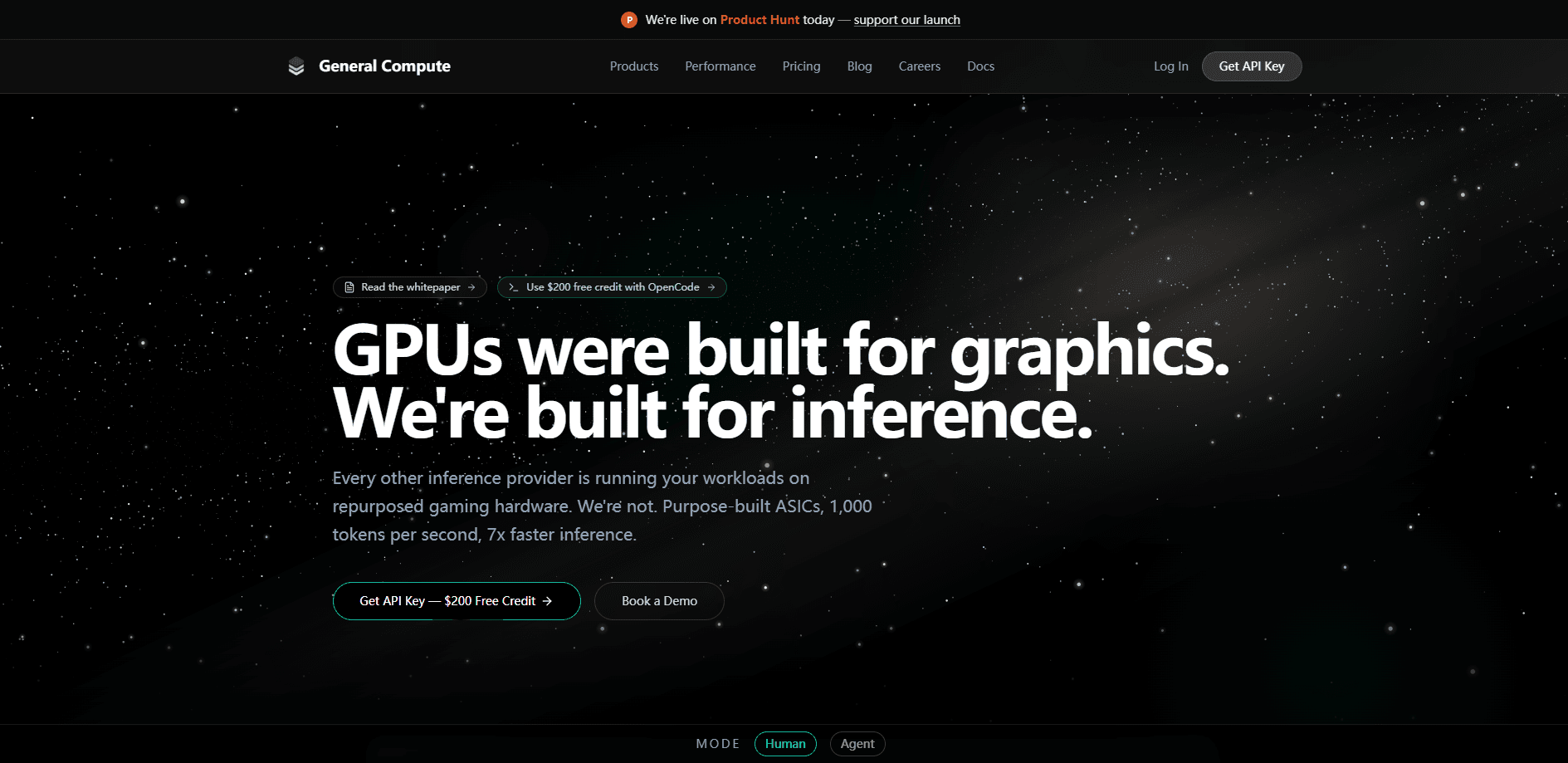
General Compute is an AI inference cloud built for one job: serving large language models faster than GPU-only providers can. It runs OpenAI-compatible endpoints on purpose-built decode silicon from SambaNova, Cerebras, Positron, and d-Matrix, while prefill stays on NVIDIA B300 racks. New accounts get $100 in free credit, and teams that need reserved capacity or private weights can sign a dedicated contract instead. Pricing is transparent too. Inference API pricing runs per million tokens, with no monthly seat fee on the self-serve tier. No hidden platform charge.
About General Compute
What Is General Compute
General Compute is an inference provider that splits LLM workloads across two kinds of hardware. Prefill, the compute-heavy opening pass, runs on GPUs. Decode, the memory-bound part that generates tokens one at a time, runs on ASIC accelerators built specifically for it. The pitch is straightforward: decode speed is what makes agent runs feel slow, and adding more GPU compute doesn't fix it.
The product surfaces as a REST API you can point your existing OpenAI SDK at. Swap the base URL and API key, and your tool calling, JSON mode, and streaming keep working. Available models include MiniMax M2.7, DeepSeek V3.2, DeepSeek V3.1, and GPT-OSS 120B.
The main limit is maturity. General Compute is a young provider, and its own benchmarks are the source for its headline speed claims. If you need a decade-old cloud with every region and compliance cert, this isn't it. If you want fast token generation and a simple migration path, it's worth a look.
Getting Started
- Create an account at app.generalcompute.com and claim the $100 free credit.
- Generate an API key from the dashboard and copy your base URL.
- Point your OpenAI SDK at the General Compute endpoint by swapping the import and key.
- Pick a model ID such as
minimax-m2.7ordeepseek-v3.2in your request. - Run your first call, then scale usage from the pay-as-you-go plan.
Product Information
A quick look at General Compute's pricing, supported platforms, and performance.
Best for
The users, tasks, and scenarios where this tool fits best.
Users
- AI developers
- Agent builders
Tasks
- Latency-sensitive chat
- Structured agent workflows
- Private model hosting
Scenarios
- Prototyping a new AI feature
- Production inference at scale
Key features
Purpose-Built Decode Silicon
Most inference clouds run everything on GPUs. General Compute sends the decode step to chips designed for it, including SambaNova SN50 in production and Cerebras wafer-scale hardware for the fastest tier. The company says this serves 1,000 to 2,000 tokens per second per user on multi-trillion-parameter models, against under 320 tokens per second on a B300 rack running a 230B MoE. That gap is the whole reason the product exists. Big difference. Decode is memory-bound, so stacking GPUs barely moves it.
OpenAI-Compatible API
The API speaks the same endpoints, parameters, and streaming semantics as OpenAI. You keep your orchestrators, your tool definitions, and your retry logic. Migration is a one-line change in most codebases. It's that simple. For teams already deep into the OpenAI SDK, that's the difference between a weekend project and a quarter of rework.
Model Variety Including Reasoning Models
The catalog covers general-purpose and reasoning models. MiniMax M2.7 handles chat and generation with a 192k context window. DeepSeek V3.2 and V3.1 add built-in chain-of-thought reasoning for math, code, and analysis. GPT-OSS 120B rounds out the list for open-weight fans.
Bring Your Own Model
You can deploy private weights, whether that's a LoRA, a GGUF file, or a full finetune. General Compute containers the checkpoint, attaches accelerators in us-west-2, and exposes it behind a private model ID. Your custom models then behave like any other model parameter, streaming and tool calling included. For teams with proprietary weights, this model hosting option is the reason to look past the consumer API.
Dedicated Racks With Root Access
Beyond the self-serve API, you can contract dedicated prefill and decode capacity under one agreement with SLAs. You get bare metal with root access, price-protected quota across three vendors, and orchestration of prefill and decode as a single service for the life of the contract.
Multi-Vendor Capacity
Quota spreads across SambaNova, Cerebras, Positron, and d-Matrix, so you aren't locked to one chip supplier. Reserved decode capacity can burst onto the paired B300 fleet when traffic spikes, which keeps a lumpy workload from stranding an idle rack. For teams whose demand swings between quiet weeks and sudden launch-day surges, that flexibility is the difference between paying for headroom you never use and scrambling for capacity you can't get.
Pros and cons
Pros
- Decode speeds that GPU-only clouds can't match on large models, per the company's own benchmarks.
- OpenAI-compatible API means most teams migrate without rewriting code.
- Tool calling, JSON mode, and reasoning support are available across the catalog.
- Multi-vendor hardware plus $100 free credit lowers the cost of trying it.
- Bring-your-own-model support covers LoRA, GGUF, and full finetunes.
Cons
- Headline speed figures come from General Compute's own benchmarks, not independent testing, so treat them as vendor claims until you test your own workload.
- All production traffic currently runs in a single US region, which matters if you need data residency elsewhere or low latency outside the US.
- Reserved and enterprise tiers use custom pricing, so you can't estimate dedicated capacity costs without talking to sales.
- Pay-as-you-go plans get best-effort reliability, with contractual SLAs reserved for enterprise.
Frequently asked questions
It's an AI inference cloud for running large language models, especially decode-heavy workloads like multi-step agent runs where latency compounds. You call it through an OpenAI-compatible API rather than managing your own GPUs, which means you avoid the hardware procurement, model bring-up, and capacity planning that come with self-hosting inference.
Related content
Explore related tools, skills, and articles for General Compute.
General Compute Alternatives
Forefront
Forefront · CodingForefront is a web platform for building with open-source AI. It lets you fine-tune leading open-source language models on your own data, evaluate how they perform, and run them through an API or export them to host yourself. Developers who want the convenience of a closed-source platform but insist on owning their models and data are the target audience here.

Startkit
StartKit.AI · CodingStartkit is a boilerplate for building AI SaaS and AI wrapper products. Think of it as an AI startup boilerplate with the boring parts already wired up: authentication, Stripe and Lemon Squeezy payments, usage limits, transactional email, and an AI API starter that talks to OpenAI, Anthropic, Groq, or Llama. You clone the repo, set your price, and start on the part of your product that people actually pay for. It's Next.js under React and Tailwind, so most of the boilerplate code already feels familiar.
Testim
Tricentis · CodingTestim is an AI-powered test automation platform for building and running end-to-end tests across web, mobile, and Salesforce applications. It leans on machine learning to keep tests stable when an interface changes, so teams spend less time fixing broken selectors. Not bad for an automated testing tool you can start using today. You create tests by recording actions in a browser, then optionally add JavaScript when you need more control. It's a solid pick for busy QA teams.