

GenPage 3.0
GenPage · Marketing · Business
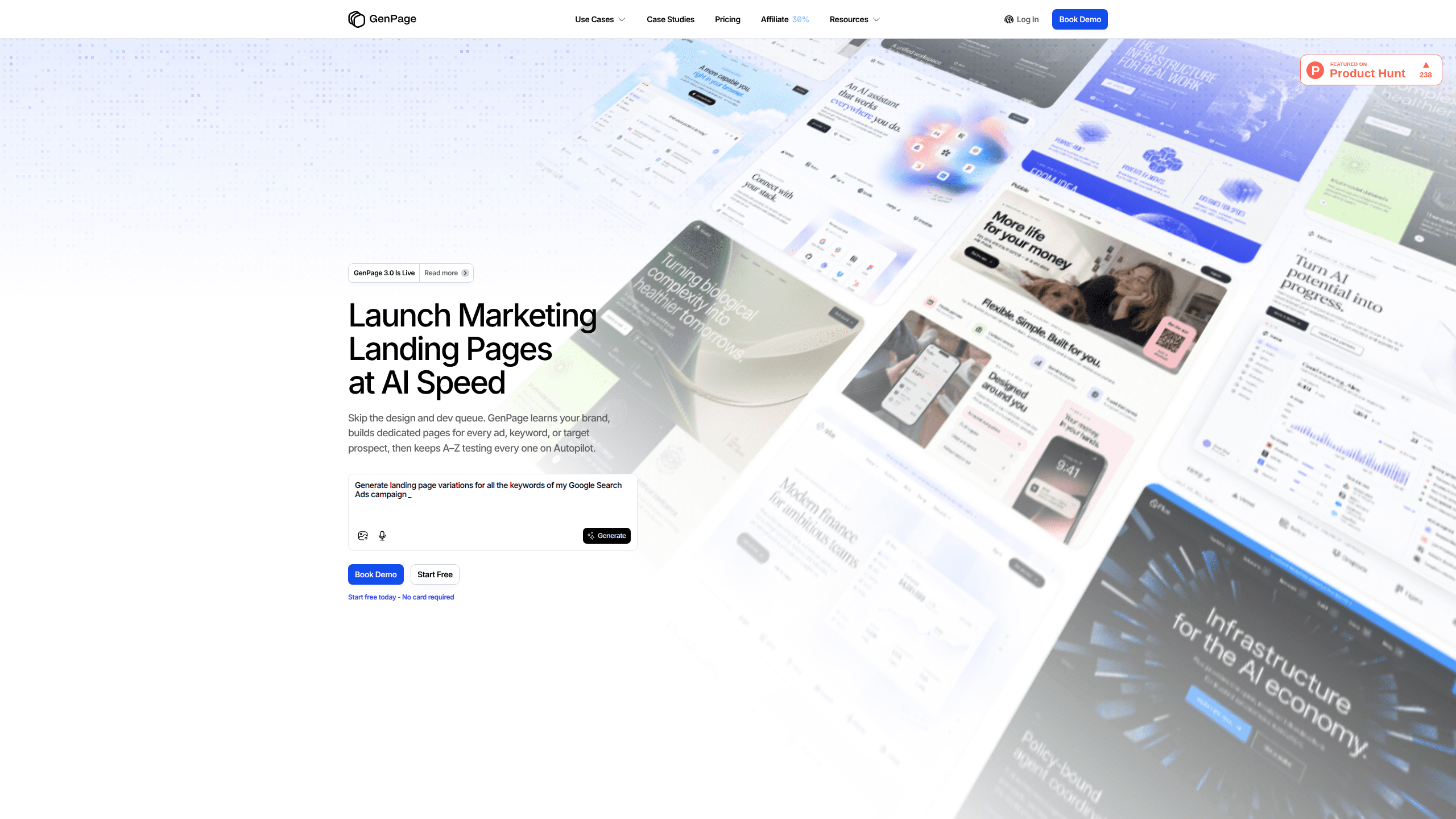
GenPage 3.0 is an AI landing page platform for GTM teams. It builds personalized landing pages for every ad, keyword, or prospect, then tracks and tests each one on Autopilot.
About GenPage 3.0
What Is GenPage 3.0
GenPage 3.0 is an AI landing page builder that writes, publishes, and measures GTM landing pages for marketing, growth, and sales teams. You connect a domain, an ad account, or a lead list, and the tool builds pages matched to that specific campaign, keyword, or person instead of routing every click to the homepage.
The 3.0 release reshaped landing page personalization, moving the product from a template-driven builder to a conversational one. You describe the page you want, and an agent plans the layout, pulls context from a brand knowledge base, and generates copy and design. The same release added GenPage Concierge, an AI agent that sits on the published page and answers visitor questions, plus an MCP connection that works in both directions.
The main constraint is the credit system. Generation, enrichment, and Concierge conversations all draw on a monthly credit pool, and several items sit behind higher plans: custom domains, MCP and API access, and session replays start at Scale. Teams that publish a handful of pages a month rarely notice. Teams running hundreds of ad variants will.
Getting Started
- Create an account at app.genpage.ai and start on the free plan, which includes 100 credits.
- Add your brand by entering a domain. GenPage crawls your site, then you upload sales decks, product docs, or battlecards to sharpen what the AI knows.
- Connect a source: import Google Ads or LinkedIn Ads campaigns, upload a lead list, or paste a campaign brief.
- Describe the page in plain language and let the agent draft it, then adjust sections in the editor and set your personalization variables.
- Publish to a GenPage subdomain, or connect a custom domain on the Scale plan and up, then watch visits and conversions in the overview.
Product Information
A quick look at GenPage 3.0's pricing, supported platforms, and performance.
Best for
The users, tasks, and scenarios where this tool fits best.
Users
- Growth marketers at B2B software companies who run many campaigns and need a page per keyword or ad group rather than one catch-all page.
- Small marketing teams without a designer or front-end developer, since the AI page generator handles layout and copy from a written brief.
- Sales and SDR teams running account-based outbound, because prospect-level enrichment lets one page speak to one company or one person.
Tasks
- Turning ad groups and keywords into matching Google Ads landing pages, with conversion tracking down to each variant.
- Building one-to-one pages for a named account list before a cold email sequence goes out.
- Testing headline, offer, and proof variants across campaigns without rebuilding pages by hand.
- Adding a Q&A layer to existing pages through GenPage Concierge, so visitors get answers without filling a form first.
Scenarios
- A paid search account with hundreds of keywords where message match decides cost per lead.
- A product launch that needs campaign, pricing, and feature pages live within a day.
- A webinar or event push aimed at a fixed list of target accounts, where each invitee should land on a page that names their company.
Key features
Conversational page agent
The builder starts with a prompt, not a settings panel. You describe the campaign, audience, and offer in ordinary language, and the agent decides page structure, section order, and how personalization should work. GenPage also rewrites your instruction before it reaches the generation model, so a rough brief still produces a usable first draft. That matters for teams who never learned to write prompts and don't want to.
Brand knowledge base and brand memories
Most AI page tools read your website and stop there. GenPage crawls your domain for design system, positioning, and product pages, then lets you add internal material: sales decks, battlecards, case studies, positioning docs. The agent retrieves the most relevant source for each page instead of treating everything as equally useful. Brand memories carry your phrasing preferences and structural rules from one project to the next, so you stop repeating the same instructions.
GenPage Concierge
Concierge puts an AI agent on the published page. It knows the brand and the page a visitor is reading, so it can answer a pricing question or explain a feature in the context of that specific offer. Conversations happen before the form, which means a visitor with an objection gets a reply at the moment they have it. It also qualifies inbound prospects, so your team sees the questions people actually ask.
Google Ads and LinkedIn Ads module
The ads module imports campaigns, ad groups, and keywords, generates a page for each one, and publishes them in bulk. Final URL updates and variant edits can run with one click instead of a manual pass through the account. Tracking goes down to the individual variant, so you can see which keyword-to-page pairing converts. The module is sold separately and priced against the ad spend it supports, starting at $399 per month.
MCP and two-way integrations
GenPage now works as an MCP server and as an MCP client. Connect it to Claude or another AI tool and generate pages from wherever you already work, such as turning a sales call transcript into a follow-up page or a HubSpot record into a proposal page. In the other direction, you can attach external MCPs so the agent can read Figma designs or Notion docs while it builds.
Autopilot testing and conversion analytics
The overview shows visitors, conversions, and page performance as soon as you log in. Analytics include heatmaps, session replays, and alerts in Slack, email, or Microsoft Teams when a target account visits or a form gets submitted. Autopilot, available on the Ultimate plan, keeps testing and adjusting pages after launch, which is the difference between a one-time build and a page that keeps improving.
Pros and cons
Pros
- Page creation starts from a written brief, so a marketer can ship a campaign page without waiting on design or dev.
- The knowledge base accepts internal sales material, which produces copy closer to how your team actually sells.
- Concierge answers visitor questions on the page and captures what those questions are.
- The Google Ads module covers campaign import, bulk publishing, and variant-level conversion tracking in one flow.
- A real free tier with 100 credits and unlimited pages makes testing the product possible before spending.
Cons
- Credits meter generation, enrichment, and Concierge use, so heavy accounts need to watch consumption or buy top-ups.
- Custom domains, MCP and API access, and session replays only unlock at Scale, which costs $249 per month.
- The ads module is billed on top of the plan and scales with ad spend, so the total cost is hard to predict from the pricing page alone.
- Output quality tracks the context you provide. A domain crawl with no internal docs tends to produce pages that read like your homepage.
Frequently asked questions
It builds and publishes landing pages for campaigns, then tracks how each one converts. Marketing teams use it to replace one generic page with pages written for a specific ad, keyword, or target account.
Related content
Explore related tools, skills, and articles for GenPage 3.0.
GenPage 3.0 Alternatives

ngram 2.0
ngram · Video · Marketingngram 2.0 is an AI video generator for teams. It turns a prompt, a screen recording, or a product URL into a narrated explainer, product demo, or AI avatar video, and every scene stays editable.

shippedit.me
Krawlup · Marketing · Businessshippedit.me now redirects to Krawlup, a web platform that audits SEO, AEO and page speed every week, then hands the fixes to AI coding agents over MCP.

MePersona
MePersona, Inc. · Writing · Productivity · MarketingMePersona is an AI unified inbox for creators. It learns your voice, drafts replies to fan messages from 12 platforms, and sends only what you approve.