

Gigacatalyst
Gigacatalyst · Coding
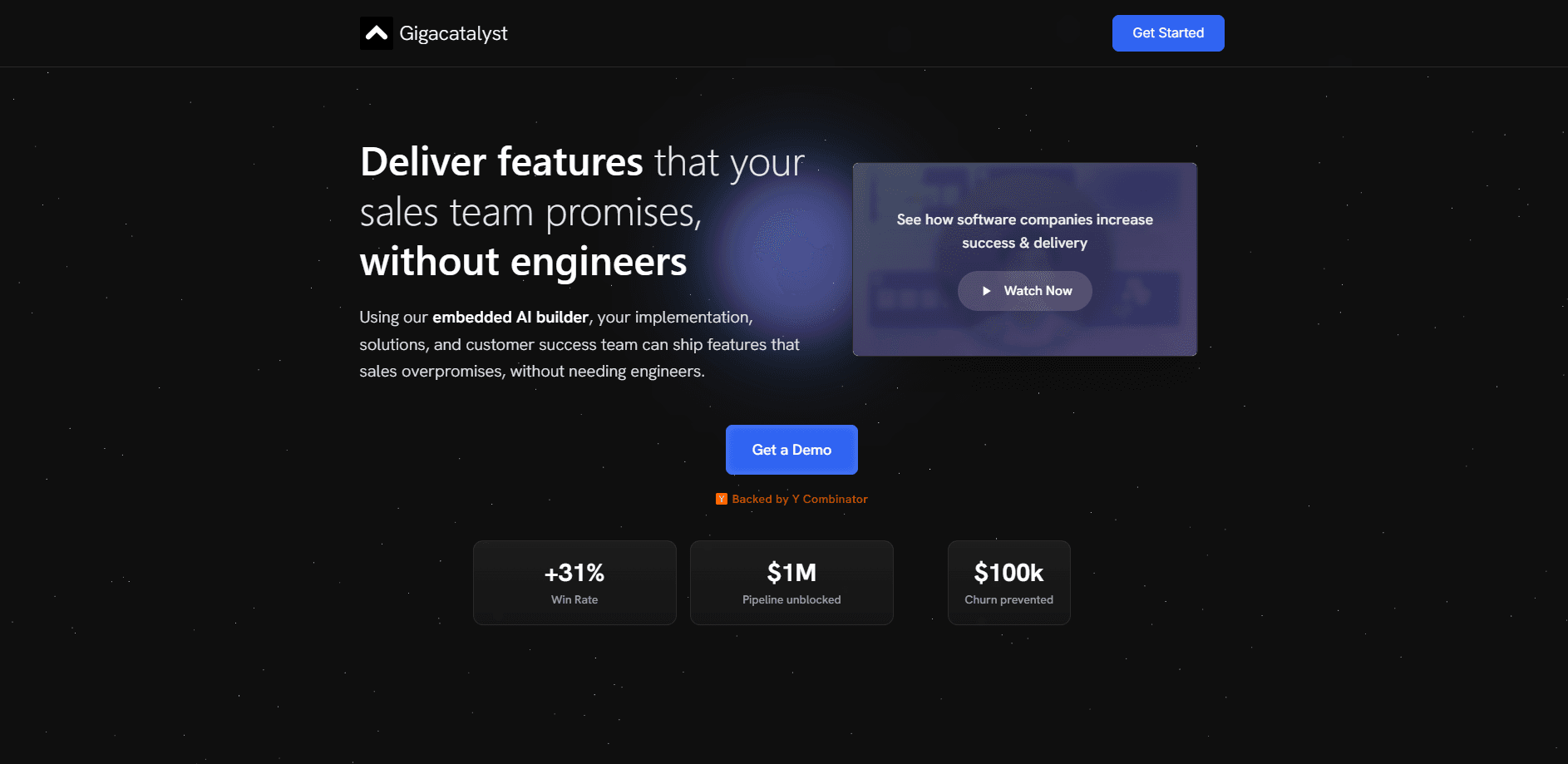
Gigacatalyst is an embedded, white-label AI app builder for B2B SaaS products. It lets your customers describe a dashboard, report, or workflow in plain English, then generates a working app inside your product using your approved APIs and permissions. Teams use it as a B2B SaaS dashboard builder to ship customer-facing analytics and missing features in minutes instead of waiting weeks for a custom build.
About Gigacatalyst
What Is Gigacatalyst
Gigacatalyst is an embedded AI app builder that sits inside a B2B SaaS product and turns customer requests into dashboards, reports, and workflows. It generates AI microapps: small, focused apps that solve one job inside your product. A user types what they want, like "show renewal risk by region and let each CSM assign a follow-up," and the tool builds it against your data.
The point is customization without the backlog. Every SaaS company hears the same request: "can this dashboard be different for us?" Building each one by hand eats engineering time. Those tickets pile up fast. Gigacatalyst hands the build to the customer, under your brand, inside their own account.
It isn't a generic chart tool. Every app it generates has to inherit your access rules, call only approved API operations, and pass a check against the records your product actually returns. That constraint is the whole design. The output stays tied to your source of truth instead of drifting into a spreadsheet someone made up. Scope is the tradeoff. Gigacatalyst is built for embedded, white-label use, so it isn't meant to be a standalone analytics suite your team runs on its own.
Getting Started
- Contact the Gigacatalyst team with your website and the request you want to ship, since deployments are scoped per customer.
- Run a pilot on your APIs so the builder learns your data model, approved operations, and permission structure.
- Connect your design system so generated apps match your existing product look and feel.
- Turn it on for a customer or a CSM team and let them describe the dashboard or workflow they need.
- Review the generated app, confirm it respects your access rules, and ship it inside your product.
Product Information
A quick look at Gigacatalyst's pricing, supported platforms, and performance.
Best for
The users, tasks, and scenarios where this tool fits best.
Users
- B2B SaaS product teams
- Customer success managers
- SaaS founders and presales teams
Tasks
- Customer-facing dashboard generation
- Report building
- Internal workflow creation
- Presales demos
Scenarios
- A customer asks for a dashboard view that only their team needs, and the request keeps getting deprioritized.
- A CSM wants to see renewal risk by region and act on it without waiting on engineering.
- A sales team needs a live proof of concept that runs on the buyer's actual data.
- A spreadsheet-based process, like inventory transfer analysis, needs to move into the product as a real workflow.
Key features
Plain-English App Building
Customers describe what they want in their own words, and Gigacatalyst builds the dashboard, report, or workflow from that request. No query language. No configuration wizard to fight through. The builder figures out the shape of the app from the description and the data it's allowed to touch.
Runs on Your Own APIs
Every generated app calls your approved API operations, not a shadow copy of your data. That's the difference between a tool customers trust and one that slowly produces wrong numbers. The operations are the same ones your product already uses. So the results match what your team would build by hand.
Inherits Your Permissions
Apps follow the access rules of the signed-in customer. If someone can only see their own territory, the dashboard shows their territory. Metrics are checked against API results, so a number that doesn't reconcile gets caught rather than shipped straight into a customer's view.
White-Label Inside Your Product
The finished app appears inside your product under your brand. Customers never leave your interface. They never see Gigacatalyst's name on the page. For SaaS companies that want a white-label app builder rather than a tool that wears its own logo, that matters more than any feature list.
Governed App Contracts
Each app version keeps an auditable contract: account scope, the metric definition, and the permissions it follows. When a customer asks why a number changed, you have a record to point to instead of a guess. Quiet feature. Until an audit or a support escalation makes it the most useful one.
Presales Demos and POCs
Product-connected demos and proofs of concept can run on a prospect's real data during the sales process. A VP of sales reported that more than 1,000 UpKeep customers use it daily, which is the kind of adoption number that only shows up when the tool survives contact with real users.
Pros and cons
Pros
- Generates customer-facing dashboards and workflows from plain-English requests, which cuts the wait on customization tickets.
- Apps run on approved APIs and inherit access rules, so output stays tied to your source of truth.
- White-label delivery keeps customers inside your product under your brand.
- Auditable contracts for each app version help with support, audits, and metric disputes.
- No charge for end customers logging in, which removes the cost trap that hits internal tool builders.
Cons
- Pricing is quoted per deployment rather than published, so you can't estimate cost from a page. You have to scope a pilot and talk to the team first.
- It's built for embedded, white-label use, so it won't work as a standalone analytics suite your own team runs separately.
- The platform depends on having clean, well-documented APIs. If your product's data access is messy, setup takes longer.
Frequently asked questions
It builds dashboards, reports, and workflows inside your SaaS product from plain-English customer requests. Think of the generated apps as AI microapps that run on your APIs and permissions, not on a separate copy of your data.
Related content
Explore related tools, skills, and articles for Gigacatalyst.
Gigacatalyst Alternatives
Forefront
Forefront · CodingForefront is a web platform for building with open-source AI. It lets you fine-tune leading open-source language models on your own data, evaluate how they perform, and run them through an API or export them to host yourself. Developers who want the convenience of a closed-source platform but insist on owning their models and data are the target audience here.

Startkit
StartKit.AI · CodingStartkit is a boilerplate for building AI SaaS and AI wrapper products. Think of it as an AI startup boilerplate with the boring parts already wired up: authentication, Stripe and Lemon Squeezy payments, usage limits, transactional email, and an AI API starter that talks to OpenAI, Anthropic, Groq, or Llama. You clone the repo, set your price, and start on the part of your product that people actually pay for. It's Next.js under React and Tailwind, so most of the boilerplate code already feels familiar.
Testim
Tricentis · CodingTestim is an AI-powered test automation platform for building and running end-to-end tests across web, mobile, and Salesforce applications. It leans on machine learning to keep tests stable when an interface changes, so teams spend less time fixing broken selectors. Not bad for an automated testing tool you can start using today. You create tests by recording actions in a browser, then optionally add JavaScript when you need more control. It's a solid pick for busy QA teams.