

Glassix
Glassix · Marketing
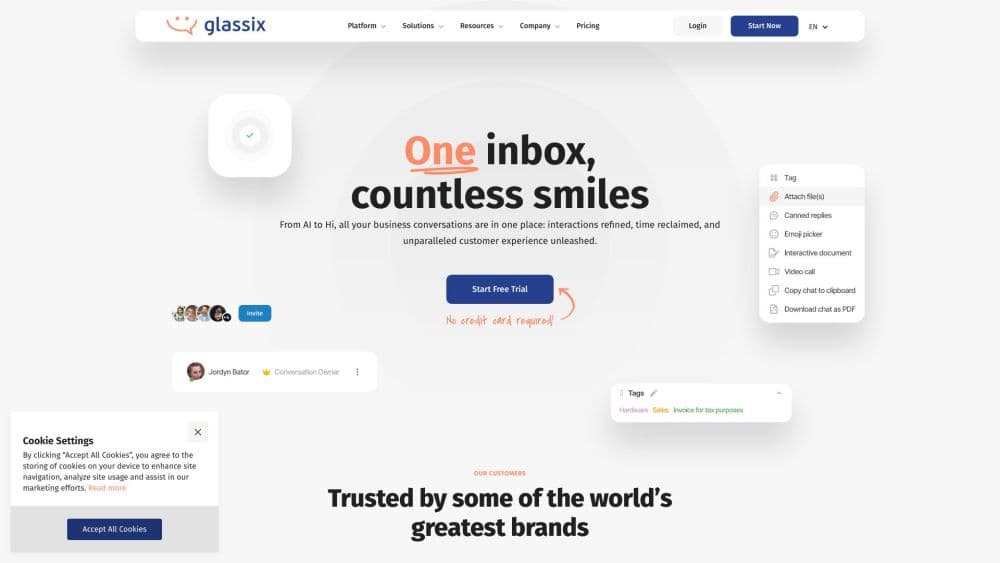
Glassix is an AI-native contact center platform where agents and AI chatbots handle customer conversations across chat, voice, and social channels from one unified inbox.
About Glassix
What Is Glassix
Glassix is an omnichannel customer support software platform that puts AI chatbots and human agents in the same workspace. Messages from WhatsApp, SMS, Apple Messages, Instagram, Facebook, email, web chat, and voice land in one unified inbox, and the platform routes each one to a chatbot or a person based on rules you set.
The product targets the problem that most support teams share: customers reach out on whichever channel they prefer, and someone has to answer fast without losing the thread. Glassix keeps every conversation in a single history, so AI chatbots can resolve routine questions and pass the rest to an agent with full context. According to the company, routing chats to chatbots by default pushes first contact resolution past 35 percent without a human touching the ticket.
The main limit is scope. Glassix is built for organizations that run real support and sales volume, not for a solo seller who just wants a chat widget. The smaller plans cap how many agents you can add, and the full AI suite and unlimited API calls sit behind the Enterprise tier.
Getting Started
- Start a 30-day free trial from the Glassix site and create your account.
- Connect your channels, such as WhatsApp, SMS, email, live chat, or social messaging, from the settings area.
- Build a chatbot flow with the visual builder, or import a template and adjust it to your business.
- Set routing rules so the platform sends each conversation to a chatbot, a department, or a specific agent.
- Invite your team, then watch conversations, reports, and CSAT scores from the dashboard.
Product Information
A quick look at Glassix's pricing, supported platforms, and performance.
Best for
The users, tasks, and scenarios where this tool fits best.
Users
- E-commerce and retail support teams
- Hospitality and hotel groups
- Automotive and dealership service desks
- Enterprise contact centers
Tasks
- Answering routine questions around the clock
- Routing tickets to the right department
- Following a conversation across channels
- Running sales conversations alongside support
Scenarios
- A seasonal spike in messages
- A multilingual customer base
- A support team split between chat and phone
Key features
Unified Omnichannel Inbox
Every channel feeds into one inbox, from WhatsApp and SMS to Instagram, Facebook Messenger, email, web chat, and voice. Agents work from a single queue instead of juggling tabs, and each conversation keeps its full history. That matters when a customer starts on chat and finishes by email.
No-Code Chatbot Builder
Glassix ships a visual builder for automated flows, and the company says it runs on GPT-4 for conversational replies. You drag blocks, pick a template, and deploy the bot across every connected channel with one click. It means a support lead can launch a chatbot without waiting on developers.
AI Agents That Resolve End to End
Beyond scripted bots, the platform positions AI agents as autonomous resolvers that handle inquiries from the first message to the final answer. The pitch is consistency: the same policy holds no matter how many conversations run at once. You still set the guardrails and the knowledge the agents draw on.
Conversation Routing Engine
The routing engine assigns each message by expertise, availability, workload, and SLA rather than a simple round robin. It can shift a conversation between channels and keep it within a customer's account rules. For a busy desk, that spreads work evenly and stops one agent from drowning.
Digital Plus Voice in One Place
Glassix handles voice alongside digital channels, so agents manage calls, chat, WhatsApp, and messaging from the same screen. AI runs suggestions and routing in the background. Combining the two avoids a separate phone system bolted onto a chat tool.
Integrations and Open API
The platform connects to tools teams already use, including Salesforce, Slack, and Jira, and offers an open API for custom work. Enterprise plans include unlimited API calls. That lets a business wire Glassix into its own stack instead of copying data between systems.
Analytics and Quality Tools
Reporting covers conversation volume, resolution times, and customer satisfaction, and the Enterprise tier adds business intelligence and quality assurance tools. Managers can spot recurring issues and check how AI and agents perform. The data is what turns a pile of chats into a service you can improve.
Pros and cons
Pros
- Runs AI chatbots and human agents in one unified inbox, so routine questions get answered without pulling a person in.
- Supports a wide channel set, including WhatsApp, SMS, Apple Messages, Instagram, and voice, which covers most customer habits.
- The no-code chatbot builder lets a support team launch flows without engineering help.
- An open API and ready integrations with Salesforce, Slack, and Jira fit it into an existing tech stack.
- A 30-day free trial lets you test the platform before paying, and the Starter plan starts at $49 per agent per month.
Cons
- There is no permanent free plan, so small teams or solo users pay from the first agent onward.
- The full AI suite, unlimited API calls, and advanced reporting sit behind the Enterprise tier, which needs a custom quote.
- The Starter and Growth plans cap agent counts at 5 and 9, so a fast-growing team hits a ceiling and must move up.
- Setup takes real work, since routing rules, chatbot flows, and channel connections all need configuring before the platform pays off.
Frequently asked questions
Glassix is an AI contact center platform for customer support and sales. It gathers conversations from chat, voice, WhatsApp, SMS, email, and social channels into one inbox, then uses AI chatbots and routing to resolve and assign them.
Related content
Explore related tools, skills, and articles for Glassix.
Glassix Alternatives

ngram 2.0
ngram · Video · Marketingngram 2.0 is an AI video generator for teams. It turns a prompt, a screen recording, or a product URL into a narrated explainer, product demo, or AI avatar video, and every scene stays editable.

shippedit.me
Krawlup · Marketing · Businessshippedit.me now redirects to Krawlup, a web platform that audits SEO, AEO and page speed every week, then hands the fixes to AI coding agents over MCP.

MePersona
MePersona, Inc. · Writing · Productivity · MarketingMePersona is an AI unified inbox for creators. It learns your voice, drafts replies to fan messages from 12 platforms, and sends only what you approve.