

Google Gemma 4
Google DeepMind · Other
Google Gemma 4 is an open-weight AI model family from Google DeepMind built for advanced reasoning and agentic workflows. It ships in four sizes, from compact models that run on phones to a 31B dense model that fits a single workstation GPU. You download the weights for free under the Apache 2.0 license, tweak them, and run them anywhere, which makes Gemma 4 a practical pick when you want full control over your data instead of a cloud-only API. No upload required. No surprise bill at the end of the month.
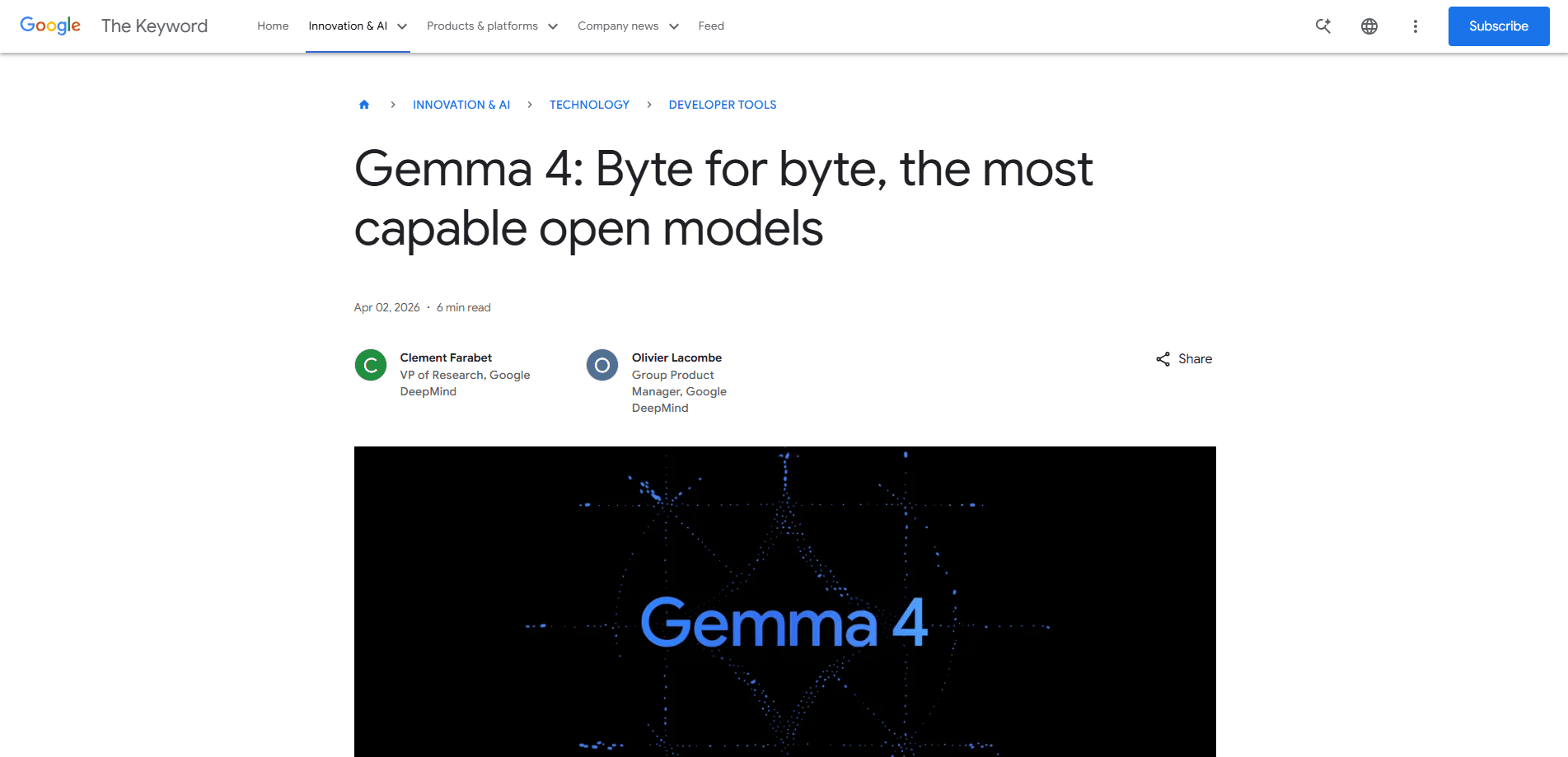
About Google Gemma 4
What Is Google Gemma 4
Google Gemma 4 is the fourth generation of Google's open model line, and it's the same research stack behind the company's closed Gemini 3 models, released as downloadable weights anyone can inspect and fine-tune. The family covers four sizes: two compact edge models (Effective 2B and Effective 4B), a 26B mixture-of-experts model, and a 31B dense model. On Arena AI's text leaderboard, the 31B version ranks as the third-best open model, while the 26B version sits at sixth. Think of it as a local LLM you own outright.
The main problem it solves is control. With weights on your own hardware, nothing leaves your machine and there's no per-token bill. That matters if you handle private records, work offline, or need predictable costs at scale. It really is that simple.
The biggest catch is hardware and setup. The smaller models run on everyday devices, but the 26B and 31B versions need a real GPU, and every size still asks you to handle serving, quantization, and updates yourself. Fine-tuning is genuinely open, but that freedom comes with work. Bring patience.
Getting Started
- Pick a size that matches your hardware, starting with E2B or E4B if you're on a phone or laptop.
- Download the weights from Hugging Face or Google's Gemma page, or open them in Google AI Studio.
- Load the model into your runtime and, if needed, apply 4-bit quantization to cut memory use.
- Feed it text, images, or audio depending on the task, then wire up function calling or JSON output if you're building an agent.
- Optionally fine-tune on your own data to lock in a specific tone or task, then deploy locally.
Product Information
A quick look at Google Gemma 4's pricing, supported platforms, and performance.
Best for
The users, tasks, and scenarios where this tool fits best.
Users
- Developers who want to fine-tune an on-device AI model on their own data and keep the weights, since the Apache 2.0 license allows commercial use and redistribution.
- Researchers and privacy-minded teams that need to run inference offline on local hardware instead of sending data to a cloud service.
- Hobbyists with a mid-range GPU who want frontier-style reasoning without paying per-token fees.
Tasks
- Multi-step reasoning and logic puzzles
- Building local agents
- Multimodal work such as describing images or handling short video and audio clips, which the whole family supports at varying depths.
Scenarios
- A startup prototyping an assistant on a laptop before committing to cloud infrastructure.
- Picking the right Gemma 4 use cases for a team that wants full data control rather than a managed API.
- A company with regulated data that has to keep everything on-premises.
- An Android app that needs on-device understanding without a network round-trip.
Key features
Four Sizes for Different Hardware
Gemma 4 comes in E2B, E4B, 26B MoE, and 31B dense variants, so you match the model to the device instead of the other way around. The two edge models target phones and laptops, while the 26B and 31B versions run on a single consumer or workstation GPU. That range is the whole point: one family, from pocket to desktop. Pick by device, not by hype.
Advanced Reasoning and Agentic Workflows
Google built Gemma 4 for multi-step logic, not just chat. It handles function calling, structured JSON output, and system instructions natively, which is what you need to assemble an agent that acts on results rather than just talking. The 31B model currently ranks third among open models on Arena AI's leaderboard. Big jump from last gen.
Multimodal Input
The family reads text and images, and the edge models add native audio input for speech understanding. Support for images and short video runs across the line with variable-resolution input, so you're not locked to one format. For simple captioning or image Q&A, the compact models can often handle it without a bigger server model. That's a lot of range for one family.
Apache 2.0 Open License
Earlier Gemma releases shipped under a custom license with usage restrictions. Gemma 4 switches to Apache 2.0, which means commercial use, modification, and redistribution are allowed without a special agreement. This is the single biggest change for anyone deciding whether they can ship a product on top of it. No legal team required.
Base Built on Gemini 3 Research
The models are built on the same research and tech as Gemini 3, so you get capabilities close to Google's closed flagship in an open package. Google frames the two lines as complementary rather than competing, with Gemma for control and Gemini for managed convenience. For teams that never wanted the cloud dependency, that shared base is the appeal. Same DNA, different rules.
API Access Alongside Local Runs
You can pull Gemma 4 through Google's Gemini API and AI Studio if you'd rather not host it yourself, and it's also available through Vertex AI and Hugging Face. Hosting it yourself is optional, not mandatory. That flexibility suits teams that want to prototype in the cloud and move to local hardware later. Test cheap, deploy local.
Pros and cons
Pros
- Free to download and run, with no per-token cost once it's on your hardware.
- Apache 2.0 license permits commercial use, fine-tuning, and redistribution.
- Four sizes cover everything from phones to workstations, so you can pick for your device.
- Native function calling and JSON output make it usable for agent-style automation.
- Multimodal input, including audio on the edge models, covers more than text-only tasks.
Cons
- The 26B and 31B models need a capable GPU and real setup work, so they're not plug-and-play.
- You handle serving, quantization, and updates yourself, which shifts the maintenance burden onto you.
- Context length and peak reasoning still trail Google's closed Gemini models on the hardest benchmarks.
- On smaller devices, the compact models trade accuracy for speed, so complex tasks may underwhelm.
Frequently asked questions
It's an open-weight AI model for reasoning, coding, and agentic tasks you run yourself. People use it to build local assistants, fine-tune on private data, and add multimodal understanding to apps without relying on a cloud API. If you want your data to stay put, this is one answer.
Related content
Explore related tools, skills, and articles for Google Gemma 4.
Google Gemma 4 Alternatives
BinkBink
BinkBink · OtherBinkBink is a free online game platform and AI game maker that lets anyone turn a short text description into a playable browser game. You can jump into hundreds of community-made games. Or describe your own idea and play it in seconds, then share it with friends. Want to create your own game? You don't need to code. No engine setup, no download, no hassle.

Audiogen
Audiogen Inc. · OtherAudiogen is an AI music generator built by Audiogen Inc., a small research team that spent about 2.5 years training its own generative music model and designing a web interface around it. Instead of a plain text box, this AI music tool turns the timeline into a beginner-friendly Generative Audio Workstation, or GAW, where inpainting, extending, remixing and stem editing work more like painting on a canvas. The product is still in beta, so access runs through a waitlist or an invite. Paid plans aren't published yet.

Aiml API
AIMLAPI OÜ · OtherAiml API is a unified AI model API that puts more than 1000 models from OpenAI, Google, Anthropic, and others behind one endpoint and one bill. You write code against a single OpenAI-compatible schema, then switch between chat, image, video, and audio models by changing a model string. It suits developers and small teams who want multi-model access without juggling a dozen separate provider accounts, and it removes the usual billing headache that comes with testing several vendors. One key covers it all.