

Google Willow
Google (Google Quantum AI) · Other
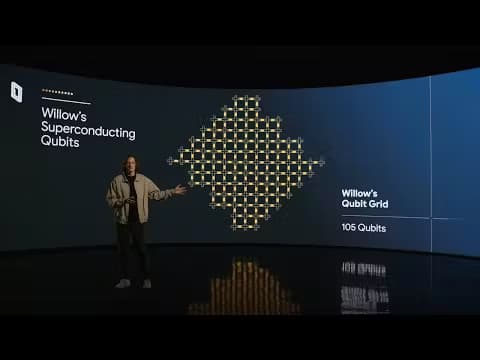
Google Willow is a 105-qubit quantum processor built for research, cutting errors as it scales instead of piling them up.
About Google Willow
What Is Google Willow
Google Willow is a superconducting quantum chip from Google Quantum AI, unveiled on December 9, 2024, and it's a research processor rather than a product you buy or download. Its job is to show that quantum computers can get more reliable as they get bigger.
That matters because quantum error correction has been the field's wall for almost 30 years, and a processor that keeps getting cleaner as you add more qubits is the first real answer to it. Every qubit tends to swap information with its surroundings, so adding more of them usually makes the system noisier, not better. Willow flips that. Google's team tested grids of 3x3, 5x5, and 7x7 encoded qubits, and each step cut the error rate roughly in half. Not a small thing.
The headline number is a benchmark called random circuit sampling. Willow finished a computation in under five minutes that, by Google's estimate, would take one of today's fastest supercomputers around 10 septillion years, a span so large it exceeds the age of the universe many times over. Google says the estimate is conservative and assumes no memory or bandwidth limits for the classical machine.
Keep the limits in view. Willow hasn't run a computation tied to a real-world, money-making problem yet, and both of its wins so far sit in benchmark and simulation territory, which means the practical payoff that would justify the whole effort is still open. So if you're waiting for a quantum chip that speeds up your actual workflow, this isn't it yet.
Getting Started
- Start at the Google Quantum AI site to read the published Nature paper and the official Willow announcement.
- Review the chip specs, including the 105 qubits, T1 times near 100 microseconds, and the error-correction results.
- Use the open-source Cirq framework to write or run quantum circuits in simulation on your own machine.
- Apply for access to Google's quantum hardware through the Quantum AI research program if you're with an institution.
- Follow the roadmap for updates on when real-world, beyond-classical workloads become available.
Product Information
A quick look at Google Willow's pricing, supported platforms, and performance.
Best for
The users, tasks, and scenarios where this tool fits best.
Users
- Quantum researchers
- Physics and CS students
- Tech followers
Tasks
- Benchmarking quantum hardware
- Error-correction research
- Learning quantum algorithms
Scenarios
- Writing a paper on logical qubits that can grow
- Teaching a class on quantum computing
- Tracking the industry
Key features
105 Qubits With Below-Threshold Error Correction
Willow packs 105 physical qubits, and it's the first system to show errors dropping as the qubit count rises. Google tested 3x3, 5x5, and 7x7 encoded grids, halving the error rate at each step. This "below threshold" result is the milestone the field chased since 1995.
Exponential Error Reduction in Practice
The chip also hit "beyond breakeven," meaning its arrays of qubits outlast the individual physical qubits inside them. That's hard to fake. It's the strongest sign yet that error correction is improving the whole system, not just parts of it.
Random Circuit Sampling Benchmark
Google used RCS, the hardest benchmark a quantum computer can run today, to size up Willow. The chip completed the task in under five minutes against an estimated 10 septillion years for a leading supercomputer. It's a performance gauge, not a real-world workload.
Real-Time Error Correction
Willow is one of the first superconducting systems to correct errors fast enough to matter during a computation. Errors that pile up faster than you can fix them ruin the calculation before it ends. This keeps it on track.
Long Qubit Lifetimes
T1 times measure how long a qubit holds its state. They now approach 100 microseconds. That's a big jump. About a fivefold gain over Google's previous generation, it gives computations more room to run before the state decays.
Purpose-Built Fabrication
Willow was made in Google's dedicated fabrication facility in Santa Barbara, one of only a few sites in the world built from the ground up for quantum chips. All the pieces, from single and two-qubit gates to reset and readout, get engineered together, since one lagging component drags down the whole chip.
Pros and cons
Pros
- Delivers the first below-threshold error correction, a result that the field chased for nearly 30 years and that points toward quantum machines people can actually rely on for long calculations.
- Cuts error rates roughly in half with each increase in grid size.
- Posts a benchmark result that dwarfs classical supercomputers by an enormous margin.
- T1 times near 100 microseconds mark a roughly 5x gain over the prior chip, which buys longer computations before the state decays.
Cons
- No public API or consumer access, so you can't use it without institutional ties.
- Hasn't run a commercially useful, beyond-classical task yet, so its practical payoff is unproven.
- The 10 septillion year figure is Google's own estimate and hasn't been independently verified at scale.
Frequently asked questions
It's a research processor for quantum error-correction and benchmarking work. So what does Google actually do with it? It tests whether scaling up qubits can reduce errors, and it runs the random circuit sampling benchmark.
Related content
Explore related tools, skills, and articles for Google Willow.
Google Willow Alternatives

Odyssey 3
Odyssey · OtherOdyssey-3 is Odyssey's foundation world model. It simulates physics in real time, turns a prompt into an interactive environment, and adapts to robots, cars and games.

JarvisCore
Prescott Data · Coding · Productivity · OtherJarvisCore is an open source Python runtime where AI agents work as equal peers on an agent mesh, claim tasks from a shared ledger, and reach external services through a zero-trust broker.
Clef
Cloudflare · Business · OtherClef is Cloudflare's open-source decision model for Workers AI. It returns calibrated probabilities for typed questions, not generated text, so agents can classify, route, and act fast.