

GradPipe
GradPipe · Business
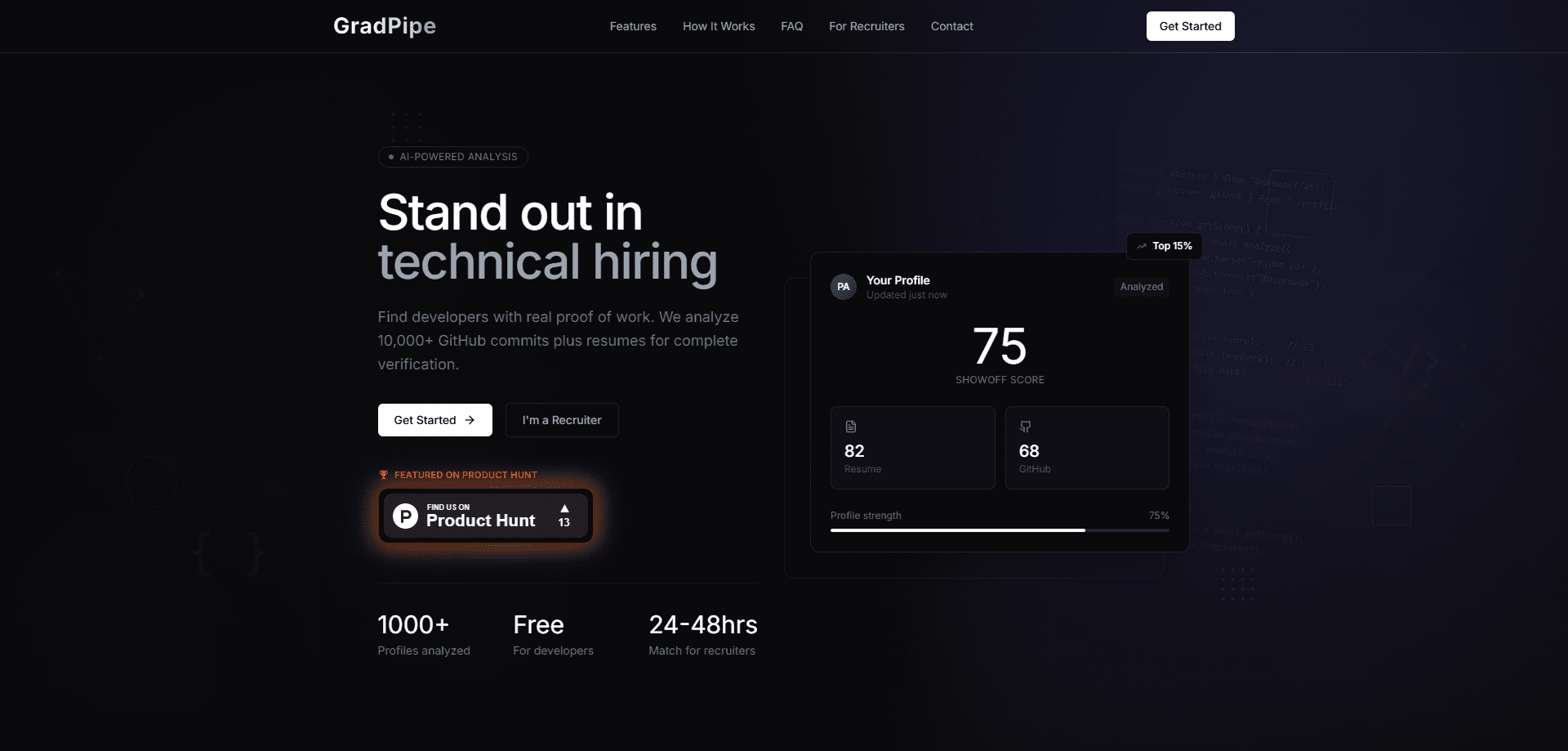
GradPipe is an AI talent marketplace for companies that want to hire student developers without drowning in resume keyword matches. It's a technical recruiting platform built on GitHub proof-of-work. It reads a candidate's repositories and verifies what they can actually build. Then it surfaces the engineers whose work looks strongest, not the ones whose profile reads best. For hiring teams, that means a shorter path from an open role to a shortlist worth a conversation.
About GradPipe
What Is GradPipe
GradPipe is a recruiting platform built around proof-of-work instead of self-reported skills. The pitch is direct: resumes reward people who describe themselves well, and GitHub rewards people who ship. GradPipe leans on the second signal, and everything in the product follows from that single choice.
The system analyzes GitHub repositories at the AST (abstract syntax tree) level. In plain terms, it reads code structure, not just file names or commit counts. A portfolio full of copy-pasted tutorials looks different from one built through real problem solving. Compare that to a keyword screen on a resume. The gap is obvious. One rewards vocabulary, the other rewards output.
The main limitation is reach. Anyone whose best work lives outside GitHub, in private repos, in notebooks, or in coursework that never gets published, is harder to surface. A candidate who learned everything through private company code and never pushed a public commit can be excellent and still end up invisible here. It's a strong filter for open-source activity, not a complete picture of a person. So who does it actually fit? Teams that already expect to see public code.
Getting Started
- Go to gradpipe.com and create a company account.
- Describe the role you're hiring for and the skills you care about.
- Let the platform scan public GitHub activity and rank matching student profiles.
- Review the shortlist, check the proof-of-work behind each candidate, and reach out.
- Track responses and move finalists into your normal interview flow.
Product Information
A quick look at GradPipe's pricing, supported platforms, and performance.
Best for
The users, tasks, and scenarios where this tool fits best.
Users
- Startup hiring managers
- Technical recruiters
- Engineering leads screening interns
Tasks
- Sourcing junior developers
- Verifying claimed skills
- Reducing resume screening time
Scenarios
- Filling an internship before the semester starts
- Sourcing for a niche stack
- Building a talent pipeline for future roles
Key features
AST-Level Code Analysis
GradPipe parses repositories at the abstract syntax tree level, which means it looks at how code is structured rather than how a profile is worded. A student who refactored a messy project into clean, reusable modules that other people can actually read shows up differently from one who only forked a template and tweaked a few values. For a hiring manager, that's a signal a keyword filter simply can't produce.
Proof-of-Work Verification
This is the core idea behind the whole product, and everything else supports it. GradPipe centers on GitHub proof-of-work over self-reported claims. It checks what a candidate has actually built and committed. A portfolio carries more weight than a skills list. Simple as that.
Student Talent Discovery
GradPipe is aimed at the "undiscovered" part of the market: students whose work is strong but whose networks aren't. That focus helps teams reach candidates who never make it onto a recruiter's radar through traditional channels. It also means the pool skews toward people early in their careers.
Skill Matching by Repository Activity
Rather than tagging candidates with skills they simply claim on a form, the platform infers strengths from the repositories they maintain over time. A backend-heavy GitHub tells a different story than a frontend one that leans on layout and interaction work. Recruiters get a far more concrete starting point for a conversation than a list of self-assigned labels.
Candidate Ranking for Shortlists
Results arrive ordered by how well each profile matches the role, so a hiring team starts with the strongest matches instead of a flat list. That ordering is the difference between a search tool and a shortlist tool.
Company-Side Search and Filtering
Hiring teams describe the role and requirements, then let the platform surface relevant student profiles. The workflow assumes you already know roughly what you need and want help finding it faster, rather than help deciding what to hire for in the first place. That's a real assumption. Not every team has a clear role spec on day one.
Pros and cons
Pros
- Screens on real code output instead of resume wording, which cuts down sharply on candidates who interview well but ship very little measurable work.
- AST-level analysis catches code quality differences that raw commit counts and star totals tend to miss entirely.
- Focus on student and early-career talent reaches people who are genuinely hard to find through normal recruiting channels.
- Ranking and shortlisting save time at the top of the funnel before a human ever opens a folder of applications.
Cons
- Anyone without public GitHub work, including strong candidates from private repos or non-code backgrounds, is largely invisible to the platform.
- Pricing isn't published, so you'll have to talk to the team before you know if it fits your budget.
- It's a sourcing tool, not an end-to-end hiring suite, so interviews, offers, and onboarding still live elsewhere.
- GitHub-heavy screening can skew toward candidates who already know how to market their work publicly.
Frequently asked questions
It's an AI talent marketplace that helps companies find student developers by analyzing their GitHub repositories instead of their resumes. The goal is to surface candidates based on what they've built.
Related content
Explore related tools, skills, and articles for GradPipe.
GradPipe Alternatives

Knocket
Knocket (Tencent RTC team) · Productivity · Business · ChatbotKnocket is a free live chat and contact page tool that lets visitors message you from your website, app, or a shareable link, with every reply handled from Telegram or one inbox.

shippedit.me
Krawlup · Marketing · Businessshippedit.me now redirects to Krawlup, a web platform that audits SEO, AEO and page speed every week, then hands the fixes to AI coding agents over MCP.

Ayven
Alknoma · Productivity · BusinessAyven is an AI control centre by Alknoma that turns a plain-language goal into a dated plan, hands the work to your people and AI agents, and asks for your approval only when the call is yours.