

GraphBit
InfinitiBit · Coding
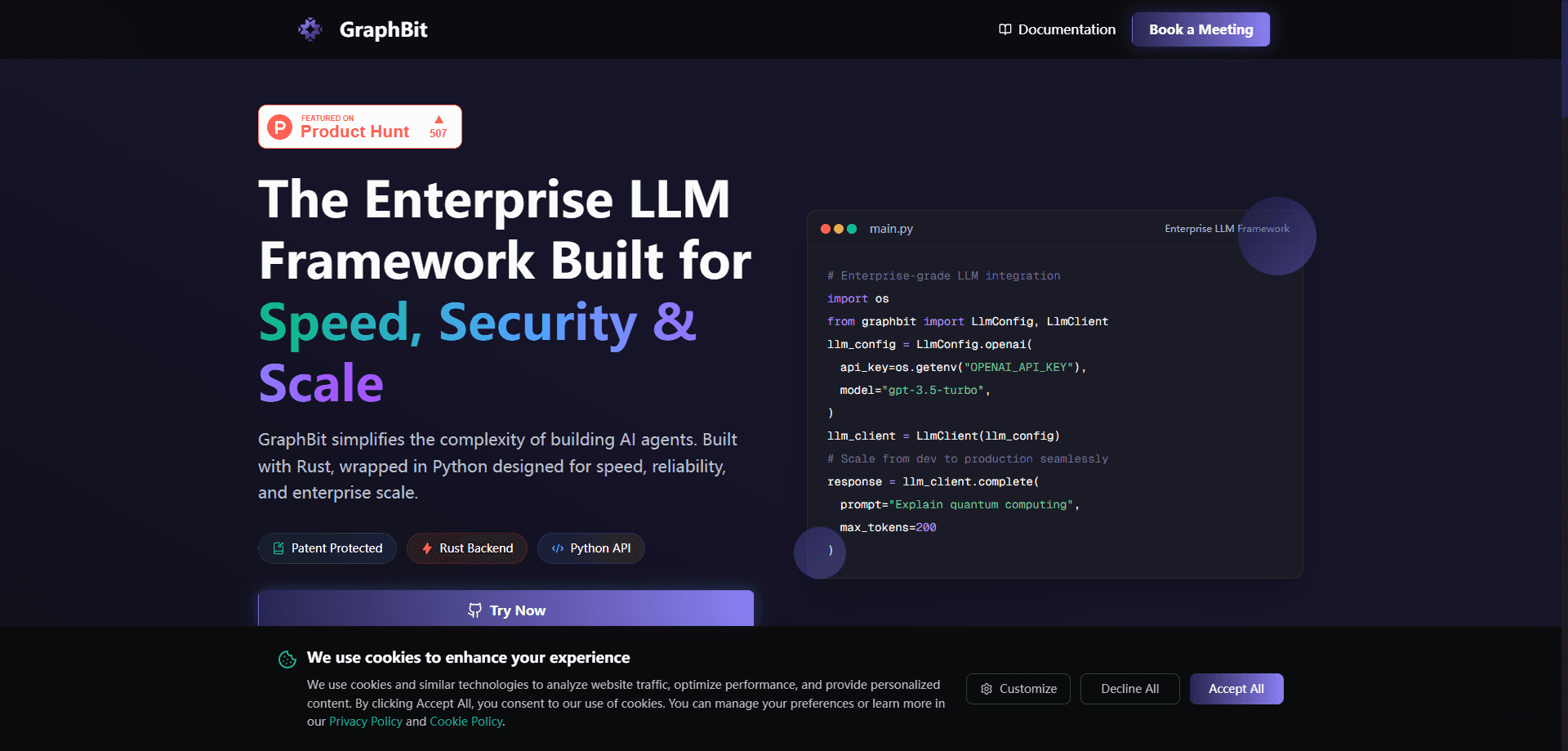
GraphBit is an open-source agentic AI framework from InfinitiBit that runs multi-agent orchestration on a Rust core with a thin Python layer. It targets teams that need speed, low resource use, and predictable behavior in production rather than experimental demos. The tool handles orchestration, model routing, memory, and guardrails under one roof, so you can move an AI agent setup from prototype to a governed deployment without rebuilding the foundations.
About GraphBit
What Is GraphBit
Most AI agent frameworks let the model decide the next step on the fly. That's flexible. It also produces loops, unpredictable paths, and results you can't reproduce when an auditor asks. GraphBit takes the opposite approach. It defines workflows as a directed acyclic graph, so a Rust engine controls routing, state changes, and tool calls instead of the model.
The framework ships as an open-source package on GitHub, maintained by InfinitiBit, a Munich-based company. Its selling point is efficiency: the team reports up to 68x lower CPU use and 140x lower memory use than comparable frameworks, while keeping throughput equal or higher. Enterprises in regulated sectors, such as professional services firm Grant Thornton, use it for governed deployments. InfinitiBit holds ISO/IEC 27001:2022 certification and has completed the TISAX assessment for automotive data security.
The catch is the audience. GraphBit assumes you're comfortable with code and graphs. There's no drag-and-drop canvas for non-technical users. The deterministic model also means less freedom for agents that should improvise. If you want a no-code agent builder, this isn't it.
Getting Started
- Install the package from the GitHub repository or Python package index on a supported machine.
- Set up your model providers and API keys, then define which LLMs or multimodal models the workflow can reach.
- Sketch your agent workflow as a graph, connecting typed functions, tools, and decision branches.
- Add memory, policies, and guardrails so the engine knows what agents can and can't do.
- Run the workflow locally or deploy it on-prem, in a private cloud, or in a managed environment.
Product Information
A quick look at GraphBit's pricing, supported platforms, and performance.
Best for
The users, tasks, and scenarios where this tool fits best.
Users
- Backend and platform engineers who already write Python and want control over agent behavior instead of prompt-only orchestration.
- Enterprise AI teams in regulated fields such as finance, automotive, and professional services, where audit trails and compliance matter more than fast prototyping.
- Infrastructure-focused developers running agents on edge devices or low-resource servers, since the Rust core keeps CPU and memory use low.
Tasks
- Building deterministic multi-agent pipelines where the same input should always produce the same path, such as document processing or compliance checks.
- Defining deterministic AI workflows that stay reproducible for audits and debugging instead of drifting run to run.
- Connecting agents to internal APIs, databases, and enterprise workflows with validated tool calls.
- Running parallel branches of a workflow at once and merging the results under defined rules.
- Adding persistent memory and state across long-running tasks without letting context grow out of control.
Scenarios
- Deploying an AI assistant that must stay inside strict governance guardrails instead of acting freely.
- Running agent workloads on-prem or in a private cloud where data can't leave the company's boundary.
- Swapping the underlying LLM for a cheaper or newer model without rewriting the workflow.
- Research and benchmarking work that needs reproducible agent runs for comparison.
Key features
Deterministic Graph Orchestration
GraphBit defines every workflow as a directed acyclic graph, so a Rust engine decides routing, branching, and execution order rather than the model. That setup kills the hallucinated routing and infinite loops that plague prompt-driven agents. Not ideal for demos that need to wander. According to InfinitiBit, this design also delivered zero framework-induced hallucinations on GAIA benchmark tasks in its own testing.
Rust Core With a Python Wrapper
The performance engine is written in Rust, but you work with it through a Python layer that stays close to plain Python. The company reports up to 68x lower CPU usage and 140x lower memory footprint than other frameworks at equal or higher throughput. That's a big gap. In practice, you can run more concurrent agents on the same hardware, or fit an agent on a device that couldn't handle a heavier stack.
Model-Agnostic Routing
Workflows reach LLMs and multimodal models from multiple providers, and you can swap a model without breaking the surrounding logic. This matters when a provider changes pricing, deprecates a version, or when you want a smaller model for simple steps and a larger one for hard reasoning. The governance layer stays the same either way. Swap the model, keep the rules.
Three-Tier Memory
GraphBit separates memory into ephemeral scratch space, structured state, and external connectors. Each tier keeps its own context, which stops long pipelines from drowning in accumulated history. That isolation is a big part of why multi-step tasks stay coherent as they run for hours, according to the team's ablation studies.
Tool and Action Integration
Agents connect to APIs, databases, and enterprise workflows, and every action runs under defined controls. You get validation before a tool fires, which is the difference between an agent that reads a system and one that can safely write to it. That distinction decides whether a bank or a hospital will let your agent near production data at all. The framework treats each action as a governed event, not a free-for-all.
Central Policy and Guardrails
Policies, rules, and guardrails are configured in one place and enforced without touching application code. Teams keep their existing interfaces while the engine constrains what agents are allowed to do. For regulated deployments, that keeps behavior consistent and audit-ready across every workflow.
Flexible Deployment
GraphBit runs on-prem, in a private cloud, or in a managed environment, with data residency and security boundaries under the enterprise's control. The open-source core also means you can inspect and extend it. InfinitiBit's ISO 27001:2022 certification and completed TISAX assessment back the compliance story for security-sensitive buyers who can't move data off their own infrastructure.
Parallel Execution and Recovery
The engine supports parallel branch execution, conditional control flow over structured state, and configurable error recovery. If a step fails, the workflow follows rules you set instead of crashing or drifting. Why does that matter? Reliability is the core reason the framework targets production workloads rather than demos.
Pros and cons
Pros
- Deterministic graph execution makes agent runs reproducible, which matters for audits and debugging.
- Very low CPU and memory overhead thanks to the Rust core, so it scales on modest hardware.
- Model-agnostic design lets you switch LLM providers without rewriting workflows.
- Built-in governance, memory tiers, and tool validation cover needs that other frameworks leave to add-ons.
- Open-source core plus ISO 27001 and TISAX credentials suit regulated enterprise buyers.
Cons
- Requires Python and graph-based thinking, so it's a poor fit for no-code users.
- Deterministic workflows leave little room for agents that need to improvise freely.
- Enterprise pricing isn't published, so budget planning means contacting sales.
- The community is younger than established frameworks, meaning fewer tutorials and answers.
Frequently asked questions
GraphBit is used to build and run multi-agent AI workflows that need to be fast, secure, and repeatable. Teams use it for document processing, compliance checks, and enterprise automation where predictable behavior beats open-ended improvisation.
Related content
Explore related tools, skills, and articles for GraphBit.
GraphBit Alternatives
Forefront
Forefront · CodingForefront is a web platform for building with open-source AI. It lets you fine-tune leading open-source language models on your own data, evaluate how they perform, and run them through an API or export them to host yourself. Developers who want the convenience of a closed-source platform but insist on owning their models and data are the target audience here.

Startkit
StartKit.AI · CodingStartkit is a boilerplate for building AI SaaS and AI wrapper products. Think of it as an AI startup boilerplate with the boring parts already wired up: authentication, Stripe and Lemon Squeezy payments, usage limits, transactional email, and an AI API starter that talks to OpenAI, Anthropic, Groq, or Llama. You clone the repo, set your price, and start on the part of your product that people actually pay for. It's Next.js under React and Tailwind, so most of the boilerplate code already feels familiar.
Testim
Tricentis · CodingTestim is an AI-powered test automation platform for building and running end-to-end tests across web, mobile, and Salesforce applications. It leans on machine learning to keep tests stable when an interface changes, so teams spend less time fixing broken selectors. Not bad for an automated testing tool you can start using today. You create tests by recording actions in a browser, then optionally add JavaScript when you need more control. It's a solid pick for busy QA teams.