

Grass
Grass · Coding
Grass is a bandwidth-sharing network that pays people to put their unused internet to work, with rewards tracked as points and paid out in GRASS tokens or USDC.
About Grass
What Is Grass
Grass is a decentralized network that lets people earn rewards by sharing the internet bandwidth they are not using. You install the app, and it runs quietly in the background, letting verified organizations route traffic through your connection. It is one of the best-known DePIN projects, a category of networks that reward people for contributing real-world resources like storage, computing power or, in this case, bandwidth. The company behind it, Wynd Network, describes Grass as a source of live data for AI and other applications, gathered by millions of ordinary internet users instead of a single company.
The idea rests on a simple observation: most people pay for a connection they barely use. Grass takes the idle part and puts it to work, then rewards you for the contribution. The network says it is used by more than 8.5 million people worldwide. Rewards arrive as Grass Points first, and those points, along with factors like how your bandwidth is used and where you are located, feed into the Grass Tokens or USDC you may receive.
Two things are worth knowing before you install it. Grass says it cannot see your personal data or your browsing activity, and it only uses bandwidth you are not using. The other is that token payouts depend on your jurisdiction, so people in some regions are not eligible to receive them.
Getting Started
- Download the desktop app, mobile app or browser extension from getgrass.io
- Create a Grass account and sign in so your earnings are tied to you
- Leave the app running in the background, and keep an eye on the dashboard for your connection status and points
- Refer others or keep your device online to add to your points, then claim rewards when distribution opens
Product Information
A quick look at Grass's pricing, supported platforms, and performance.
Best for
The users, tasks, and scenarios where this tool fits best.
Users
- Everyday internet users
- Web3 and crypto users
- People with an always-on device
- Privacy-minded users
Tasks
- Passive earning
- Referring others
- Running a node
- Claiming rewards
Scenarios
- A spare laptop sits idle
- You want income with no work
- You follow crypto airdrops
- You travel and keep a home connection
Key features
Share Unused Bandwidth
Grass puts the idle part of your internet connection to work. Verified organizations route traffic through your connection to support their online services, and your contribution is tracked in return. The app measures how much capacity you have available and stays under it, so it never crowds out your own use. The company says your personal data stays inaccessible to Grass and to anyone else on the network.
Uptime and Network Points
Rewards come in two forms. Uptime Points are earned for staying connected and for bringing others in through referrals. Network Points are earned when your connection is actually used to handle traffic. Together they track how much you contribute, and they feed into the Grass Tokens or USDC you may receive in later distributions.
Runs Quietly in the Background
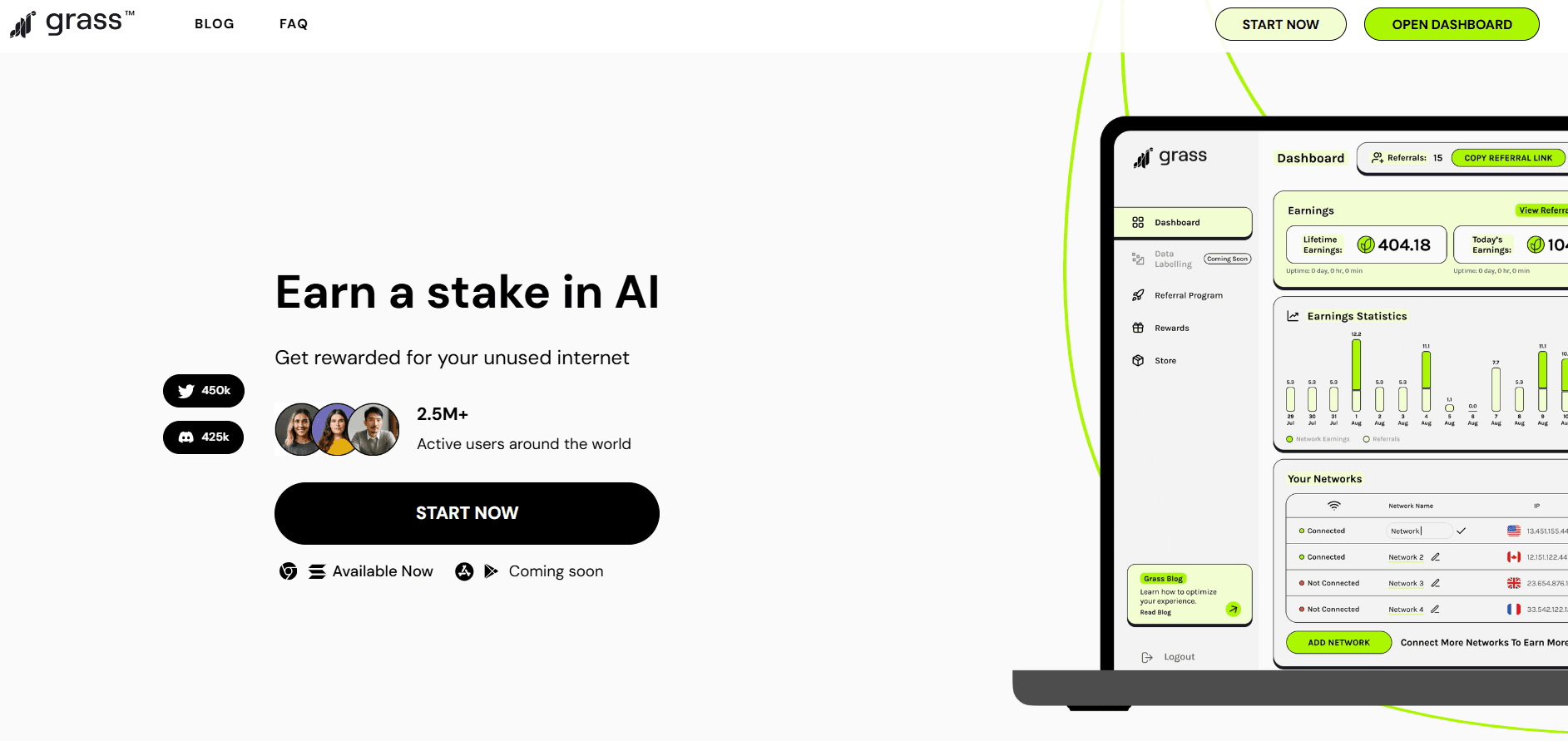
The app is built to stay out of the way. It runs behind whatever you are doing and only draws on bandwidth you are not using, so the pitch is that your browsing, streaming and games are unaffected. Everything is visible on a plain dashboard where you can check connection status, uptime and points, and pause or disconnect with one tap.
Desktop, Mobile and Browser Options
You can join from more than one type of device. There is a desktop app, a mobile app and a browser extension, so you can pick the one that fits how you use the internet. Devices that stay online around the clock tend to earn more uptime points, which is why a spare PC or a home machine left running tends to be the popular setup.
Wallet-Based Rewards
Rewards are tied to a wallet. When a distribution opens, you connect a compatible wallet and claim the GRASS tokens or USDC you have accrued. The token is the native asset of the Grass network, and it reflects your participation in building the network rather than a fixed payout per hour. Eligibility depends on where you live, since some jurisdictions are not currently able to receive tokens.
A Data Network for AI
The bigger purpose behind Grass is data. The company frames the network as a way to gather live, public web data for AI training and for real-world applications, in place of a single company running its own crawlers. Because the gathering is spread across millions of residential connections, the company argues the data can be fresher and harder to block than a centralized effort.
Pros and cons
Pros
- No upfront cost, so you can try it on a connection you already pay for
- Runs in the background without changing how you use your internet, and it only draws on unused capacity
- Works across desktop, mobile and browser, so you can join from a device you already own
- The company says your personal data and browsing activity stay private and are not accessible to it
- Clear dashboard and a one-tap pause, so you can see what is happening and stop it anytime
Cons
- Rewards are paid in tokens or USDC rather than cash, so the value moves with the market
- Payouts depend on your jurisdiction, and some regions are not eligible to receive tokens
- Earning is tied to how much your connection is actually used, so income varies widely and can be small
- Running multiple accounts on one device or network is penalized, which limits how much one person can earn
Frequently asked questions
Grass is a decentralized network that pays people to share their unused internet bandwidth. You install an app and it runs in the background, letting verified organizations route traffic through your connection while your contribution is tracked as points. The company behind it, Wynd Network, says the network is used by more than 8.5 million people worldwide.
Related content
Explore related tools, skills, and articles for Grass.
Grass Alternatives

Base Code
Base44 (Wix) · Coding · ProductivityBase Code is a shared cloud development environment from Base44. Teammates describe changes to an existing GitHub codebase in chat, preview them live and send them back as pull requests.

Google EmbeddingGemma 2
Google DeepMind · Writing · Image · CodingGoogle EmbeddingGemma 2 is a 740M-parameter open model that turns text, code, images, audio, and video frames into vectors in one 768-dimension space, running on phones and laptops.

GitGlow
GitGlow · Coding · ProductivityGitGlow is a local-first desktop Git client that lets independent developers review their own code and their AI agents' changes in one place before shipping.