

Greptile
Greptile · Coding
Greptile is an AI code review agent that indexes your whole repository, reviews each pull request in about three minutes, and sends fixes to Claude Code, Cursor, or Codex with one click.
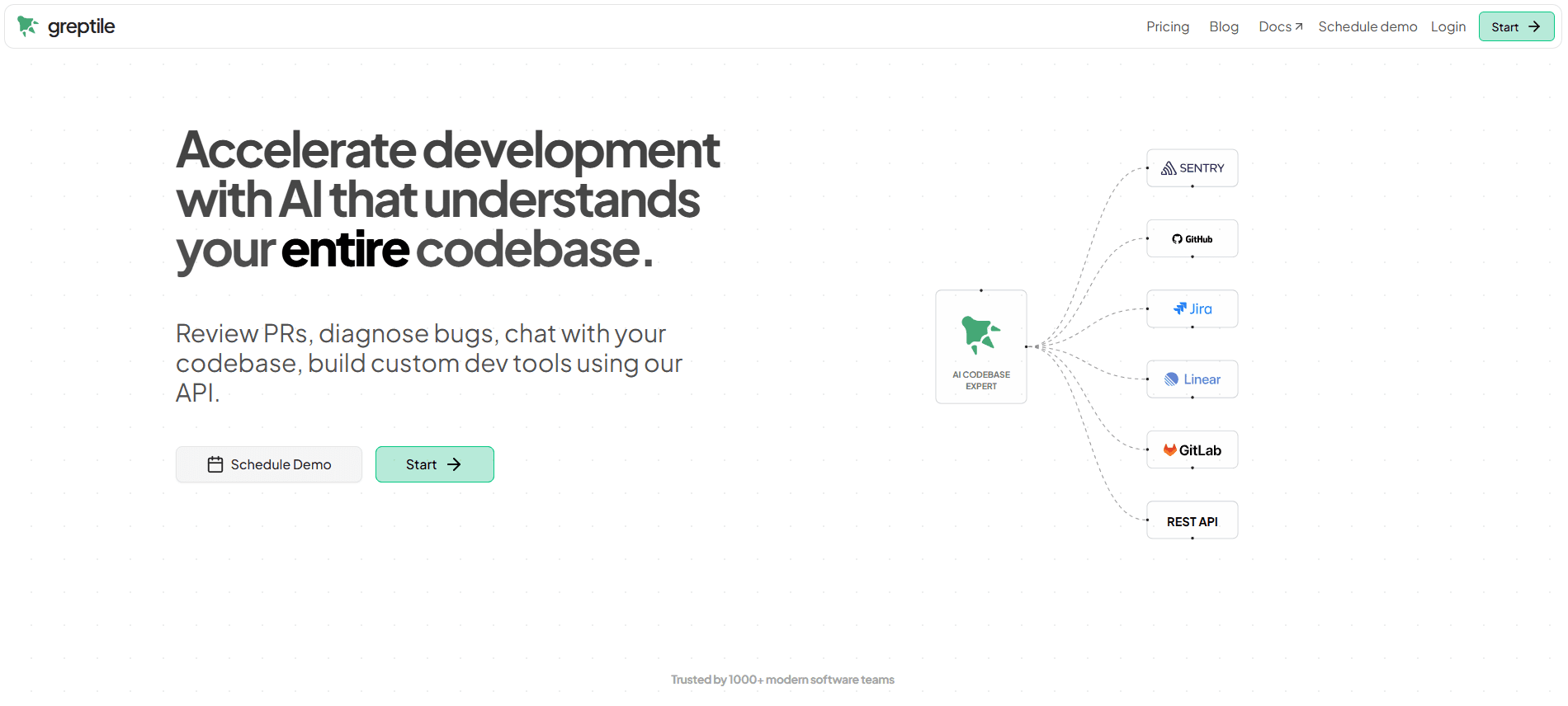
About Greptile
What Is Greptile
Greptile is an automated code review service for teams that ship through pull requests. Rather than checking a diff in isolation, it builds a graph of every file, function, and dependency in the repository, then has a group of agents review the change against that map. Findings appear as ordinary PR comments with file paths, line numbers, and a suggested patch.
The product targets a specific failure: the bug that looks fine inside the changed lines but breaks something three files away. Greptile's own framing is that an AI code reviewer with full-repo context differs from a linter in one way: it can see the damage outside the diff. The company reports roughly 100,000 bugs caught per month across its customers. More than 22,000 teams use it, including Brex, WorkOS, and Mintlify, according to the vendor.
It doesn't replace your reviewers. It takes the first pass so people can spend their attention on design and intent. Three limits matter before you sign up. Reviews run on credits, so a busy monorepo can get expensive. Comments are sometimes wrong or trivial, and the learning system needs a few weeks of feedback before noise drops. And any code review tool that reads your repositories needs a security review before install, which slows down procurement in most companies.
Getting Started
- Sign in with GitHub or GitLab and install the Greptile app on the organization you want reviewed.
- Enable the repositories to index. Small projects finish in minutes, large monorepos take longer on the first pass.
- Set review standards with plain-English custom rules, a link to your style guide, or a
./greptile/rulesfile scoped to file patterns. - Open a pull request and read the review. React with a thumbs up or down on each comment so later reviews match your team's taste.
Product Information
A quick look at Greptile's pricing, supported platforms, and performance.
Best for
The users, tasks, and scenarios where this tool fits best.
Users
- Small engineering teams without a dedicated reviewer
- Platform teams on large monorepos
- Engineering managers who want review data
Tasks
- Catching cross-file bugs before merge
- Enforcing house rules
- Clearing a backed-up PR queue
- Handing comments to a coding agent
Scenarios
- A PR volume that outruns reviewer attention
- Regulated environments that can't send code to a shared cloud
- Open source maintenance with drive-by contributions
Key features
A graph index of your codebase
Greptile parses the repository into files, functions, and dependencies before it reviews anything. That map lets a comment reference a caller two services away instead of guessing from the diff. Reindexing happens as the code changes, so the context stays current rather than drifting toward the state of the repo on install day.
Parallel agents that read beyond the diff
Each pull request goes to a swarm of agents working at the same time on different parts of the change. One may trace an auth check through middleware, another may look at error paths or null handling. The output is a single review rather than several competing threads, which keeps the PR readable.
Fix with your Agent and Fix All
Every comment carries a Fix with your Agent button that packages the file path, line number, and suggested code for Claude Code, Codex, Cursor, Conductor, or Devin. A Fix All button in the summary sends the whole set at once. For teams already running coding agents, this removes the copy-paste step between review and patch.
Learning from team reactions
Thumbs up and thumbs down on comments, plus replies, feed a model of what your team considers worth flagging. Greptile says it stops commenting on patterns you ignore after two to three weeks. The same mechanism supports cross-repo context and a shared knowledge base, so conventions from one service carry into another.
Review extras built into the PR
Beyond inline comments, each review adds a confidence score from zero to five, a PR summary, and generated sequence diagrams or flowcharts for changes that touch several components. Unit tests are drafted for new and changed code, and you can ask follow-up questions in the PR thread instead of opening a separate chat window.
TREX runtime validation
TREX, currently in beta, is a separate agent that writes and runs tests for each pull request inside a sandbox. It covers the gap between reading code and watching it behave, which is where logic bugs tied to real inputs tend to surface. Runtime checks consume credits on top of the review itself.
Pros and cons
Pros
- Cross-file context catches bugs that line-based tools and linters miss, especially around callers and shared state.
- Reviews land in about three minutes, fast enough to sit inside a normal PR loop.
- One-click handoff to Claude Code, Cursor, Codex, or Devin fits teams that already fix issues with agents.
- The learning loop cuts noise over time instead of repeating the same complaints.
- Broad host support, from GitHub and GitLab to Bitbucket, Gitea, and Perforce, plus a self-hosted option.
Cons
- Credit pricing scales with PR volume, not seats. Apex reviews cost 10 credits each, so heavy use on a large repo adds up quickly.
- Some comments are wrong or restate the diff, and the first weeks are the noisiest.
- Self-hosting and SSO sit behind Enterprise, so smaller teams can't keep code in their own network.
- The free plan allows one developer and 50 credits a month, which is enough to test the workflow but not to run a team on it.
Frequently asked questions
It reviews pull requests automatically and posts comments with suggested fixes, using full-repo context instead of the changed lines alone. You connect a code host, pick repositories, and it runs on every new PR unless you set other triggers.
Related content
Explore related tools, skills, and articles for Greptile.
Greptile Alternatives

Base Code
Base44 (Wix) · Coding · ProductivityBase Code is a shared cloud development environment from Base44. Teammates describe changes to an existing GitHub codebase in chat, preview them live and send them back as pull requests.

Google EmbeddingGemma 2
Google DeepMind · Writing · Image · CodingGoogle EmbeddingGemma 2 is a 740M-parameter open model that turns text, code, images, audio, and video frames into vectors in one 768-dimension space, running on phones and laptops.

GitGlow
GitGlow · Coding · ProductivityGitGlow is a local-first desktop Git client that lets independent developers review their own code and their AI agents' changes in one place before shipping.