

Greta
Questera · Coding
Greta is Questera's growth engineering agent. It writes custom code to build and test growth strategies inside your product, so teams can ship experiments without waiting on engineering.
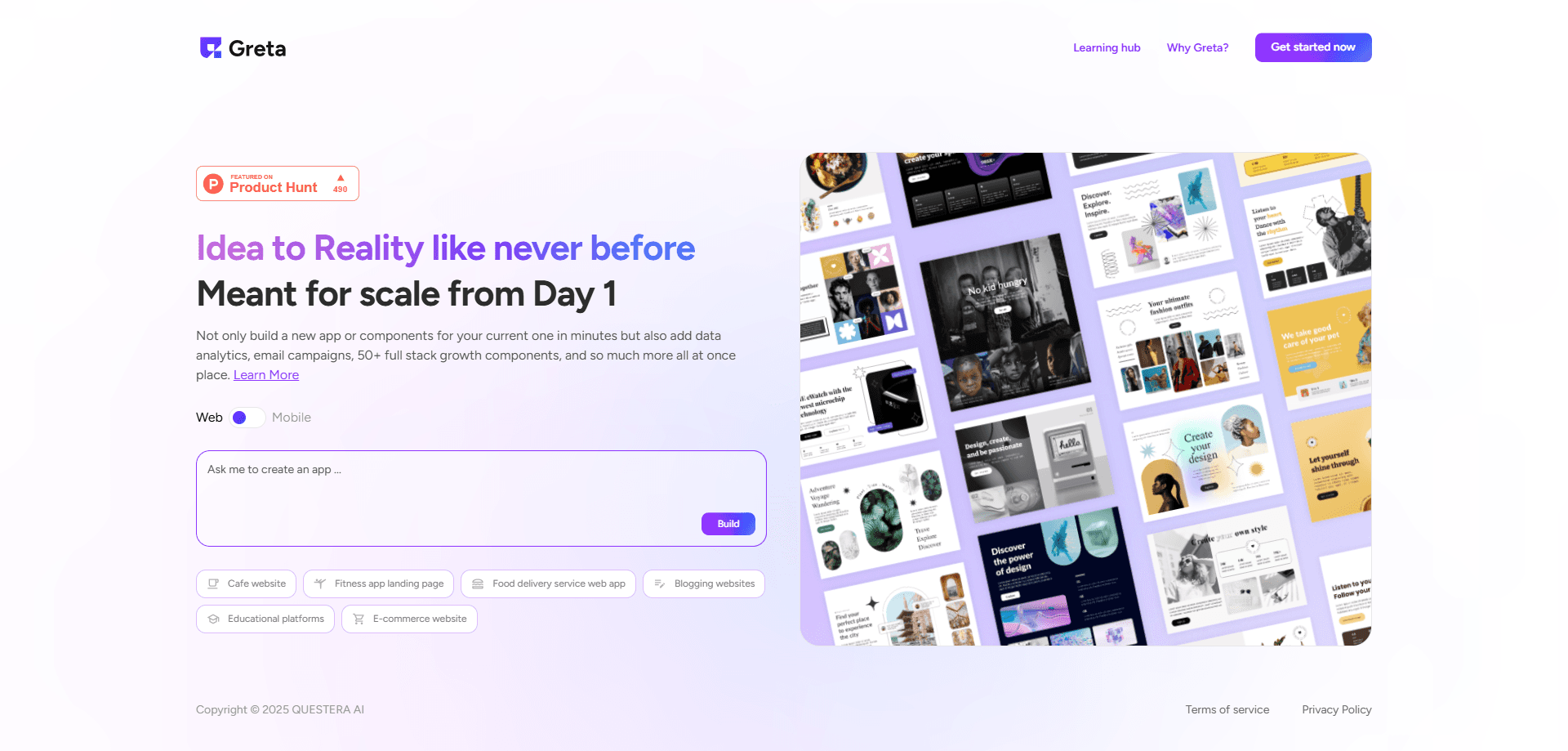
About Greta
What Is Greta
Greta is an AI agent from Questera, the company behind an agentic customer engagement platform. Its job is narrow and technical: it acts as a growth-focused engineering agent, generating custom code solutions to implement and test growth strategies directly within the product. Where most marketing tools make you assemble flows by hand, Greta writes the code that runs the experiment.
It fits teams that want to move on growth ideas faster than a backlog allows. Product and lifecycle marketers usually wait on engineering to build a paywall tweak, an onboarding change, or a new offer. Greta closes that gap by turning a described goal into working code, then helping test it.
The limits are worth knowing before you buy in. Greta is one agent inside Questera's suite, so it works best when your data already lives in the platform. It generates code for growth experiments, not full product features, and it assumes you have somewhere to review and deploy what it builds.
Getting Started
- Ask your Questera contact for access, since the platform is sold to teams rather than individuals.
- Connect the data sources you want Greta to work from, such as your product analytics, CRM, and warehouse.
- Describe the growth goal in plain language, like testing a new onboarding step or a pricing prompt.
- Review the code Greta generates and the experiment it sets up, then approve or adjust it before it runs.
- Let the test run, read the results in your dashboards, and roll the winning version out.
Product Information
A quick look at Greta's pricing, supported platforms, and performance.
Best for
The users, tasks, and scenarios where this tool fits best.
Users
- Growth and lifecycle marketers who want experiments live without a long engineering queue.
- Product managers who need to test onboarding, paywall, or pricing changes quickly.
- Growth engineers who'd rather review agent-written code than start it from scratch.
- Data teams already using Questera who want to turn stored signals into shipped tests.
Tasks
- Writing custom code for a growth experiment, such as a new paywall variant or an in-product offer.
- Testing a growth strategy inside the product instead of mocking it up in a separate tool.
- Turning a plain-language goal into runnable code you can review and deploy.
- Iterating on a live experiment as results come in rather than rebuilding from zero.
Scenarios
- A marketer wants to test a new onboarding nudge this week and can't wait on a sprint.
- A product team wants to try three pricing prompts at once and needs the code for each.
- A growth team already storing user signals in Questera wants to act on them without exporting data.
- An engineer gets a half-built experiment from Greta and spends their time reviewing it instead of writing boilerplate.
Key features
Custom code generation for growth
The core of Greta is code, not clicks. It generates custom code solutions to implement and test growth strategies directly within the product, which means an idea can become a running experiment in the same place your users already are. You describe the goal, and this AI code agent writes the implementation.
Growth engineering, not just campaign building
Greta is framed as a growth engineering agent, so it sits closer to the build than to the campaign editor. Instead of dragging blocks into a journey, you get an agent that treats growth work as an engineering problem: write it, test it, measure it. That shift matters for teams whose ideas keep stalling at the build step, and it's the difference between slow growth strategy automation and experiments that actually ship.
Built into Questera's agent suite
Greta isn't a standalone tool. It's one of several agents on Questera's agentic customer engagement platform, alongside teammates like ELMA for lifecycle email and GIA for data analysis. Working inside that suite means Greta can lean on the same data and destination tools the rest of your stack uses.
Works with your existing data stack
Questera plugs into tools teams already run, and Greta inherits that reach. The platform lists integrations with Segment, Braze, Snowflake, HubSpot, Salesforce, Iterable, Amplitude, Databricks, MongoDB, Google Sheets, and BigQuery. So the signals Greta acts on can come from the systems you already trust.
Act on real-time signals
Questera describes its agents as watching real-time signals, deciding the next best action, and acting instantly across channels. For Greta, that means experiments can respond to behavior as it happens, not on a batch schedule. It's the difference between testing a nudge an hour later and testing it in the moment.
An agent teammate, not a connector
Questera sells pre-configured AI teammates rather than another set of pipes. Greta is pitched as a hire you add to the team, one that handles a specific slice of growth work. That framing sets expectations: you get a specialist, not a blank automation canvas you build alone.
Pros and cons
Pros
- Generates custom code for growth experiments, which removes the handoff between a marketing idea and a developer build.
- Tests strategies inside the product itself, so results reflect real user behavior rather than a mocked-up copy.
- Sits inside Questera's suite, giving it access to the platform's data and destination integrations.
- Fits teams already on Questera, since their stored signals feed straight into what Greta builds.
- Frames growth as engineering work, which suits teams whose ideas stall at the build step.
- Treats growth experimentation as a build task, so the agent fits teams that already think in code.
Cons
- It's not sold on its own, so you need a Questera plan and a sales conversation before you can try it.
- It generates code for growth experiments, not general product features, so it won't replace your engineering team.
- It works best when your data already lives in Questera, so teams storing signals elsewhere get less from it.
- Pricing isn't public, which makes it hard to weigh the cost before you talk to sales.
Frequently asked questions
Greta is an AI agent from Questera that works as a growth-focused engineering agent. It generates custom code solutions to implement and test growth strategies directly within your product, so growth ideas turn into running experiments faster.
Related content
Explore related tools, skills, and articles for Greta.
Greta Alternatives

Base Code
Base44 (Wix) · Coding · ProductivityBase Code is a shared cloud development environment from Base44. Teammates describe changes to an existing GitHub codebase in chat, preview them live and send them back as pull requests.

Google EmbeddingGemma 2
Google DeepMind · Writing · Image · CodingGoogle EmbeddingGemma 2 is a 740M-parameter open model that turns text, code, images, audio, and video frames into vectors in one 768-dimension space, running on phones and laptops.

GitGlow
GitGlow · Coding · ProductivityGitGlow is a local-first desktop Git client that lets independent developers review their own code and their AI agents' changes in one place before shipping.