

Grok 2.5 (OSS Ver.)
xAI · Coding · Other
Grok 2.5 is xAI's open-weight chatbot model, released as Grok 2 in 2024 and published with full weights in 2025 so teams can run it on their own hardware.
About Grok 2.5 (OSS Ver.)
What Is Grok 2.5
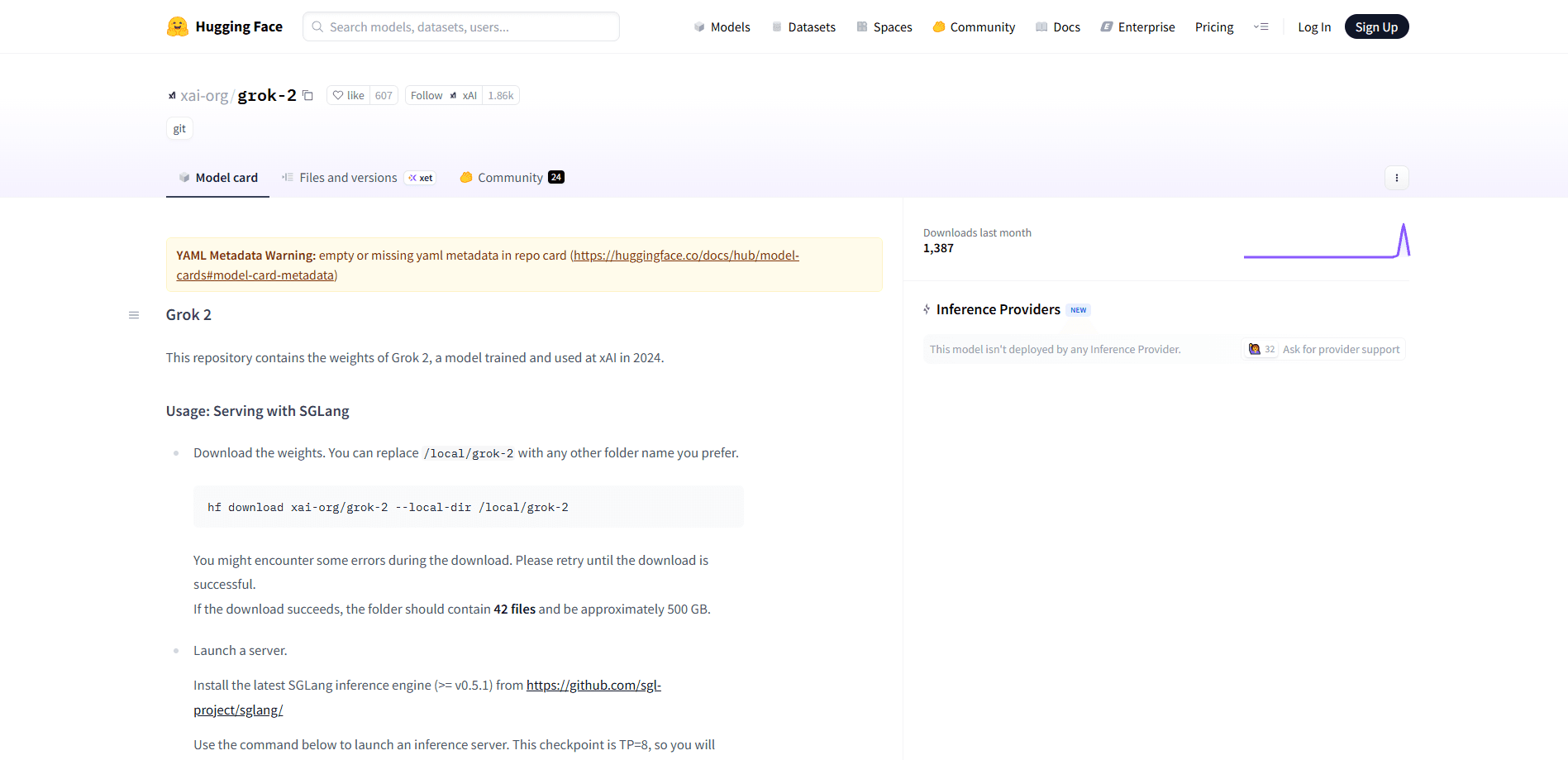
Grok 2.5 is the open-weight release of xAI's Grok 2 line, the chatbot model the company shipped in 2024 as its then-best offering. In August 2025 xAI put the trained weights on Hugging Face under the repo xai-org/grok-2, turning a model that once lived behind the X platform into something anyone can download and run. The name tracks with how xAI labels its checkpoints, and the "OSS Ver." tag is what marks this build as the openly published version rather than the hosted one.
The download is large. The repository runs to 42 files and roughly 500GB in BF16, and you need a multi-GPU machine to load it. That puts Grok 2.5 in the reach of studios, research groups and companies with their own servers, not someone running a laptop. The model itself is a mixture-of-experts design with a 128K context window, which is enough to work through a long document in a single pass.
The catch is the license. Grok 2.5 ships under the Grok 2 Community License, not Apache 2.0. You can use it for research and for limited commercial work, but the terms carry real restrictions, and anyone planning to build a product on top should read them before committing. The section below covers what those terms mean in practice.
Getting Started
- Install the SGLang inference engine, version 0.5.1 or newer, on a machine with the GPUs to hold the weights
- Download the model with a command like hf download xai-org/grok-2 --local-dir /local/grok-2, and retry if the transfer drops partway
- Launch the server with python3 -m sglang.launch_server, pointing it at the model folder, using tensor parallelism across 8 GPUs and FP8 quantization
- Send a request through the chat template the model expects, using the Human and Assistant markers the repo documents, and read the reply
Product Information
A quick look at Grok 2.5 (OSS Ver.)'s pricing, supported platforms, and performance.
Best for
The users, tasks, and scenarios where this tool fits best.
Users
- Research teams
- Machine learning engineers
- Companies with private data
- Startups on a budget
Tasks
- Local chat and drafting
- Long-document processing
- Model research and benchmarking
- Fine-tuning experiments
Scenarios
- Air-gapped work
- Reproducing published results
- Teaching and coursework
- Cost-sensitive prototyping
Key features
Open Weights You Can Download and Run
The point of this release is access. xAI published the trained Grok 2 checkpoint as downloadable weights, so you can run it on your own machines instead of calling a hosted endpoint. The repository holds 42 files and about 500GB, and you load it locally with an inference engine rather than through a web page. For teams that need the model in-house, that is the whole value.
Mixture-of-Experts Architecture
Grok 2.5 uses a mixture-of-experts design, where each layer holds multiple expert networks and only a couple activate per token. That keeps the compute per request lower than a dense model of the same total size, which matters when you are paying for GPUs by the hour. It is the same broad approach xAI used across the Grok line, and it is why the checkpoint can be large without being unusable.
128K Context Window
The model accepts a 128K token context, enough to hold a long document in a single conversation. You can drop in a lengthy report, a code file or a transcript and ask questions across all of it without chunking first. For work like document review or long-form drafting, that window removes a lot of the plumbing you would otherwise build around a smaller model.
Local Deployment with SGLang
xAI points users to SGLang as the way to serve the model, and the repo's steps are specific. You run tensor parallelism across 8 GPUs, each with more than 40GB of memory, and apply FP8 quantization to fit the weights. The instructions assume a Linux server with that hardware, so the model is aimed at people who already run inference infrastructure rather than first-time users.
Research-Friendly Release
Because the weights are public, you can benchmark the model, inspect how its experts route and fine-tune it on your own data. That is different from a hosted chatbot, where you only get text in and text out. The release gives researchers a checkpoint from a named lab to test against, which is useful when published benchmark numbers are hard to reproduce otherwise.
Fully Self-Hosted Privacy
Running Grok 2.5 yourself means prompts and outputs never leave your network. There is no external API call and no vendor seeing your traffic. For teams handling sensitive material, regulated data or internal code, that control is often the deciding factor between a hosted model and an open one, even when a hosted service would be cheaper.
Pros and cons
Pros
- Weights are public, so you can run the model on your own hardware with no per-token fees
- The 128K context window handles long documents without splitting them into chunks
- A mixture-of-experts design keeps per-request compute lower than a dense model of similar size
- Hosting it locally keeps prompts and outputs inside your own network
- xAI documents the SGLang setup, so the path to a running server is spelled out
Cons
- The download is about 500GB and needs 8 GPUs with more than 40GB each, which rules out most individual users
- It is a 2024-generation model, so it trails newer flagship models on reasoning and coding
- The Grok 2 Community License restricts commercial use and bars training other foundation models on its outputs
Frequently asked questions
Grok 2.5 is the open-weight release of xAI's Grok 2 chatbot model, a checkpoint from 2024 that xAI published with full weights in August 2025. You can download it, run it on your own hardware and use it under the Grok 2 Community License.
Related content
Explore related tools, skills, and articles for Grok 2.5 (OSS Ver.).
Grok 2.5 (OSS Ver.) Alternatives

Base Code
Base44 (Wix) · Coding · ProductivityBase Code is a shared cloud development environment from Base44. Teammates describe changes to an existing GitHub codebase in chat, preview them live and send them back as pull requests.

Google EmbeddingGemma 2
Google DeepMind · Writing · Image · CodingGoogle EmbeddingGemma 2 is a 740M-parameter open model that turns text, code, images, audio, and video frames into vectors in one 768-dimension space, running on phones and laptops.

GitGlow
GitGlow · Coding · ProductivityGitGlow is a local-first desktop Git client that lets independent developers review their own code and their AI agents' changes in one place before shipping.