
Grokipedia
xAI · Leaning · Business
Grokipedia is an AI-generated online encyclopedia built by xAI, Elon Musk's AI company, and launched in October 2025. It uses the Grok language model to draft, edit, and fact-check entries, and it presents itself as a leaner alternative to Wikipedia. The site is free to browse in a web browser, its entries run without images, and typical articles are short, text-heavy summaries with a handful of source links at the bottom. But can an AI really write an encyclopedia you can trust? That's the question worth keeping in mind as you read.
About Grokipedia
What Is Grokipedia
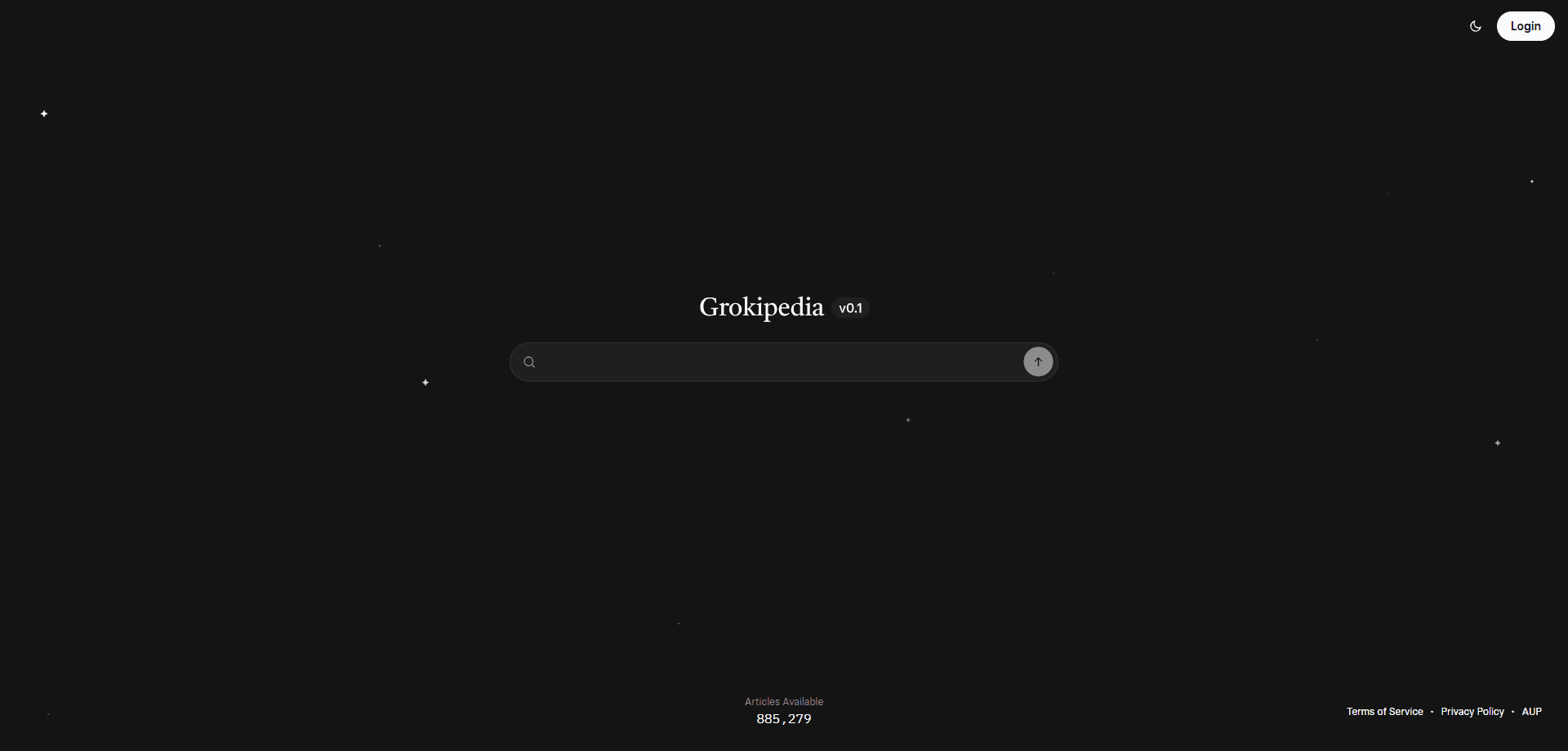
Grokipedia is xAI's attempt to rebuild a general-reference encyclopedia around a large language model instead of volunteer editors. Every article is written by Grok, reviewed by Grok, and stamped as fact-checked. There's no login wall and no paywall. You open the homepage, type a topic, and read the result.
The short version of Grokipedia how it works: the model writes, the model checks. No editorial board. No wiki markup. No talk pages.
The pitch is speed and coverage. Wikipedia has a fraction of its articles written by hand, and some entries sit unreviewed for years. Grokipedia claims to generate entries at machine speed across subjects as narrow as a single phone model or a niche historical figure. If you need a fast orientation on a topic and you're comfortable treating it as a starting point, the site delivers that in seconds.
The limitations matter as much as the promise. Grokipedia launched as a v0.1 product, and its early entries leaned heavily on Wikipedia itself, sometimes reproducing phrasing verbatim. Editing is effectively closed: some pages show an edit button that only reveals past changes, with no public way to submit a correction. Because the text comes from a language model, errors and fabricated details are a real risk, and the site doesn't always say when a page was last checked. Read it as a draft, not a settled reference.
Getting Started
- Open grokipedia.com in any modern browser. No account is required to read.
- Use the single search box on the homepage and type a person, place, event, or product.
- Read the generated entry, then scroll to the bottom to check the cited sources before you trust a claim.
- Cross-check anything consequential against Wikipedia, an official site, or a primary document.
- If a page shows an edit history, open it to see what changed. You can't submit corrections yourself yet.
Product Information
A quick look at Grokipedia's pricing, supported platforms, and performance.
Best for
The users, tasks, and scenarios where this tool fits best.
Users
- Curious readers
- Researchers doing early scoping
- Grok users
Tasks
- Getting a fast summary of a niche subject
- Comparing framing on contested topics
- Seeding a research outline
Scenarios
- Killing five minutes of curiosity
- Checking a claim someone posted
- Prepping background before a meeting
Key features
AI-written entries built on Grok
Every article on Grokipedia is generated by Grok, xAI's language model, rather than typed by a human editor. You search a topic and the page appears with a title, subheadings, and a body of text produced on demand. That's the core difference from Wikipedia, where a person writes and defends each sentence. If you want a topic covered at scale and instantly, this is the feature that makes it possible.
Claimed fact-checking by the model
Grokipedia marks entries as reviewed and fact-checked by Grok. In practice that means the same model that wrote the text is also asserting the text is correct, which is a circular setup worth understanding before you rely on it. It gives the page a confident tone, but confidence isn't the same as accuracy. Treat the stamp as a claim from xAI, not an independent audit.
A clean, image-free reading layout
Pages use a simple structure: a heading, subheadings, paragraphs, and citation links near the bottom. There are no photos, charts, or infoboxes crowding the page. The tradeoff is a fast load and easy scanning on a phone, but also a drier read than Wikipedia's illustrated entries. For text-first reference, it works.
Free access with no account
Reading Grokipedia costs nothing and needs no login. There's no subscription tier, no ad-heavy interstitial, and no usage cap for browsing that xAI has published. For a site meant to compete with a nonprofit, keeping the front door open is a deliberate move, and it's the reason casual readers can test it without commitment.
Instant coverage of narrow topics
Because entries are generated, Grokipedia can spin up pages on subjects too small for a volunteer encyclopedia to prioritize. That means a specific gadget, a local landmark, or a recent event may have an entry here before it has a polished Wikipedia page. The upside is breadth; the downside is that nobody has vouched for the details.
Source links at the bottom of each page
Entries pull together a short list of sources, often including Wikipedia itself, which the project's critics have pointed out is awkward for a site positioning against it. The links give you somewhere to go to check the text, even if the model's summary of those sources isn't guaranteed to match them. Use them as a starting trail, not proof.
Pros and cons
Pros
- Free to read with no account, signup, or subscription required.
- Fast, plain-language summaries for quick orientation on a topic.
- Covers narrow subjects that may not have a full Wikipedia entry yet.
- Clean, lightweight layout that loads quickly and scans well on mobile.
Cons
- Grok writes and fact-checks its own text, so the verification isn't independent, and errors or invented details can slip through.
- Public editing is effectively closed, which means you can't fix a mistake you spot.
- Early entries drew heavily on Wikipedia, sometimes word for word, undermining the claim of being a fresh alternative.
- The site offers no published API, so developers can't pull its content into their own tools.
Frequently asked questions
It's a reference site for looking up a topic and getting a short, AI-written summary fast. Think of it as a first stop for orientation, not a source you cite in serious work. Confirm anything that matters against a verified reference.
Related content
Explore related tools, skills, and articles for Grokipedia.
Grokipedia Alternatives

Kaggle AI
Google · Coding · LeaningKaggle AI is a community platform where people build, test, and compare machine learning models against shared data. It combines data science competitions, tens of thousands of public datasets, and free cloud notebooks with GPU and TPU access, so anyone with a browser can train a model without buying hardware. Google owns the platform, and joining costs nothing.

Bunch
Bunch AI · Leaning · BusinessBunch is an AI leadership coaching app that turns a few spare minutes a day into real management practice. It hands you one short, personalized tip each day, tracks how you respond, and lets you compare notes with peers inside private groups. The pitch is simple: you lead better by practicing a little, often, instead of sitting through a weekend seminar. Think of it as a leadership training app you actually open.

AI Mock Interview
SQLPad · Coding · LeaningAI Mock Interview is a practice tool built into SQLPad that simulates real job interviews and gives you instant feedback on both what you say and how you say it. You pick a role template or upload a job description, answer questions out loud in real time, and then review a transcript with notes on structure, clarity, and grammar. It's aimed at data professionals prepping for SQL, Python, data engineering, machine learning, and system design roles, and it works entirely in the browser. No install needed.