

GroupBy
GroupBy Inc. (a Rezolve Ai company) · Coding · Productivity · Business
GroupBy is an enterprise ecommerce product discovery platform built on Google Cloud Vertex AI Search for Commerce, with merchandising, recommendations and catalog enrichment in one console.
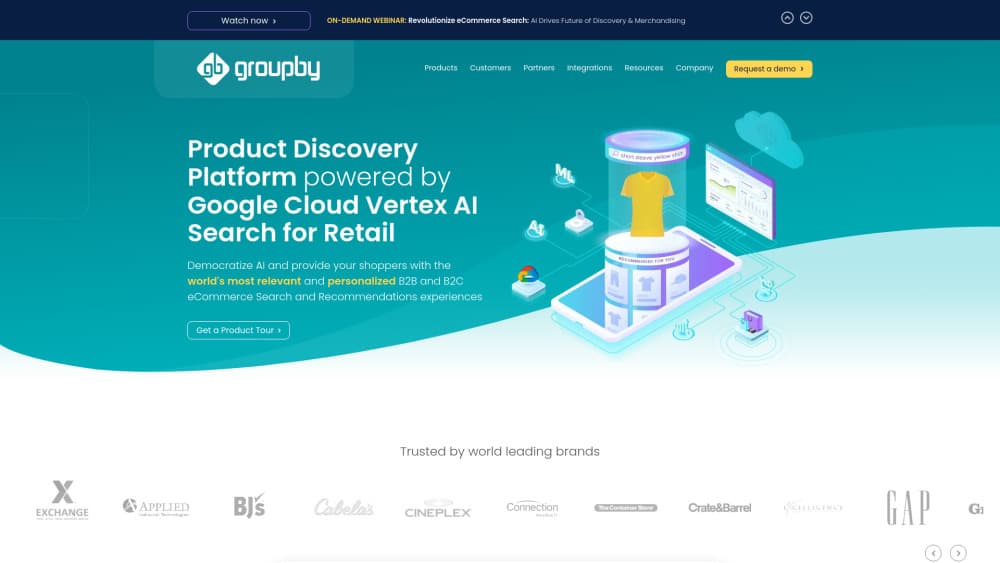
About GroupBy
What Is GroupBy
GroupBy is site search software for stores with large, messy catalogs. Retailers, wholesalers, distributors and parts sellers use it to decide what a shopper sees after typing three words into a search box, and to keep that decision under business control instead of buried in code. The company started in Toronto in 2013 with a team out of Endeca, the search vendor Oracle bought in 2011, and it has sold to B2B and B2C merchants ever since.
The product is really three layers stacked together. Search and recommendations run on Google Cloud Vertex AI Search for Commerce, so ranking and personalization come from models trained on Google's own commerce traffic. Underneath that sits product data enrichment, a service that classifies, attributes and curates your catalog so the models have something clean to work with. On top is the merchandising layer, where category managers pin products, boost by margin and build campaigns without filing a ticket.
In March 2025 the company became part of Rezolve Ai (NASDAQ: RZLV), which bought it in an all-equity deal with a $55 million enterprise value and reported that the platform supported more than $30 billion in annual sales. Practically, you still buy GroupBy as GroupBy, with Rezolve's conversational commerce tools sitting alongside it on the roadmap.
The limits follow from who it's built for. There's no self-serve signup, no published price list and no free plan. Implementation runs as a project, and the catalog work that makes search good lands on your team or on a paid services engagement. A store with 400 SKUs gets nothing from this.
Getting Started
- Book a demo and scope the job: search only, or search plus enrichment, recommendations, fitment and analytics.
- Connect the catalog through the ETL layer, whether it comes from a commerce platform, an ERP or a nightly feed.
- Run the enrichment pass so every product carries consistent attributes and sits in a shared taxonomy.
- Configure ranking, synonyms, filters and campaigns in the Command Center, then connect the storefront through the Shopify app, the Salesforce connector or the APIs.
- Launch, watch the search analytics for zero-result and low-click queries, and tune from there. GroupBy puts typical go-lives in weeks rather than quarters.
Product Information
A quick look at GroupBy's pricing, supported platforms, and performance.
Best for
The users, tasks, and scenarios where this tool fits best.
Users
- Ecommerce and category managers at mid-market and enterprise retailers
- B2B distributors and wholesalers
- Auto parts, powersports and equipment sellers
- Digital and ecommerce leads inheriting a legacy search box
Tasks
- Swap out a storefront's native search
- Cleaning up a catalog before it hurts revenue
- Adding personalized recommendations
- Tracking down broken search demand
Scenarios
- A B2B catalog where the same part has six names across suppliers
- Peak season with a small merchandising team
- A replatform or a move to composable commerce
Key features
Site Search on Google's Commerce Models
Queries are parsed and ranked by Google Cloud Vertex AI Search for Commerce, the same stack behind Google's retail search products. GroupBy wraps it in the controls a merchant needs: synonyms, redirects, filters, boost and bury rules, and a preview mode for testing a change before shoppers see it. The pitch is that AI search for ecommerce stops being a black box. A merchant can explain why a product ranks third.
AI Recommendations and Personalized Relevance
The product recommendations engine fills home page, product detail and cart slots with items picked from browsing and purchase signals rather than a static list. GroupBy's Personalized Relevance layer blends that with merchandising intent, so a promotion can outrank a predicted bestseller when you need it to. Swanson reported search click-through up more than 50% and search add-to-cart up more than 65% within a year of switching.
Product Data Enrichment
Most bad search results are a data problem in disguise. GroupBy's enrichment service runs the catalog through a three-step pass it calls classify, attribute and curate: products get sorted into a global taxonomy; empty attributes get filled in, and the results get reviewed. Cleaner attributes mean better filters and fewer products that exist in the system but never appear in a result set.
Merchandising Command Center
This is the part that separates GroupBy from a search API. Category managers can pin a product to position one for a campaign, boost a house brand, schedule a rule set for a holiday window, and preview the outcome, all without a developer. Rules are versioned and reversible, which matters when a bad boost rule runs over a weekend.
Fitment AI for Parts and Equipment Catalogs
Fitment AI adds a year, make, model selector that filters the catalog to parts that fit the shopper's vehicle, and it applies at every touchpoint rather than only on the search results page. For auto parts and powersports sellers this removes the returns that come from a shopper guessing, and it's the feature most B2B ecommerce search vendors skip entirely.
Analytics and Reporting
Dashboards cover what shoppers searched, what they clicked, what came back empty and how each campaign performed against revenue targets. GroupBy also links in-store behavior to an online profile for merchants with physical locations, which is unusual and useful for omnichannel teams. The reports are aimed at merchandisers, not analysts, so the numbers arrive without a query language in the way.
Pros and cons
Pros
- Ranking comes from Google's commerce models while control stays with your merchandising team, a combination most rivals only half deliver.
- Enrichment fixes the catalog instead of re-ranking broken data, which pays off on large B2B assortments.
- Fitment search covers parts and equipment catalogs that consumer-first search tools ignore.
- Prebuilt Shopify and Salesforce connectors plus REST APIs shorten the integration, and go-lives are quoted in weeks.
- Rezolve Ai ownership adds conversational commerce and checkout to the same account team.
Cons
- No published pricing, no free plan and no self-serve signup, so any budget conversation starts with a sales cycle.
- Enrichment and taxonomy work is real labor, and it has to happen before launch or the search quality story never materializes.
- The AI layer is Google's, so capability and cost track a platform you don't control.
- The setup effort only pays back on big catalogs, which leaves smaller stores paying for complexity they can't use.
Frequently asked questions
GroupBy handles search, recommendations, merchandising, plus analytics for ecommerce stores, mostly large B2B and B2C catalogs. Merchants use it to replace a weak native search box, clean up product data and give category managers direct control over what ranks where.
Related content
Explore related tools, skills, and articles for GroupBy.
GroupBy Alternatives

Base Code
Base44 (Wix) · Coding · ProductivityBase Code is a shared cloud development environment from Base44. Teammates describe changes to an existing GitHub codebase in chat, preview them live and send them back as pull requests.

Google EmbeddingGemma 2
Google DeepMind · Writing · Image · CodingGoogle EmbeddingGemma 2 is a 740M-parameter open model that turns text, code, images, audio, and video frames into vectors in one 768-dimension space, running on phones and laptops.

GitGlow
GitGlow · Coding · ProductivityGitGlow is a local-first desktop Git client that lets independent developers review their own code and their AI agents' changes in one place before shipping.