
Hamming
Hamming AI · Marketing · Other · Chatbot · Prompts
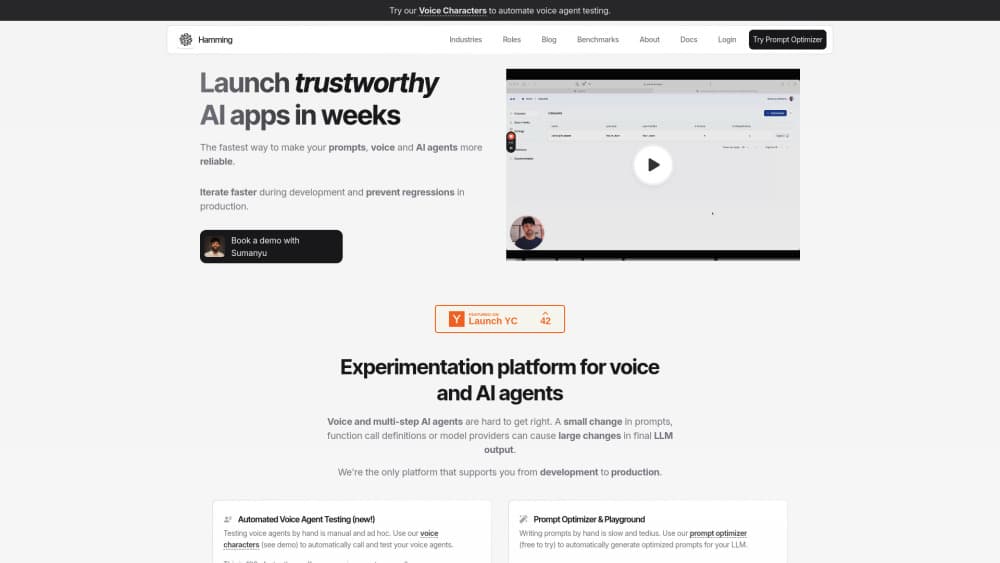
Hamming is a testing and monitoring platform for AI voice and chat agents. It runs simulated calls, red-team probes, and live call analytics so teams catch failures before customers do.
About Hamming
What Is Hamming
Hamming is a QA platform for teams that ship AI voice agents and chat agents. One system covers three jobs: conversational AI testing before launch, adversarial red teaming, and monitoring of every production call. The company came out of Y Combinator's Summer 2024 batch and now works with banks, health tech companies, and call-heavy startups.
The problem it targets is narrow and real. A voice agent can sound fluent in a demo and still confirm a booking it never made, lose the thread when a caller talks over it, or read back patient details to whoever asks. Manual test calls catch a few of those failures. They can't cover thousands of accent, noise, and interruption combinations, and nobody can listen to every live call.
Two limits matter before you sign up. Hamming doesn't build agents or supply voice models, so it only evaluates what you already run. Public pricing doesn't exist yet, which means a sales conversation comes before any cost estimate. Setup work, such as importing agents and wiring tests into your build pipeline, sits with your own engineers.
Getting Started
- Request a demo and get workspace access for your team.
- Connect the agent you want to test, either through its provider or through the Hamming API.
- Generate a scenario suite from your system prompt, then run the first test batch and read the scored report.
- Turn failed scenarios into permanent regression tests, and route live call data into monitoring.
Product Information
A quick look at Hamming's pricing, supported platforms, and performance.
Best for
The users, tasks, and scenarios where this tool fits best.
Users
- Voice AI engineering teams
- QA and release managers
- Compliance and risk leads in regulated sectors
- Founders at early-stage voice startups
Tasks
- Regression testing before a release
- Red teaming for prompt injection and PII leakage
- Auditing live calls for broken promises
- Comparing agent versions or vendors
Scenarios
- Hardening a booking agent before launch
- Healthcare intake lines
- High-volume support numbers
Key features
Simulated Call Testing at Scale
Hamming places real test calls to your agent, with accents, background noise, DTMF keypad input, and IVR trees in the mix. The platform reports handling 50,000 or more concurrent test calls, so a full suite finishes in the time a manual run would take to schedule. Results come back as pass or fail per scenario, with a transcript and audio you can replay.
Scenarios Generated From Your Prompt
You paste the agent's system prompt and Hamming drafts test scenarios from it, covering the happy path, edge cases, and the questions your agent should refuse. Editing and adding scenarios is manual, which is the point: the generated set is a starting draft, not a black box. Teams that already keep a test list can import it and skip generation.
Scoring With 50+ Built-In Metrics
Each call is scored on more than fifty metrics, including task completion, factual accuracy, latency, and tone. Hamming reports 95 to 96 percent agreement with human evaluators, which matters when you want to trust AI voice agent evaluation scores without listening to every recording. You can also define custom checks for rules specific to your business, such as whether the agent quoted the right refund window.
Red Teaming for Prompt Injection and PII Leaks
The adversarial suite is built from attack patterns seen across many production deployments, and it ships ready to run. Probes cover prompt injection, jailbreaks, PII leakage, policy violations, and social engineering scripts such as a caller claiming to be from the clinic. Every finding becomes a reproducible failing test, so a fixed hole stays fixed.
Production Monitoring With Human Alerts
Live traffic gets watched around the clock for drift, unverified bookings, and compliance risk. Alerts can page a person before a customer notices, which is the difference between a caught bug and a support ticket. Native OpenTelemetry support means the same traces feed the observability stack your team already uses.
Failures That Turn Into Regression Tests
A production failure can become a permanent test in one click. From then on, every release reruns it. That loop is the core of the product: the test suite grows out of real incidents rather than a planning meeting, and coverage improves without anyone writing new scenarios by hand.
Pros and cons
Pros
- Covers pre-launch voice agent testing, red teaming, and production monitoring in one platform, so you avoid stitching three vendors together.
- Scenario generation from your prompt cuts the blank-page problem and gets a first test report out in about ten minutes.
- 65+ languages and accents in the test pool, which suits teams serving multilingual callers.
- OpenTelemetry and CI/CD integration keep voice AI QA inside the pipeline your engineers already run.
- SOC 2 Type II and HIPAA-aligned workflows with a BAA make it usable for healthcare and financial agents.
Cons
- No published pricing and no self-serve signup, so evaluation starts with a sales call and a demo.
- The platform evaluates agents rather than building them, which means a second tool if you also need to create or host the agent.
- Generated scenarios still need human review, and a weak system prompt produces weak tests.
- Smaller teams without a dedicated QA function may find the metric list and red-team reports more than they can act on.
Frequently asked questions
Hamming tests AI voice and chat agents before launch, attacks them with adversarial prompts, and monitors live calls afterward. The output is a pass or fail report per scenario, plus alerts when a production call goes wrong.
Related content
Explore related tools, skills, and articles for Hamming.
Hamming Alternatives

ngram 2.0
ngram · Video · Marketingngram 2.0 is an AI video generator for teams. It turns a prompt, a screen recording, or a product URL into a narrated explainer, product demo, or AI avatar video, and every scene stays editable.

shippedit.me
Krawlup · Marketing · Businessshippedit.me now redirects to Krawlup, a web platform that audits SEO, AEO and page speed every week, then hands the fixes to AI coding agents over MCP.

MePersona
MePersona, Inc. · Writing · Productivity · MarketingMePersona is an AI unified inbox for creators. It learns your voice, drafts replies to fan messages from 12 platforms, and sends only what you approve.