

cloudfactory.com
CloudFactory (Hasty GmbH) · Coding
Hasty is CloudFactory's vision AI tool for image and video annotation. AI-assisted labeling, automated quality checks, and no-code training help teams reach a working vision model faster.
About cloudfactory.com
What Is Hasty
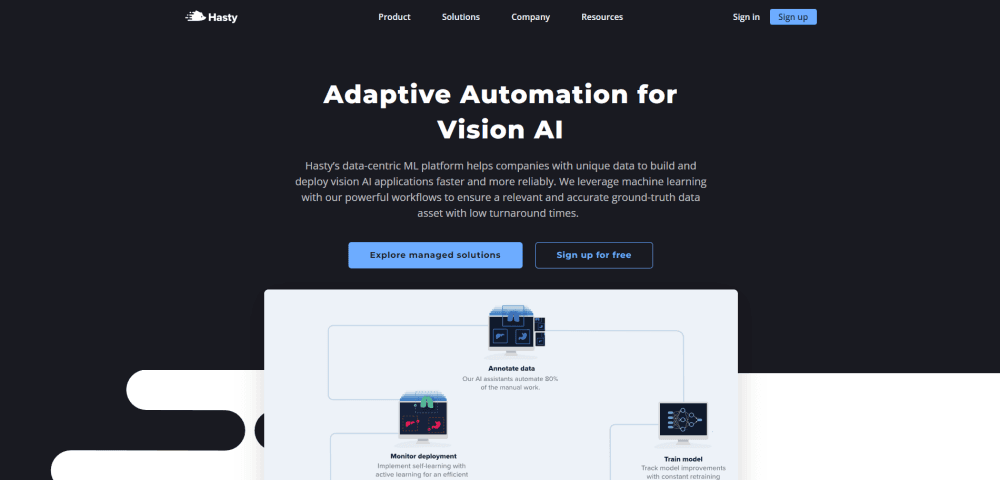
Hasty is an image and video annotation platform built for computer vision work. It started in Berlin in 2018 as a standalone labeling tool, and CloudFactory acquired it in 2022. Today it runs as the vision AI layer inside CloudFactory's AI data platform, so the same workspace can handle software-assisted labeling and, when you need it, a managed team of annotators.
The pitch is simple. Labeling is the slowest part of most vision projects, and Hasty tries to shrink it. Its assistants learn from the annotations your team makes, then pre-label the next batch. Each completed project trains its own model, which means the tool gets more useful the longer a team stays on one dataset.
The limits matter too. The AI assistants don't work on an empty project. You need to annotate around ten images fully, or create 25 classifications, before the first model has enough signal to help. Pricing is quote based and aimed at organizations with a real budget, so a solo developer testing an idea will find lighter options cheaper.
Getting Started
- Go to app.hasty.ai and sign up with an email address or a Google account.
- Create a project and choose the task type, such as object detection, classification, or semantic segmentation.
- Upload images or video frames and label the first small batch by hand to give the system training data.
- Wait for the project model to train, then accept or correct the AI suggestions on the remaining images.
- Review flagged items, export the dataset, and train or deploy a model from the Model Playground.
Product Information
A quick look at cloudfactory.com's pricing, supported platforms, and performance.
Best for
The users, tasks, and scenarios where this tool fits best.
Users
- ML engineers and data scientists
- Annotation team leads
- Product teams without in-house ML staff
Tasks
- Building a ground-truth dataset for object detection
- Auditing an existing dataset
- Prototyping a vision model
Scenarios
- Piloting a computer vision use case
- Scaling labeling past in-house capacity
- Regulated industries
Key features
AI-Assisted Annotation
Hasty's assistants learn from the labels your team produces and then predict the next ones. For object detection and segmentation, that means a click can place a full polygon instead of a dozen manual points. The catch is the cold start: the first model needs roughly ten fully annotated images, or 25 classifications, before it activates.
Model Playground
The Model Playground trains and compares models without code. A team can try a detector, look at the metrics, adjust the dataset, and retrain in the same session. It's useful for answering a narrow question early: is this dataset good enough to build on?
Automated Quality Control
Consensus scoring compares annotations from different sources and flags the ones that disagree. Instead of spot-checking a sample by eye, reviewers get a ranked list of suspicious labels. The practical effect is less time spent on clean images and more on the ones that actually need a decision.
Seven Computer Vision Task Types
One workspace covers classification, tagging, object detection, instance segmentation, semantic segmentation, panoptic segmentation, and attribute prediction. Teams that move between task types don't have to migrate data to a second tool, which matters when a project starts as detection and later needs pixel-level masks.
Managed Annotation Workforce
Because Hasty sits inside CloudFactory, a project can hand off part of the queue to trained annotators. You keep the same project, guidelines, and quality rules. This is the main difference from standalone labeling tools, and it's the reason the pricing conversation usually starts with a scoped statement of work.
Security and Compliance
CloudFactory holds ISO 9001:2015, ISO 27001, SOC 2, HIPAA, and GDPR certifications. For teams in healthcare or automotive, those documents often decide whether a vendor can be used at all, regardless of how good the labeling tool is.
Pros and cons
Pros
- AI assistants cut repetitive labeling work after a short seeding period.
- Consensus scoring turns quality control into a review list rather than a manual sampling exercise.
- Seven task types in one workspace, so a project can grow from detection to segmentation without a migration.
- Direct access to CloudFactory's managed annotators when internal capacity runs out.
- Compliance coverage that meets the procurement requirements of regulated industries.
Cons
- No public price list. Budgeting requires a sales conversation and a scoped quote.
- The AI features stay dormant until a project has enough manual annotations, which slows the first day of work.
- The standalone Hasty product is gone. Documentation and support now assume the wider CloudFactory platform, so older tutorials can feel out of date.
- Smaller teams may find the enterprise model and contract terms heavier than they need.
Frequently asked questions
Hasty is used to build training datasets for computer vision. Teams upload images or video, label objects and regions, run quality checks, and train a model inside the same workspace.
Related content
Explore related tools, skills, and articles for cloudfactory.com.
cloudfactory.com Alternatives

Base Code
Base44 (Wix) · Coding · ProductivityBase Code is a shared cloud development environment from Base44. Teammates describe changes to an existing GitHub codebase in chat, preview them live and send them back as pull requests.

Google EmbeddingGemma 2
Google DeepMind · Writing · Image · CodingGoogle EmbeddingGemma 2 is a 740M-parameter open model that turns text, code, images, audio, and video frames into vectors in one 768-dimension space, running on phones and laptops.

GitGlow
GitGlow · Coding · ProductivityGitGlow is a local-first desktop Git client that lets independent developers review their own code and their AI agents' changes in one place before shipping.