
Hierarchical Reasoning Model
Sapient Intelligence · Business · Other
The Hierarchical Reasoning Model (HRM) is a brain-inspired AI architecture from Sapient Intelligence. It reasons in a single pass without a chain of thought and solves hard puzzles with just 27 million parameters.
About Hierarchical Reasoning Model
What Is Hierarchical Reasoning Model
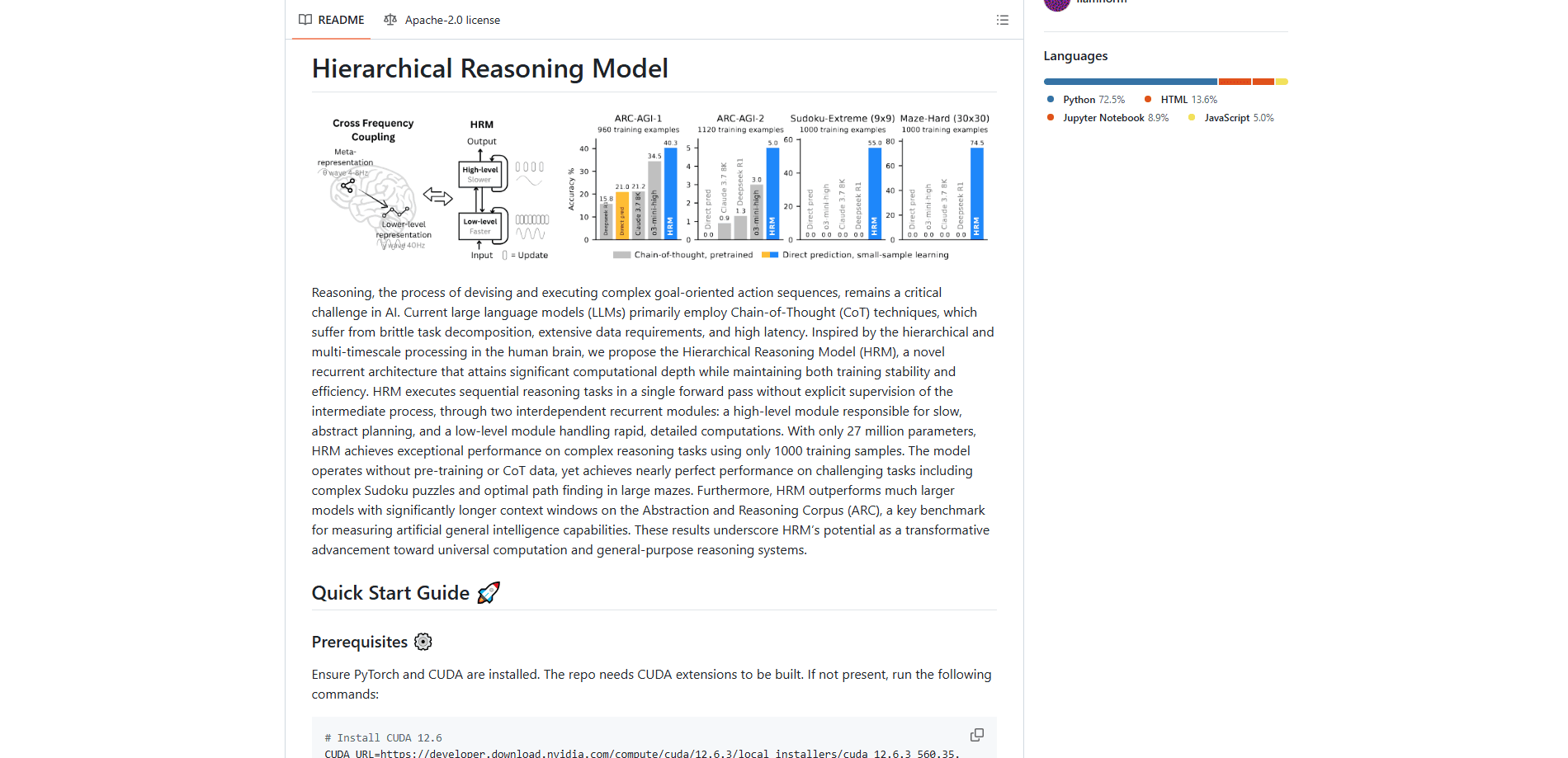
The Hierarchical Reasoning Model is a recurrent neural network architecture that Sapient Intelligence introduced in June 2025. It takes its cues from how the human brain splits work across regions that run at different speeds. A high-level module handles slow, abstract planning and a low-level module handles fast, detailed computation. The two pass control back and forth until the model settles on an answer.
The problem it targets is the weak spot in current large language models. Most of them lean on chain-of-thought (CoT) prompting, which writes every reasoning step out as text. That approach breaks when one step in the chain goes wrong, needs huge amounts of labeled data, and runs slowly because the model generates so many words. HRM skips the written steps entirely. It reasons inside a latent space and returns an answer in a single forward pass.
The catch is scope. HRM is not a general assistant you can chat with. It trains from scratch on one type of task and then solves that task well, so a model tuned for Sudoku plays Sudoku and little else. Sapient has since extended the architecture toward text with HRM-Text, a roughly 1B-parameter generation model, but the original release is a narrow reasoning engine rather than a drop-in replacement for a chatbot.
Getting Started
- Visit the Sapient Intelligence site or the sapientinc/HRM repository on GitHub to read the paper and architecture notes
- Clone the repository and install the Python dependencies listed in requirements.txt
- Prepare a task dataset in the expected input-output format, such as Sudoku puzzles or maze grids
- Run pretrain.py to train the model from scratch, then evaluate.py or the ARC notebook to measure results
Product Information
A quick look at Hierarchical Reasoning Model's pricing, supported platforms, and performance.
Best for
The users, tasks, and scenarios where this tool fits best.
Users
- AI researchers
- Machine learning engineers
- Graduate students and academics
- Puzzle and benchmark hobbyists
Tasks
- Solving constraint puzzles
- Research on reasoning depth
- Studying latent-space reasoning
- Benchmarking against CoT models
- Reproducing published results
Scenarios
- A lab with a small GPU budget
- Comparing architecture ideas
- Teaching a course module on reasoning models
- Early-stage research sprints
- ARC-AGI experiments
Key features
Brain-Inspired Hierarchical Architecture
As a recursive reasoning model, HRM splits its work across two coupled recurrent modules. The high-level module plans slowly and sets direction; the low-level module computes fast and fills in detail. This mirrors the multi-timescale processing in the human cortex, where higher regions integrate information over longer periods and lower regions react in the moment. The design lets the model build real computational depth without stacking dozens of Transformer layers.
Single-Pass Reasoning Without Chain of Thought
The model reaches an answer in one forward pass, and nothing supervises the steps in between. There is no chain-of-thought text and no step-by-step prompt. The paper's claim is that language is a tool for communication, not the substrate of thought, so HRM reasons in a latent space and only emits the final result. That cuts the latency and data cost that trip up CoT models.
Extreme Parameter and Data Efficiency
The 27M parameter model trains on roughly 1,000 samples, and it needs no labeled reasoning traces to get there. It needs no pretraining and no CoT data, so a lab can train it from scratch. According to Sapient Intelligence, those numbers still produce near-perfect scores on hard Sudoku and large-maze pathfinding, tasks where chain-of-thought models score zero. For a research setup, the small footprint is the headline.
Adaptive Computation at Inference Time
HRM decides how much thinking a problem needs. The high-level module updates, lets the low-level module converge, and repeats, and a learned halting signal decides when to stop. Easy puzzles take fewer cycles and hard ones take more, so compute scales with difficulty instead of running a fixed number of steps. That inference-time scaling is what lets a tiny model go deep on a problem.
Strong ARC-AGI Benchmark Results
The Abstraction and Reasoning Corpus (ARC-AGI) is a benchmark built to test general reasoning rather than memorized knowledge. According to the authors, HRM beat much larger models with longer context windows on ARC-AGI-1, including o3-mini-high and Claude 3.7, while starting from random weights and skipping chain-of-thought entirely. The ARC Prize team later re-ran it on a hidden set and reproduced a score in the low 30s percent, still strong for a model this small but below the original figure.
Open Code and Reproducible Weights
Sapient Intelligence released the code and weights on GitHub, so anyone can rerun the experiments. The repository covers training, evaluation, a puzzle dataset and an ARC notebook, and it picked up thousands of stars and a busy discussion thread within weeks. Open release matters here because the results were unusual enough that other researchers wanted to check them independently.
Extensions Toward a General Model
The same architecture now underlies HRM-Text, a text generation model of roughly 1B parameters that Sapient trained from scratch without post-training or RLHF. Reports put its scores at 56.2 on MATH, 84.5 on GSM8K, 81.9 on ARC-Challenge and 82.2 on DROP, trained for under two days on 16 H100s. It is a separate release from the original HRM, but it shows where the architecture is heading.
Pros and cons
Pros
- Reaches deep reasoning with about 27 million parameters, so it runs on modest hardware
- Trains from scratch on roughly 1,000 samples, which keeps data and compute costs low
- Reasons in a single forward pass with no chain-of-thought text, cutting latency
- Open code and weights let researchers reproduce and audit the published results
- Adaptive compute lets the model spend more cycles on harder problems without retraining
Cons
- It is a narrow solver, not a general chatbot, so it needs a fresh training run for each new task type
- The headline ARC-AGI numbers came under scrutiny, and the independent re-run landed lower than the paper reported
- Most of the public material is written for a research audience, which puts it out of reach for non-technical users
- There is no hosted API or ready-made app, so you need to set up training and evaluation yourself
Frequently asked questions
The Hierarchical Reasoning Model (HRM) is a brain-inspired neural network architecture from Sapient Intelligence. It uses two coupled recurrent modules, one for slow abstract planning and one for fast detailed computation, to reason through hard problems in a single forward pass without any chain-of-thought steps.
Related content
Explore related tools, skills, and articles for Hierarchical Reasoning Model.
Hierarchical Reasoning Model Alternatives

Knocket
Knocket (Tencent RTC team) · Productivity · Business · ChatbotKnocket is a free live chat and contact page tool that lets visitors message you from your website, app, or a shareable link, with every reply handled from Telegram or one inbox.

shippedit.me
Krawlup · Marketing · Businessshippedit.me now redirects to Krawlup, a web platform that audits SEO, AEO and page speed every week, then hands the fixes to AI coding agents over MCP.

Ayven
Alknoma · Productivity · BusinessAyven is an AI control centre by Alknoma that turns a plain-language goal into a dated plan, hands the work to your people and AI agents, and asks for your approval only when the call is yours.