

Hirebase
Hirebase · Coding · Business
Hirebase is a job data API indexing 4.6M+ live roles from 230,000 company career pages, with search, resume matching, salary benchmarks and hiring trends for builders and analysts.
About Hirebase
What Is Hirebase
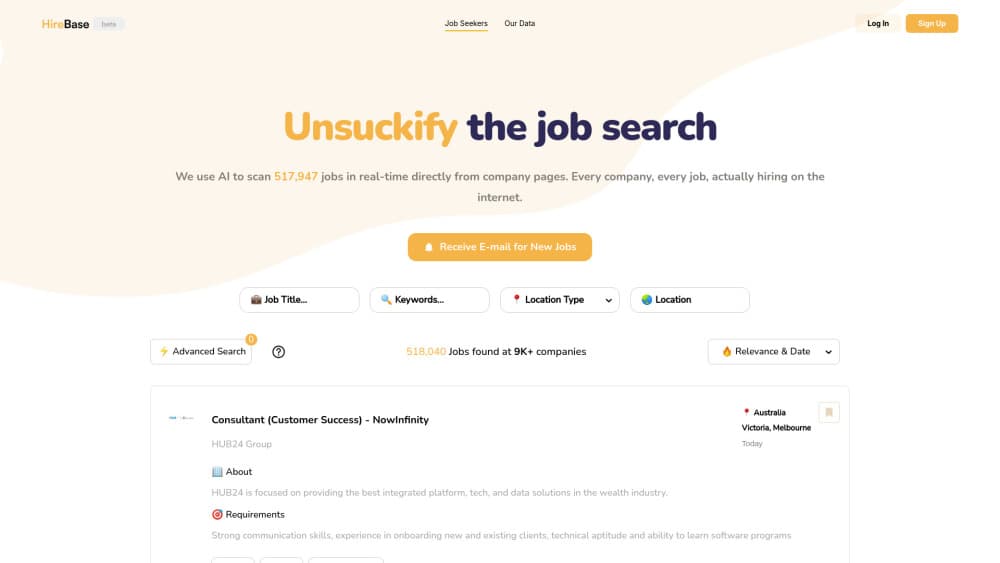
Hirebase is a job data platform, not a job board. It pulls listings straight from company career pages and 80+ applicant tracking systems, then normalizes them into one schema you can query. The index covers more than 4.6 million open roles at 230,000 companies across 140+ countries.
The problem it solves is duplication and decay. Aggregators pass listings between each other, so one role shows up five times and stays live weeks after it closed. Hirebase re-scans career pages hourly and drops listings that disappear, which keeps ghost jobs out of your results. That difference matters whether you run a job board, a recruiting desk or an investment model.
You reach the job market data through an API first. A web interface covers search and export, a Python SDK handles the heavy lifting, and connectors for n8n, Make and Clay let you skip code entirely. Billing counts returned results rather than seats, so a search that returns 100 jobs spends 100 from your monthly allowance.
Getting Started
- Sign up at app.hirebase.org and copy the API key from the dashboard.
- Install the client with
pip install hirebase, or point any HTTP client at the REST endpoints. - Run a first query with filters such as job titles, locations and posted date, and keep the limit low while you test.
- Wire the fields you need, like salary, skills and visa sponsorship, into your product, spreadsheet or automation.
Product Information
A quick look at Hirebase's pricing, supported platforms, and performance.
Best for
The users, tasks, and scenarios where this tool fits best.
Users
- Developers building job boards or AI matching tools
- Recruiters and staffing firms
- Market analysts and researchers
Tasks
- Populating a niche job board
- Matching candidates to open roles
- Benchmarking pay for a role
- Spotting companies that are scaling
Scenarios
- Launching a job search product in a few weeks
- Weekly prospecting for a sales team
- Compensation reviews inside HR
Key features
Structured Job Search API
Every listing arrives with 50+ fields: title, application link, posted date, salary range with currency and period, extracted skills, visa sponsorship and geocoded location. The job search API filters on any of them and returns up to 100 results per page in under 200ms. Most teams would spend months building this layer themselves.
Semantic Search by Meaning
Vector search takes a phrase or a resume and ranks matches by intent rather than exact keywords. Ask for a machine learning role at a healthcare startup and you get listings a keyword filter would miss. Hirebase runs its own embedding model, so you can offer meaning based search without standing up an ML stack.
Resume Matching
Send a resume and get back ranked jobs with fit scores. The document becomes a vector and gets compared against the live index. For a recruiting platform, that's a matching feature you can ship without hiring a data science team.
Salary Benchmarking
Salary benchmarking here runs on posted pay bands, not survey panels. Give Hirebase a title, a location and years of experience, and it returns percentiles and histograms built from live and expired postings. HR teams can carry the band straight into a compensation conversation.
Hiring Manager Contacts
An AI agent reads company structure, team makeup and seniority signals to find the person behind an open role, then returns verified email and LinkedIn details. It runs pay as you go at $0.30 per lookup, so you don't need a subscription to test it.
Hiring Trends and Historical Data
The Trends API aggregates hiring velocity, salary movement and sector growth without exposing individual listings. The archive holds roughly 29 million expired records going back to 2023. You can search that history for free on any plan and buy matching records when you need the full set.
Pros and cons
Pros
- The free tier covers 500 jobs and 50 companies a month with no card, which is enough to test a real integration.
- Listings refresh hourly and closed roles drop out, so you spend less time scrubbing ghost jobs from your job board.
- One schema spans jobs, companies, salaries and trends, which cuts the number of vendors a data team has to manage.
- Historical export is self serve and priced per record, so a one-off research pull doesn't turn into a sales call.
- Python SDK, REST docs and n8n, Make and Clay connectors cover code and no-code workflows alike.
Cons
- Billing counts every returned result, so broad exploratory searches burn quota fast unless you set a small limit.
- Python is the only first party SDK listed. Teams on Node, PHP or Go work through REST and maintain their own client.
- Historical exports are billed per record on top of the subscription, with a $0.50 minimum, so large pulls add up.
- Coverage depends on public career pages and ATS feeds. Roles that only move through referrals or agency inboxes won't show up.
Frequently asked questions
Hirebase supplies job market data through an API. Teams use it to build job boards, feed recruiting pipelines, score candidates against open roles, benchmark pay and track hiring trends by company.
Related content
Explore related tools, skills, and articles for Hirebase.
Hirebase Alternatives

Base Code
Base44 (Wix) · Coding · ProductivityBase Code is a shared cloud development environment from Base44. Teammates describe changes to an existing GitHub codebase in chat, preview them live and send them back as pull requests.

Google EmbeddingGemma 2
Google DeepMind · Writing · Image · CodingGoogle EmbeddingGemma 2 is a 740M-parameter open model that turns text, code, images, audio, and video frames into vectors in one 768-dimension space, running on phones and laptops.

GitGlow
GitGlow · Coding · ProductivityGitGlow is a local-first desktop Git client that lets independent developers review their own code and their AI agents' changes in one place before shipping.