

HKGPT
HKGPT · Other
HKGPT is a Hong Kong AI platform that bundles multi-model chat, fine-tuned roleplay bots and image generation in one web app, with Cantonese-aware replies built for local users.
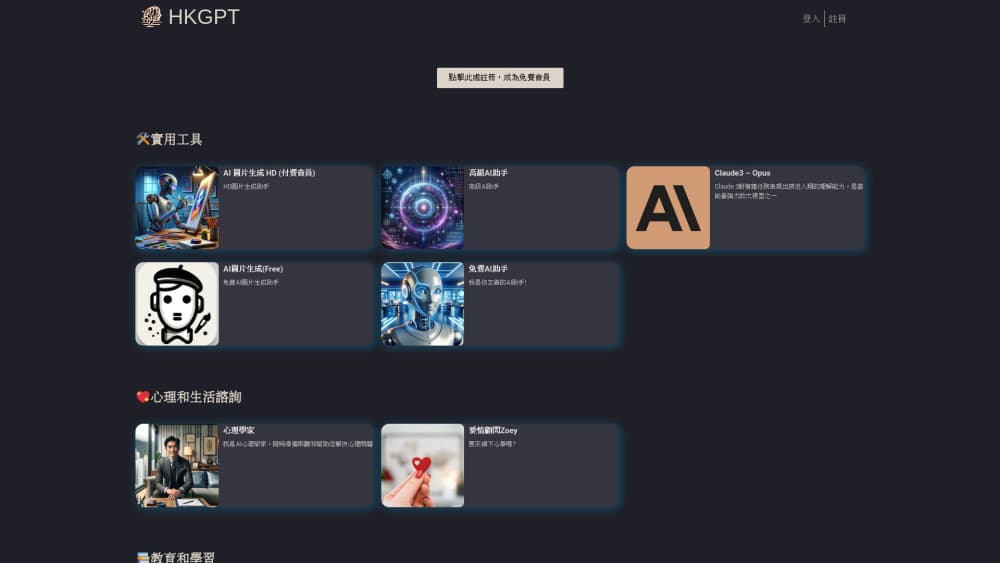
About HKGPT
What Is HKGPT
HKGPT is a Hong Kong AI chatbot platform that runs in a browser. It pulls answers from several large language models, including systems from OpenAI, Anthropic and Mistral, and picks one based on the task at hand. You get a chat window, a library of pre-built bots and an image generator in the same account.
What separates it from opening ChatGPT directly is the tuning. Each bot on the platform goes through embedding and fine-tuning for a narrow job or personality, so a Cantonese copywriting bot and a roleplay character behave in noticeably different ways. The team also tunes the models for Hong Kong slang and local references, which matters if you write the way people actually speak in the city.
The tradeoff is scope and stability. HKGPT sits on top of third-party models, so it can only be as good as the models underneath and can change when they do. Right now the platform is between versions: the team has paused AI chat while it rebuilds the underlying system, and it says a new version will return. Everything below describes what the product does when it is live, plus what to expect if you land on the site during the rebuild.
Getting Started
- Open hkgpt.io and register with an email address or a social login. You can start as a free member without entering payment details.
- Pick a bot from the library, or open a blank chat if you want a general assistant rather than a tuned personality.
- Type your prompt in Chinese, English or a mix of both. For images, describe the scene in plain language and name the style you want.
- Save the conversations worth keeping, then upgrade through the subscription page if you need more usage than the free tier allows.
Product Information
A quick look at HKGPT's pricing, supported platforms, and performance.
Best for
The users, tasks, and scenarios where this tool fits best.
Users
- Hong Kong writers and marketers
- Casual users who want one login for several AI jobs
- Non-technical users
Tasks
- Drafting social posts, product copy and follow-up emails in Chinese or English
- Character-based practice and storytelling
- Quick image concepts
Scenarios
- Working in Hong Kong's mixed-language environment
- Testing an idea before committing budget
- Running a small business page without a content team
Key features
Multi-model routing
HKGPT doesn't tie you to a single provider. The system routes a request to whichever model it expects to handle it best, drawing on OpenAI, Anthropic and Mistral among others. For you, that means a reasoning-heavy question and a light rewrite don't have to cost the same or feel the same.
Fine-tuned specialty bots
Each bot carries its own instructions, embedding set and tuning for a specific topic or personality. A copywriting bot and a tutor bot share a platform but not a voice. The practical benefit is less prompt engineering on your side, since the behavior is already shaped before you type.
Cantonese and local-language handling
The team tuned the models around Hong Kong usage, from slang to the way sentences mix Chinese and English. Output still needs a read-through, but it sounds less like translated Mandarin than a generic assistant does. For anyone hunting for a Cantonese AI assistant, this is the product's clearest point of difference against global chatbots.
Roleplay characters
The library includes AI roleplay chatbots built for character interaction rather than task completion. These hold a persona across a session, remember context inside the conversation and respond in character. Writers use them for dialogue testing, and hobbyists use them for entertainment.
AI image generation
The AI image generator takes a written description and returns an image, covering both design mockup ideas and looser creative work. Prompting tips and a public gallery on the site show the kind of results the model tends toward, which shortens the trial-and-error phase.
Content generation workspace
As an AI content generator, it handles text work from short captions to longer reports, with the chat history acting as a rough project log. You can keep a thread going across sessions instead of restating context each time, which helps on multi-day writing tasks.
Pros and cons
Pros
- Localized tone that generic chatbots miss, especially on Cantonese phrasing and Hong Kong references.
- Several AI jobs under one login, so chat, roleplay and images don't require three separate bills.
- A free membership tier to test before paying, which lowers the cost of trying the platform.
- Payment options that fit Hong Kong users, including AlipayHK, WeChat Pay HK, PayPal and cards.
Cons
- AI chat is currently paused while the team rebuilds the system, so you can't rely on it for work today.
- It runs on third-party models, which means output quality and feature sets shift whenever those providers update.
- There is no public API, so developers can't wire HKGPT into their own apps or automate workflows.
- Published pricing details are hard to check while the service is offline, which makes budgeting awkward.
Frequently asked questions
It's a general-purpose AI workspace for chat, writing, character roleplay and image generation. Most people use it for content drafts, quick answers and visual ideas rather than heavy technical work.
Related content
Explore related tools, skills, and articles for HKGPT.
HKGPT Alternatives

Odyssey 3
Odyssey · OtherOdyssey-3 is Odyssey's foundation world model. It simulates physics in real time, turns a prompt into an interactive environment, and adapts to robots, cars and games.

JarvisCore
Prescott Data · Coding · Productivity · OtherJarvisCore is an open source Python runtime where AI agents work as equal peers on an agent mesh, claim tasks from a shared ledger, and reach external services through a zero-trust broker.
Clef
Cloudflare · Business · OtherClef is Cloudflare's open-source decision model for Workers AI. It returns calibrated probabilities for typed questions, not generated text, so agents can classify, route, and act fast.