

How AI-pilled are you?
Point Nine Capital · AI Detection
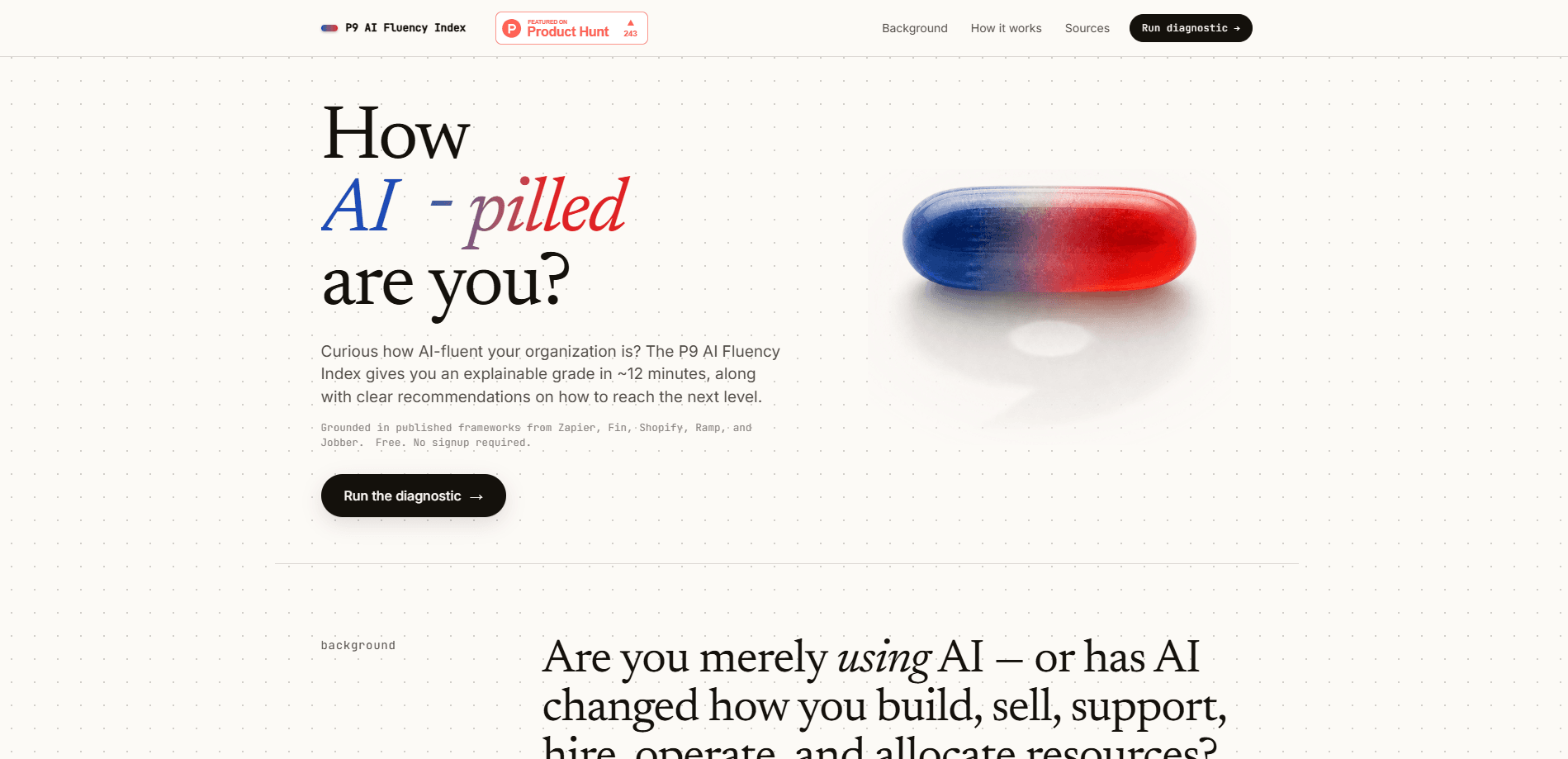
How AI-pilled are you? is a free web diagnostic from Point Nine Capital that measures how deeply AI has changed the way a company actually works. Nine plain-language questions map onto six dimensions of AI fluency, and the tool rolls your answers into a 0-100 score plus one of six tiers, with Unactivated at the bottom and AI-Native at the top. There's no signup, no email wall, and the whole thing takes about 12 minutes.
About How AI-pilled are you?
What Is How AI-pilled are you?
How AI-pilled are you? is the public-facing name for the P9 AI Fluency Index, a benchmarking tool built by Point Nine Capital. It answers a question most leaders can't answer with data: is your company genuinely fluent with AI, or just dabbling with it? Adoption numbers won't tell you, because the index is designed to measure whether AI is changing how a team builds, sells, supports, hires, and spends rather than how many seats it filled.
The scoring model borrows from published frameworks at Zapier, Fin, Shopify, Ramp, and Jobber. Each of your answers is rated on a level from 0 to 5, then multiplied by that question's weight. Those weighted values roll into an overall 0-100 score and one of six tiers, running from L0 Unactivated and L1 Dabbler up through L2 Capable, L3 Adoptive, L4, and L5 AI-Native. This AI fluency diagnostic is a structured starting point, not a final verdict.
The main limitation is scope. It's a self-report diagnostic, so it grades what you say about your organization rather than auditing real usage logs. Treat the result as a structured conversation starter, not an objective audit. Useful, but not gospel.
Getting Started
- Open ai-pilled.com in a browser and click "Run the diagnostic." Nothing to install and no account needed.
- Answer the nine questions. Eight are single-select; one expands into five sub-questions covering a different functional area.
- Let the index score each answer, weight it, and combine everything into your overall 0-100 result.
- Read your report card: your tier, a six-dimension breakdown, benchmark comparisons, and three suggested moves.
- Share the card or keep it private. There's no email requirement either way.
Product Information
A quick look at How AI-pilled are you?'s pricing, supported platforms, and performance.
Best for
The users, tasks, and scenarios where this tool fits best.
Users
- Founders and operators
- Team leads and department managers
- HR and talent partners
- Consultants
Tasks
- Benchmarking AI maturity
- Prioritizing next steps
- Spotting weak dimensions
- Framing internal discussions
Scenarios
- A leadership offsite where the team needs an agreed baseline before setting AI goals.
- A pre-investment review where an operator wants a quick, structured view of a portfolio company's AI readiness.
- A quarterly self-check to track whether AI fluency is improving over time.
- Onboarding a new manager who needs to understand how the organization approaches AI.
Key features
Nine Questions, Six Dimensions
The diagnostic stays short on purpose. Nine questions spread across six dimensions: Culture & Talent, Team Fluency by Function, Throughput, Tooling & Context, Product, and Governance. Eight are single-select and one opens into five sub-questions, one per functional area. That design keeps the whole run to roughly 12 minutes. Short enough to finish in one sitting.
Weighted 0-100 Scoring
Every answer maps to a level between 0 and 5, and each question carries its own weight. The index multiplies the two and rolls the results into a single score out of 100. Weighting matters here because a strong culture score shouldn't be allowed to hide a weak governance story, and the math keeps the six dimensions in proportion instead of treating every answer as equally important.
Six-Tier Grading Scale
Your score lands in one of six tiers, climbing from Unactivated at L0 through Dabbler, Capable, and Adoptive up to AI-Native at L5. The tiers are adapted from frameworks companies like Zapier and Jobber already publish, so the labels map to ideas people have seen before. You get a plain-language grade instead of a raw number with no meaning attached.
An Explainable Report Card
The output is a one-page card showing your tier and overall score. It breaks down all six dimensions so you can see exactly where you over- or under-perform, then anchors your result against named public benchmarks. Three recommended moves tell you what to do next rather than just where you stand, and the card is shareable with no email required.
Benchmark Anchors From Real Companies
Instead of vague comparisons, the report ties your result to published cases. Zapier's fluency rubric, Fin's 2x productivity claim, Shopify's reflexive-use mandate, Ramp's Dojo rollout, and Jobber's engineering maturity ladder all feed the model and shape how each tier gets contextualized. Seeing your score next to a company you recognize is more useful than an abstract percentile that tells you nothing about real practice.
Pros and cons
Pros
- Free and genuinely frictionless: no signup, no email, no app install, just a browser tab.
- Fast enough to run in a meeting: about 12 minutes from start to report card.
- Explainable output: the six-dimension breakdown shows why you got your score instead of hiding the math.
- Grounded in named public frameworks, so the tiers carry useful context.
- The three recommended next moves turn a score into a concrete plan you can act on.
Cons
- It's a self-report tool, so a polished-sounding organization can score higher than its real practice deserves.
- Results depend on honest answers, so a team that describes its aspirations as current facts will walk away with an inflated tier and miss the gap that actually matters.
- It's built for organizations, so individual freelancers won't get much from the benchmark side.
- With only nine questions, it won't capture nuance in a very large or highly varied company.
Frequently asked questions
It measures company-level AI fluency, meaning how far AI has changed the way an organization works, not just how many people use AI tools. Adoption tells you who clicked a button, while fluency tells you whether throughput, cost, and capabilities actually moved, and the index is built to catch that second and much harder-to-see signal.
Related content
Explore related tools, skills, and articles for How AI-pilled are you?.
How AI-pilled are you? Alternatives
Isgen AI
Isgen · AI DetectionIsgen AI is a web-based AI detector that scores text for machine authorship and shows you which sentences and phrases push the number up. It's built for teachers, editors, students, and writers. Their question is simple: did this draft come from ChatGPT, GPT-5, Claude, Gemini, DeepSeek, or another model? You paste or upload content, run a scan, and get a Human, AI, and Mixed breakdown in seconds. There's also a companion editor that scores text while you write it.
Humanizeai Tools
Humanizeai Tools · Writing · AI DetectionHumanizeai Tools is a web-based AI humanizer that rewrites machine-generated text so it sounds like a person wrote it, which is the whole point of the category it belongs to. Paste a draft from ChatGPT, Claude, or Gemini, run it through the tool, and it swaps out the phrases and sentence patterns that AI detectors flag. If your goal is to make AI text sound human before you publish it, this is the kind of tool built for exactly that. It suits students, bloggers, and marketers who need copy that reads naturally and clears tools like GPTZero, Copyleaks, and Winston AI after a single pass.

Hidemyai
Hidemyai · Writing · AI DetectionHidemyai is an AI content humanizer. It rewrites text from ChatGPT, Jasper, and similar tools so the result reads like a person wrote it. You paste your draft, pick a document type and tone, and the service returns a version meant to bypass AI detectors such as Originality.ai, Turnitin, and ZeroGPT. It targets writers, marketers, and students who lean on AI drafts but can't ship copy that sounds robotic. The promise is simple: make AI content undetectable.