

HrFlow.ai
HrFlow.ai · Business
HrFlow.ai is an API-first HR data platform that parses resumes and job posts, tags skills, and ranks candidates with models trained on hiring outcomes.
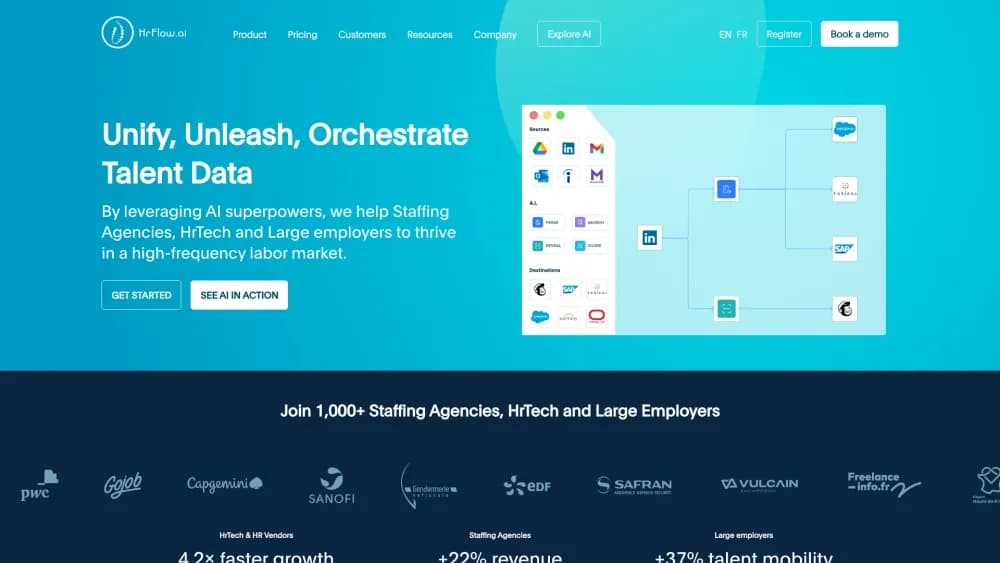
About HrFlow.ai
What Is HrFlow.ai
HrFlow.ai is a French company, founded in 2016, that sells hiring intelligence as infrastructure rather than as a single recruiting app. Its platform exposes more than a dozen APIs for parsing, tagging, searching, scoring, matching, grading, and explaining talent data, plus a portal for teams that would rather click than code. Over 1,000 customers build on it, and the company says it has processed more than 100 million profiles.
The core problem is messy input. A recruiting team receives CVs as PDFs, scanned images, Word files, and pasted text, in a dozen languages, and each one describes skills in its own words. HrFlow.ai turns that material into a profile object with consistent fields, then lets search and ranking run on top of it. It is the same talent data API layer most applicant tracking systems end up building themselves, only sold as a service.
The resume parsing API alone covers most of the intake work. The candidate matching API handles the next step, and teams often add the search endpoints once their profile database grows past a few thousand records.
The main limit is that this is developer territory. There is no drag-and-drop builder for a complete recruiting workflow, and the portal still assumes you understand sources, boards, and algorithms. Pricing is usage based, with published figures limited to a free starting tier, so real costs depend on how many requests and records you push through.
Getting Started
- Create a workspace at hrflow.ai/signup. The free tier lets you test the APIs before a sales conversation.
- Copy your API key and secret from the workspace settings. Domain whitelisting is available if you need to restrict where calls come from.
- Create a Source for candidate profiles and a Board for job posts. These act as folders that hold indexed records.
- Send a resume to the parsing endpoint, either as a file or as raw text. Synchronous parsing returns the structured object in the response, while asynchronous parsing queues the job and posts a webhook when it finishes.
- Turn on the modules you need, such as tagging, searching, or scoring, and connect your own tools through the connector catalog or a workflow.
Product Information
A quick look at HrFlow.ai's pricing, supported platforms, and performance.
Best for
The users, tasks, and scenarios where this tool fits best.
Users
- HR tech product teams
- Staffing and recruiting firms
- Large employers with internal mobility programs
- Data teams inside HR departments
Tasks
- Converting a folder of resumes into a searchable database
- Ranking applicants for an open role
- Normalizing job titles and skills
- Writing an audit explanation for a rejected candidate
- Finding lookalike candidates
Scenarios
- A hiring surge with a fixed review deadline
- Recruiting across borders in local languages
- A compliance review under the EU AI Act
- An internal job marketplace launch
Key features
Resume and Job Parsing at Scale
The parsing endpoint accepts PDF, DOCX, PNG, and JPEG files and returns 60+ data points, including contact details, work history, education, companies, job titles, and skills. It also handles raw text and has a separate OCR route for images. HrFlow.ai reports 96% accuracy across 43+ languages, a figure the company publishes rather than an independent benchmark. Synchronous and asynchronous modes let you choose between instant responses and high volume queues.
No-Code Taxonomy Tagging
The tagging API assigns labels from a taxonomy to any text: a full CV, a single work experience, or a job description. You can start from a standard referential in the marketplace, such as ROME 4.0 for job classification, or upload your own job families and competencies. Tags then drive filters, analytics, and missing skill prediction. It is the part that makes downstream reports comparable across teams.
Two-Sided Scoring and Matching
Scoring ranks jobs for a person and people for a job. The recommender behind it was trained on 1.2 billion hiring decisions. Each result carries a probability score, and HrFlow.ai reports around 83% accuracy for the model. The matching endpoint takes a different approach and returns similar profiles or similar jobs, which suits talent discovery and duplicate detection more than shortlist ranking.
Hosted Search That Returns in Milliseconds
The searching API is a managed search engine with a query DSL, typo tolerance, and HR aware semantics. It is the piece behind semantic candidate search in most customer builds. HrFlow.ai quotes sub 100ms response times. You index profiles in a Source and jobs in a Board, then query either side without running Elasticsearch or tuning analyzers yourself. For an ATS with a growing candidate database, that removes a sizeable infrastructure project.
Embeddings and Predictive Grading
The embedding API produces HR native vectors for profiles, jobs, and plain text, trained on hiring data and built to work across languages. Those vectors power similarity search, clustering, and deduplication. Grading goes a step further and predicts whether a candidate will apply and how an interview is likely to end. HrFlow.ai claims 94% accuracy against 64% for human reviewers, a comparison worth treating as a vendor claim until you test it on your own funnel.
Explanations Built for Compliance
The reasoning API explains why a score came out high or low, and it lists the factors behind the result. It also suggests upskilling paths and interview checkpoints. HrFlow.ai positions this as support for EU AI Act transparency duties, and the AI Studio includes bias auditing across gender, ethnicity, age, and location. For teams selling into regulated markets, that documentation often matters as much as the score itself.
Connectors and Workflow Automation
More than 200 connectors link the platform to ATS, HRIS, HCM, CRM, job board, and cloud storage systems. Vendors that sell AI recruiting software to enterprises use these connectors to keep their own product in sync with client systems. Data moves through Sources, Boards, and Destinations, and workflows let you chain steps such as parse, tag, score, then push to a downstream tool. Webhooks cover the events in between. That adds up to an ETL layer for talent data, and it is often the reason buyers pick HrFlow.ai over a standalone parser.
Pros and cons
Pros
- One vendor covers parsing, tagging, search, scoring, matching, and grading, which cuts the number of integrations an HR product has to maintain.
- Language coverage is broad at 43+ languages, and the parser accepts scanned images as well as text based files.
- Search and scoring run as hosted services, so your team does not operate a separate search cluster or ranking stack.
- The connector catalog reaches more than 200 systems, including the ATS and HRIS platforms most recruiters already use.
- Compliance features such as score explanations and bias auditing are built in, which helps in EU procurement and AI Act reviews.
Cons
- The product assumes engineering resources. A small HR team without developers will find the portal useful but limited.
- Published pricing stops at the free tier, so budgeting requires a quote and depends on request and record volumes you may not know in advance.
- Accuracy numbers come from HrFlow.ai, and real world results vary with CV layout, scan quality, and language. Plan for a review step.
- Custom scoring algorithms need labeled examples from your own hiring history, which takes time before the output is trustworthy.
Frequently asked questions
It turns resumes and job descriptions into structured data, then provides APIs for searching, scoring, matching, and explaining that data. HR tech vendors and employers use it as the intelligence layer inside their own hiring products.
Related content
Explore related tools, skills, and articles for HrFlow.ai.
HrFlow.ai Alternatives

Knocket
Knocket (Tencent RTC team) · Productivity · Business · ChatbotKnocket is a free live chat and contact page tool that lets visitors message you from your website, app, or a shareable link, with every reply handled from Telegram or one inbox.

shippedit.me
Krawlup · Marketing · Businessshippedit.me now redirects to Krawlup, a web platform that audits SEO, AEO and page speed every week, then hands the fixes to AI coding agents over MCP.

Ayven
Alknoma · Productivity · BusinessAyven is an AI control centre by Alknoma that turns a plain-language goal into a dated plan, hands the work to your people and AI agents, and asks for your approval only when the call is yours.