

Hubtype
Hubtype · Marketing · Chatbot
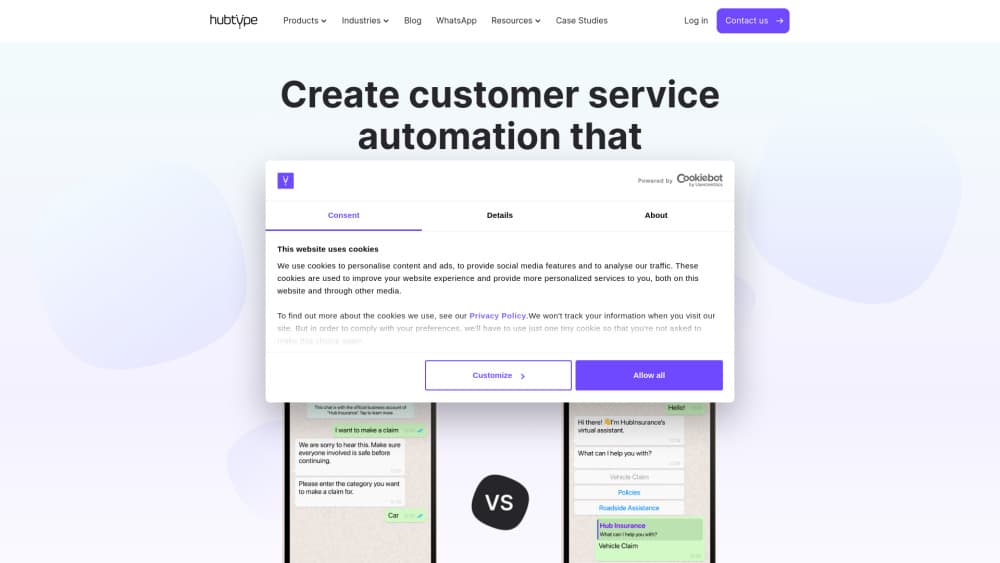
Hubtype is an agentic customer experience platform for building and running AI agents on WhatsApp and other messaging channels, with a visual flow builder and a helpdesk built for chat.
About Hubtype
What Is Hubtype
Hubtype is a Spanish software company that sells a conversational AI platform to businesses with high message volume. The core idea is narrow on purpose: put sales, support and marketing conversations on WhatsApp and the other channels customers already use, then automate as much of that traffic as possible without losing the human handoff.
The company has been an official Meta business partner in Spain since the WhatsApp Business API opened to businesses in 2018, which matters in practice. WhatsApp has rules about templates, pricing windows and opt-in, and a partner that lives inside those rules saves a lot of compliance work.
The platform itself is three products stitched together. There is a conversational CX layer for design and orchestration, an automation layer with a drag-and-drop flow builder and webviews, and a helpdesk where human agents pick up the leftovers with the full conversation in front of them. On top of that sits a growing set of AI agents for sales, service and marketing, plus internal agents for QA, data capture and analytics. The short version is one WhatsApp AI agent per customer-facing job, one messaging helpdesk for the people behind it, and a single flow builder feeding both.
The limits are worth stating up front. Hubtype does not sell to individuals, publishes no price list and offers no self-serve trial, so evaluation starts with a sales call. Projects start at 15,000 to 20,000 EUR per year according to the company's own contact page. The return depends on volume: a business answering a few hundred messages a month will not recover that cost, while an airline or an insurer handling tens of thousands will.
Getting Started
- Talk to the sales team and scope the use cases, channels and languages you need covered, since every deployment is quoted as a project.
- Connect the WhatsApp Business account plus your CRM, helpdesk or AI provider through the integrations marketplace, the REST API or webhooks.
- Build the first flows in the visual builder, or start from the prebuilt agents for sales, customer service and marketing.
- Set the handover rules so the bot passes a conversation to a human with history attached, then watch automation and deflection rates in the analytics view before widening the rollout.
Product Information
A quick look at Hubtype's pricing, supported platforms, and performance.
Best for
The users, tasks, and scenarios where this tool fits best.
Users
- Customer service teams at banks, insurers and airlines
- Support leads who already run WhatsApp as a channel but answer everything by hand
- Product and CX designers who need app-like interactions inside a chat
Tasks
- Deflecting repetitive questions
- Running sales conversations end to end
- Handing complex cases to people without losing context
- Coordinating several agents on one account
Scenarios
- Peak season spikes in travel and retail
- Multilingual support from a single build
- A contact centre migrating from phone and email to messaging
Key features
AI Agents for Sales, Service and Marketing
Hubtype ships separate agents for the three jobs that dominate messaging traffic. The sales agent qualifies leads and pushes toward checkout, the service agent resolves routine requests, and the marketing agent runs campaigns and reminders. They share a conversation history, so a customer who asks about a delayed order and then wants to buy something else does not repeat themselves.
Flow Builder
The flow builder is a drag-and-drop canvas for guided conversations. You can reuse existing FAQs, branch on intent and attach webviews to a step, which is how a simple question gets answered while a complicated one gets a booking form. Teams without developers can ship a flow in an afternoon, and the same flow renders on every channel.
Webviews
Webviews are the reason Hubtype conversations do more than text. They open small interactive screens inside the chat for date pickers, document upload, maps or payment, so a task that would normally end in "please visit our website" finishes where it started. This is the feature that most separates messaging automation from a chatbot that only talks.
Messaging Helpdesk
The helpdesk is built for asynchronous chat rather than phone queues. One agent can run three to five conversations at once, tickets route by query type, channel or region, and SLA indicators keep the pace honest. WhatsApp specifics such as specialist pricing, pre-approved templates and the 24 hour window are handled in the interface instead of a separate tool.
Universal Deploy and Integrations
Design once, render everywhere. Universal Deploy adapts a build to the capabilities of WhatsApp, Messenger, Instagram or webchat and adjusts when those channels change their features. On the systems side, Hubtype connects to Salesforce, Zendesk, Contentful, Google Analytics, Genesys and Dialogflow, plus REST API and webhooks for everything else, so you keep the stack you already paid for.
Security and Compliance
Conversations are end-to-end encrypted, webhooks run over SSL and the company holds ISO 27001 certification from Aenor alongside GDPR compliance. For banks and insurers that is not a marketing line but the condition for putting customer data through a messaging channel at all.
Pros and cons
Pros
- WhatsApp is treated as the main channel rather than an add-on, so template rules, pricing windows and opt-in mechanics come built in.
- The helpdesk and the automation builder live in one place, which removes the usual copy-paste between a bot tool and an agent inbox.
- Webviews cover transactional tasks, not just FAQ deflection, which is where most messaging bots stall.
- Integrations are additive. CRM, helpdesk, analytics and existing AI stay in place through the marketplace, the API or webhooks.
- Published customer results are specific: JetSMART reports 140,000 conversations a month at 80% automation, Alsa reports 90% in eight weeks.
Cons
- No published pricing and no free tier. You cannot compare Hubtype with alternatives or test it on your own before a sales conversation.
- The entry point starts around 15,000 EUR a year, which rules out small businesses and puts the platform out of reach for teams testing messaging for the first time.
- Everything routes through WhatsApp Business API approval and Meta's template review, so launch timing depends on a process Hubtype does not control.
- The product surface is wide, with front-facing agents, internal agents, an orchestrator, a helpdesk and a flow builder, and getting a team fluent in all of it takes onboarding time.
Frequently asked questions
Hubtype builds and runs AI agents that handle sales, support and marketing conversations on WhatsApp and other messaging channels. It combines a visual flow builder, a helpdesk for human agents and connectors to the systems a company already uses.
Related content
Explore related tools, skills, and articles for Hubtype.
Hubtype Alternatives

ngram 2.0
ngram · Video · Marketingngram 2.0 is an AI video generator for teams. It turns a prompt, a screen recording, or a product URL into a narrated explainer, product demo, or AI avatar video, and every scene stays editable.

shippedit.me
Krawlup · Marketing · Businessshippedit.me now redirects to Krawlup, a web platform that audits SEO, AEO and page speed every week, then hands the fixes to AI coding agents over MCP.

MePersona
MePersona, Inc. · Writing · Productivity · MarketingMePersona is an AI unified inbox for creators. It learns your voice, drafts replies to fan messages from 12 platforms, and sends only what you approve.