
huntr
Protect AI, part of Palo Alto Networks · AI Detection
huntr is an AI bug bounty platform where researchers report flaws in open source ML libraries and model file formats, and compete in timed challenges that probe LLM guardrails for cash prizes.
About huntr
What Is huntr
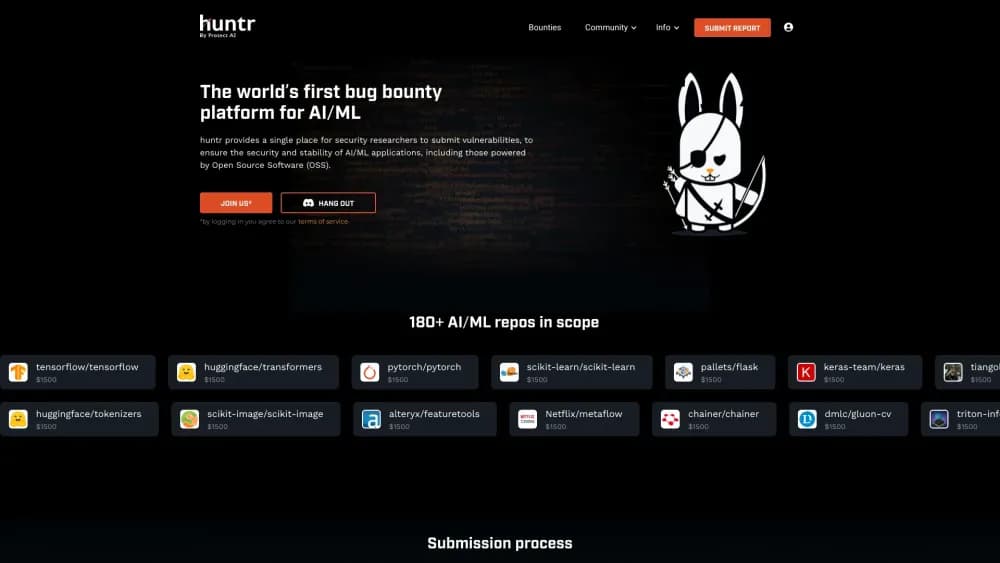
huntr is a bug bounty platform built only around AI and machine learning. Instead of the usual websites and mobile apps, its targets are the libraries that AI code runs on and the file formats that models are saved in. A malicious model file can run code the moment someone loads it, and huntr treats that whole surface as fair game.
The platform started by funding bounties per repository. Repos such as PyTorch, Transformers, Keras, ONNX and scikit-learn appear on the board with reward amounts attached, and reports go through triage before a maintainer patches anything. Those patches end up as public advisories, which is where most researchers get their credit.
The newer layer is Challenges. These are timed contests against a purpose-built AI assistant or agent. You might need to pull a secret token out of a claims assistant, or get three agents to reveal the tools they're told to protect. Prize pools on the site run to $15,000 for a single event, and a leaderboard ranks everyone who clears the objectives before the deadline.
Two things follow from that design. Findings are judged, not self-published, so a report only pays once someone agrees it's real. And the work is competitive. Popular challenges draw a crowd, and duplicate reports earn nothing. Researchers who already read Python source and understand prompt injection get the most out of it.
Getting Started
- Sign up at huntr.com with an email address or a GitHub account, then accept the code of conduct and the terms of participation.
- Choose a target. The bounty board lists open source repositories and their reward ranges, while Challenges lists live events with rules and deadlines.
- Reproduce the issue on the exact version you report, and keep a minimal proof of concept. For a library bug, note the affected function and how the payload reaches it.
- Submit the report with steps, evidence and impact. Triage validates it, the maintainer ships a fix, and the advisory goes public with your name on it.
- For a challenge, submit the objective evidence before the cut-off, then watch the leaderboard for your rank and payout.
Product Information
A quick look at huntr's pricing, supported platforms, and performance.
Best for
The users, tasks, and scenarios where this tool fits best.
Users
- Security researchers with web or infrastructure experience
- ML engineers who maintain open source projects
- Students building a portfolio
Tasks
- Reporting a deserialization flaw in a model loader
- Testing an LLM app for prompt injection
- Landing a CVE for an open source ML library
- Sharpening AI red team skills before an interview
Scenarios
- You have a free weekend and want a defined target
- Your team ships an LLM feature and wants outside eyes
- You need a portfolio item for a security role
Key features
Open Source Bounty Board
The board lists repositories with funded rewards attached, so you know what a valid report is worth before you start reading code. Major AI projects sit at similar levels, with several around $1,500 per accepted report. Amounts change, and the repository page is the only number that counts.
Timed AI Challenges
Challenges are contests, not open-ended hunts. Each one sets an objective against a live AI assistant, gives you a deadline, and ranks everyone who clears it. Prize pools are fixed and published up front, with the pot split across the top ranks.
Triage and Disclosure Pipeline
Every submission passes through a security team before a maintainer sees it, which filters noise and duplicate reports. Accepted issues get coordinated vulnerability disclosure, so the fix ships before the details go public. That sequence protects users and gives the researcher a citable advisory.
Rewards and Payouts
Bounties pay per accepted report, and challenge prizes pay per event. Researchers don't pay to join and there's no subscription tier. Payout depends on acceptance, so a rejected report returns nothing beyond the writeup experience.
Coverage of Model File Formats
Most bounty programs stop at application code. huntr goes down a layer into model file formats, where loading a downloaded model can execute code on the host. That scope is rare enough that it's the main reason security teams point people here.
Writeups and Community
The blog publishes exploit breakdowns, including work on Keras model deserialization and archive handling bugs that turn into higher-value findings. A Discord server and a public FAQ sit alongside it. Reading those writeups is the fastest way to learn the patterns the challenges reward.
Pros and cons
Pros
- Narrow, well-defined scope: AI and ML libraries plus model file formats, instead of the entire web.
- Published advisories give public credit and a citable CVE trail.
- Challenge prize pools are published before the event, so the upside is knowable.
- Free for researchers, with open source bounties funded by the projects themselves.
- Model file format coverage is hard to find on general purpose bounty platforms.
Cons
- Competition concentrates on the popular challenges, and duplicates pay nothing, so a crowded event can waste a weekend.
- Payout rides on triage acceptance, and rejection after days of work is common.
- Between challenges the board is mostly library code, which rewards source-reading skill over quick testing.
- No public API is documented, so teams can't pull their report history into their own dashboards.
Frequently asked questions
It's a place to report security flaws in AI and machine learning software and to compete in AI security contests. The two halves share a queue and a reputation system, so a good library report and a strong challenge run both build your standing.
Related content
Explore related tools, skills, and articles for huntr.
huntr Alternatives
Isgen AI
Isgen · AI DetectionIsgen AI is a web-based AI detector that scores text for machine authorship and shows you which sentences and phrases push the number up. It's built for teachers, editors, students, and writers. Their question is simple: did this draft come from ChatGPT, GPT-5, Claude, Gemini, DeepSeek, or another model? You paste or upload content, run a scan, and get a Human, AI, and Mixed breakdown in seconds. There's also a companion editor that scores text while you write it.
Humanizeai Tools
Humanizeai Tools · Writing · AI DetectionHumanizeai Tools is a web-based AI humanizer that rewrites machine-generated text so it sounds like a person wrote it, which is the whole point of the category it belongs to. Paste a draft from ChatGPT, Claude, or Gemini, run it through the tool, and it swaps out the phrases and sentence patterns that AI detectors flag. If your goal is to make AI text sound human before you publish it, this is the kind of tool built for exactly that. It suits students, bloggers, and marketers who need copy that reads naturally and clears tools like GPTZero, Copyleaks, and Winston AI after a single pass.

Hidemyai
Hidemyai · Writing · AI DetectionHidemyai is an AI content humanizer. It rewrites text from ChatGPT, Jasper, and similar tools so the result reads like a person wrote it. You paste your draft, pick a document type and tone, and the service returns a version meant to bypass AI detectors such as Originality.ai, Turnitin, and ZeroGPT. It targets writers, marketers, and students who lean on AI drafts but can't ship copy that sounds robotic. The promise is simple: make AI content undetectable.