

Idea2Site
idea2 · Coding
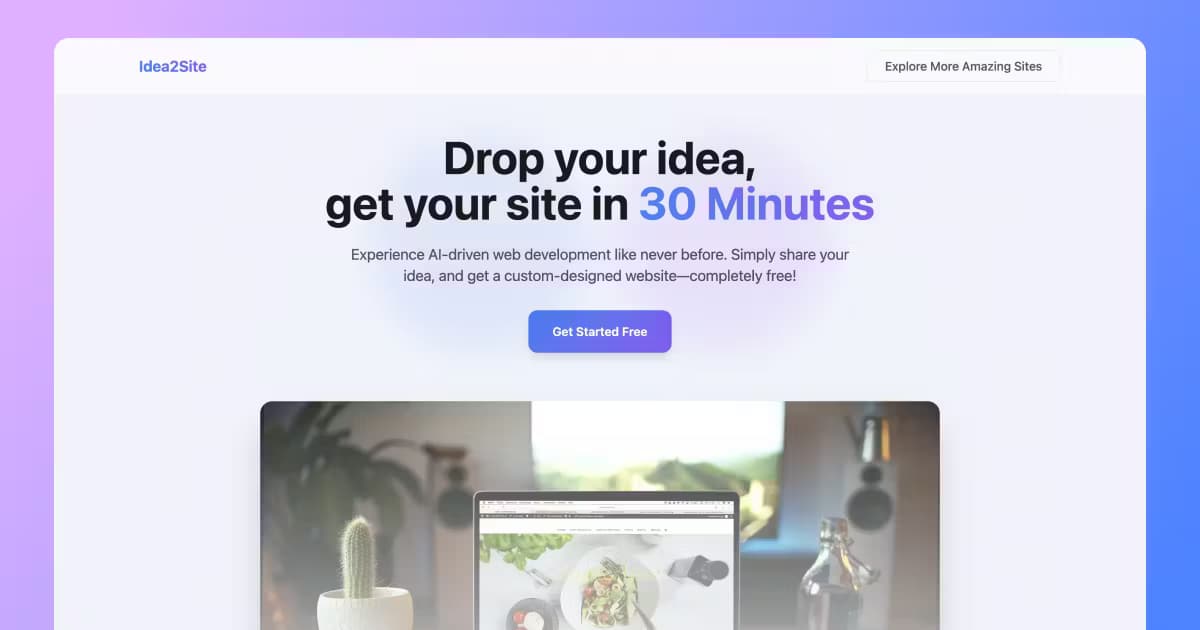
Idea2Site is the public portal of the idea2 collective, where a founder's idea is grown into a live web app through an AI venture builder pipeline called the WonderMachine.
About Idea2Site
What Is Idea2Site
Idea2Site is the web portal that the idea2 collective uses to publish the ventures it helps build. The name says what it does: it's an idea to website path, taking a vision and turning it into a site you can visit. It isn't a self-serve builder you sign into. It's the public face of a stewardship program, and the apps listed on it grew out of real projects that went through that program.
The collective describes itself as a fractal co-founder. Founders bring an idea and keep authorship and direction the whole way, while idea2 supplies infrastructure, craft, and honest feedback. Ventures are developed to roughly 80% production-ready, then handed back or kept under the organization's roof. The public portal is where anyone can see and use the results.
Two things set Idea2Site apart from a normal site builder. First, it's built around evidence, not promises. A venture only moves forward when the thing the current stage asks for has actually happened. Second, the default stack is public, so nothing you see on the portal is locked behind a tool you can't pick up yourself. The trade-off is scope: the program works venture by venture, isn't a finished product, and isn't taking customers in the usual sense.
Getting Started
- Open idea2.site and browse the living prototypes already published there
- Read idea2.org to understand how stewardship works, and idea2.life for the WonderMachine behind it
- Reach out through the co-create door if you carry an idea you want to grow
- Stay the source of your venture as it moves stage by stage, starting at Intake
- Watch new prototypes appear on the portal as ideas ripen
Product Information
A quick look at Idea2Site's pricing, supported platforms, and performance.
Best for
The users, tasks, and scenarios where this tool fits best.
Users
- Independent founders with an idea that keeps returning
- Early creators without a full team
- Curious visitors and users
- Civic and nonprofit-minded builders
Tasks
- Turn a vision into a working prototype
- Publish a first version for real use
- Get a venture found
- Find first collaborators
- Stand a venture up on its own
Scenarios
- You have a side project stuck at an idea and want a path to a live site
- You built a rough app and need hosting and a public home
- You want funding without giving up control
- You're testing a consumer tool before committing
- You run a public-interest project
Key features
Stage gates that run on evidence
Idea2Site is organized around eight stages, from Intake to Incubate, and each one opens only when the thing it asks for has actually happened. Nothing moves on narrative alone. That matters to founders because it turns a vague build into a series of concrete steps, each with a clear bar to clear before the next opens. You always know what stage you're honestly at, not the one you wish you were at.
The WonderMachine pipeline
The engine behind the portal is the WonderMachine, a human-guided, AI-augmented system. It starts from exactly two inputs, your gathered notes and one clear vision statement, and it never invents facts about your venture. Where it lacks knowledge, it asks you instead of filling the gap itself. For a founder without a technical co-founder, that keeps the machine helpful without letting it quietly make up your business.
An open, portable default stack
The collective publishes the tools it builds with: Lovable for the first prototype, Supabase for data and auth, GitHub or Codeberg for source, Netlify for hosting, and Base44 or Cursor as leaner fallbacks. None of it's secret, and any venture can diverge when its needs do. The practical upside is that the skills and accounts you build stay yours, so there's no platform you can't walk away from.
Two standing checks on every venture
Every project the machine touches is measured against two questions: does it increase the sovereignty of everyone it touches, and does it regenerate more than it depletes? The first screens out dependency traps that quietly lock people in. The second asks who bears the cost three steps out. Founders who care about impact get a filter aimed at long-term good over short-term growth.
A publication pipeline that spreads the word
The Spread stage carries a two-month, AI-accelerated publication pipeline that turns a venture's vision into one flagship artefact plus a stream of threads, carousels, one-pagers, and quote cards across LinkedIn, X, Instagram, and Facebook. The templates and workflows stay with the venture. It's aimed at founders who built something good but have no marketing engine to get it in front of people.
Free public prototypes
The portal itself is free to browse and use, and it doubles as AI prototype hosting for the collective's finished work. Visitors can open Flowtunes, a generative focus-music companion, or Purpose Pilot, a writing aid for purpose questions, among others. Each prototype links to the venture behind it and carries a status such as live or unreviewed, so you can see how finished it really is before you spend time on it.
Pros and cons
Pros
- Keeps the founder as the source: authorship and direction stay with you through every stage, and full stewardship can be handed back rather than taken over
- Evidence over promises: ventures advance only when the current stage's requirements are genuinely met, which cuts down on building things nobody wants
- Public, portable tooling: the default stack is named openly and every piece can be adopted directly, so no skill or account is locked in
- Free to try: the published prototypes cost nothing to open and use, so you can judge the output before engaging the program
- Impact-oriented filter: sovereignty and regeneration checks steer ventures toward public benefit and away from dependency traps
Cons
- Not a self-serve builder: there's no sign-up-and-generate flow, and the program works venture by venture, so you can't just spin up a site on demand
- Not a finished product: the machine is still being assembled in the open and isn't accepting customers in the usual sense, which limits how much you can rely on it today
- Little published pricing: the portal doesn't state plan prices, so cost for heavier involvement has to be discussed directly
- Small, in-progress catalogue: only a handful of prototypes are live, and some carry an unreviewed status, so the range is narrower than a mature platform
- Requires founder commitment: you have to stay willing to keep source throughout, which rules out passive or hands-off participation
Frequently asked questions
It's the public portal of the idea2 collective, where ventures built through the group's stewardship program are published as live web apps. It works as both an AI venture builder's public face and an entry point, not a sign-in site builder.
Related content
Explore related tools, skills, and articles for Idea2Site.
Idea2Site Alternatives

Base Code
Base44 (Wix) · Coding · ProductivityBase Code is a shared cloud development environment from Base44. Teammates describe changes to an existing GitHub codebase in chat, preview them live and send them back as pull requests.

Google EmbeddingGemma 2
Google DeepMind · Writing · Image · CodingGoogle EmbeddingGemma 2 is a 740M-parameter open model that turns text, code, images, audio, and video frames into vectors in one 768-dimension space, running on phones and laptops.

GitGlow
GitGlow · Coding · ProductivityGitGlow is a local-first desktop Git client that lets independent developers review their own code and their AI agents' changes in one place before shipping.