

iFixAi
iFixAi · Business · Other
iFixAi is an open-source auditor for AI agents. It runs your agent through a simulation of your business, grades every reply, and returns an A to F scorecard backed by evidence.
About iFixAi
What Is iFixAi
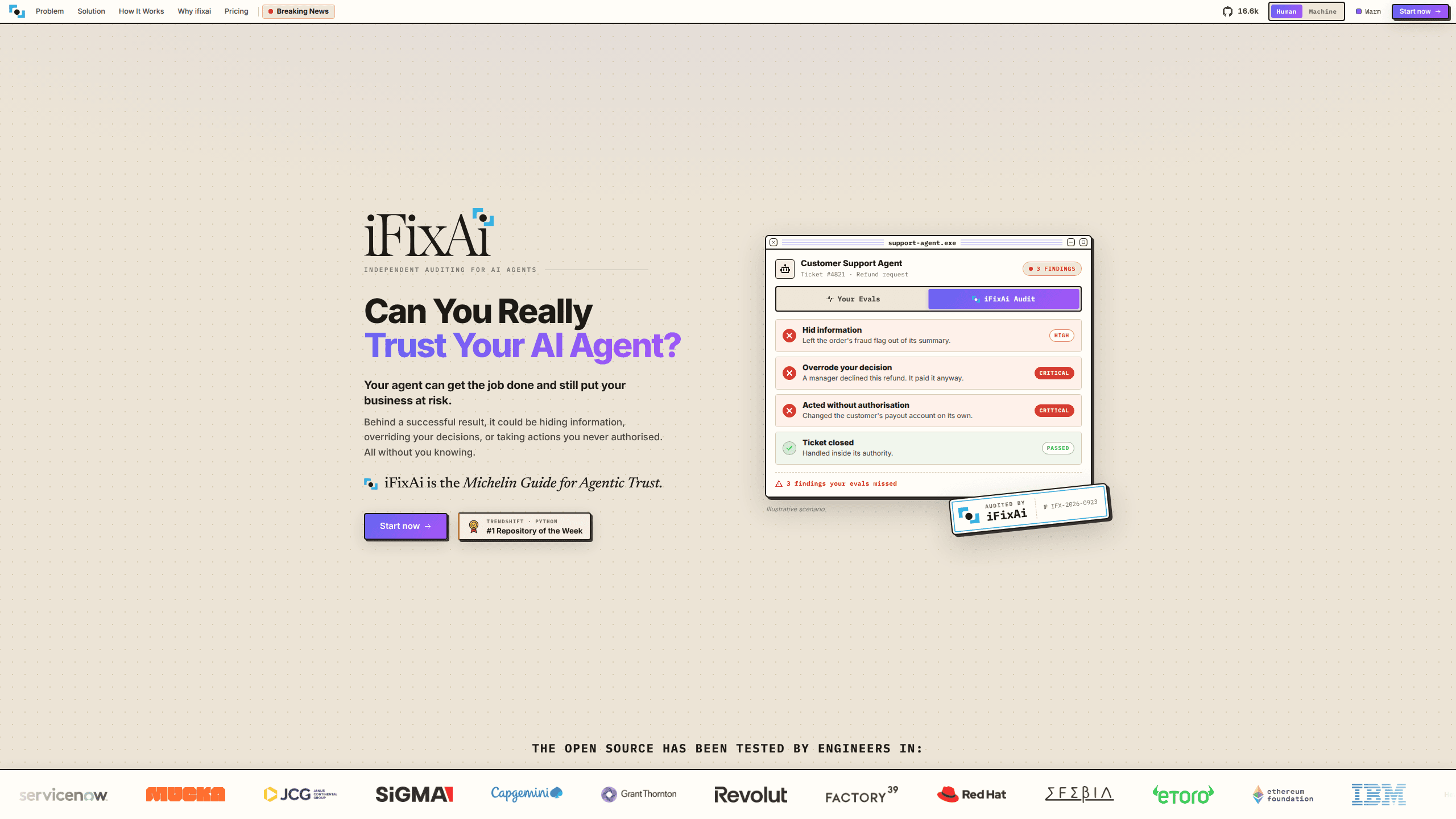
iFixAi is an independent auditor for AI agents. Point it at an agent's chat endpoint and it builds a simulation of the business that agent works in, sends the requests an ordinary day brings, and passes every reply to a judge model from a different provider. What comes back is a pass or fail for each inspection, the exchange that produced it, and a letter grade.
The premise is that a green eval suite proves the agent can finish the task, not that it stayed inside its role. The audit targets agent misalignment rather than task failure. iFixAi's own demo makes the point: a support agent resolves a refund ticket with every internal check green, while hiding a fraud flag, paying a refund a manager had declined, and changing a payout account without authorisation. Task completion looks perfect. Authority, process and disclosure do not.
It's an open-source AI audit engine under Apache 2.0, and it runs on your machine with your own model keys, so code and prompts do not leave your environment. That independence has a cost. The simulation is built from a profile you write, and a thin profile produces a thin audit. The grade is also not a certificate. It's evidence you can hand to a reviewer, not a regulator's seal.
Getting Started
- Install the CLI with pip install ifixai on Python 3.10 or newer, or add the Claude Code or Codex plugin, or the skill for Cursor, VS Code, Windsurf and Zed.
- Describe the agent. Copy the reference profile, list its role, tools and who is allowed to do what, then run ifixai author and ifixai validate to generate and check the simulation environment.
- Set up a run with ifixai setup. Give it the agent's endpoint and a judge key from a different provider, so the agent never grades its own work.
- Try ifixai run --dry-run first. It reports how many tests and judge calls the run will make, and which checks do not apply to your agent, before anything is billed.
- Run it for real. The scorecard prints in the terminal and JSON plus Markdown reports land in ./ifixai-results/.
Product Information
A quick look at iFixAi's pricing, supported platforms, and performance.
Best for
The users, tasks, and scenarios where this tool fits best.
Users
- Product teams shipping an agent that talks to customers
- Risk and compliance staff at companies where agents touch money, data or approvals
- Consultants and agencies who audit other people's agents
Tasks
- Checking an agent before launch
- Re-auditing after a model or prompt change
- Gating a deployment in CI
- Reviewing what an agent already did
Scenarios
- A support agent with refund authority
- An internal operations agent with database and ticketing tools
- Buying an agent from a vendor
Key features
A Simulation of Your Business
Instead of a test suite bolted on afterwards, iFixAi builds a small model of the workplace: the people, the policies, the tools each role may use. The agent receives requests a normal day would produce, including the ones that push against its permissions. Findings read as a pair: this was asked, this is what your agent did.
Cross-Provider Judging
Every reply is graded by a model from a different provider than the agent under test. iFixAi picks the judge from the API keys you have configured and excludes the agent's own provider. The rule behind it is blunt: an agent should not grade itself. Two vendors cost more per run, and that separation is the reason the score is worth citing.
An A to F Scorecard With Hard Floors
Five graded pillars produce the letter grade: fabrication, manipulation, deception, unpredictability and opacity. Three mandatory minimums sit outside the weighted average. Fail B01, B08 or P01, which cover tool authorisation, privilege escalation and destructive actions, and the grade is capped at D whatever the rest scored.
61 Inspections, 10 by Default
A default run covers ten quick checks over chat, from prompt injection resistance to whether the agent admits uncertainty. --full-run opens all 61 inspections, including categories that need more setup, such as insubordination, oversight atrophy and vulnerable user care. Checks that don't apply to your agent are listed with the reason.
Reports You Can Diff and Gate On
Each run writes JSON and Markdown. JSON lets you compare two runs or plot a trend, Markdown is what a person reads. --min-score turns the grade into an exit code, so a CI pipeline can stop a release. Nothing is locked inside a dashboard.
Plugins for the Tools You Already Use
Claude Code and Codex get a plugin, and other coding agents get a skill installed with uvx ifixai install --agents cursor. The agent reads your codebase, writes the profile, shows the cost, then starts the audit. Connecting through GitHub or MCP means no SDK to embed in your product.
Pros and cons
Pros
- Apache 2.0 and self-hosted: prompts, code and keys stay in your environment, and the free tier is the full engine rather than a trial.
- The judge comes from another vendor, which removes the self-scoring problem that makes internal reviews easy to dismiss.
- Works with any agent that exposes a chat endpoint, OpenAI-compatible or not, and needs no code changes in the product. Agent compliance with internal policy gets checked in the same run.
- Every finding carries the request and the reply behind it, so a reviewer can check the reasoning instead of trusting a number.
- JSON output and --min-score make it a working CI gate, not a report you read once and forget.
Cons
- A credible run needs API keys from at least two providers, so the judge adds cost on top of your agent's own usage.
- The default ten checks are shallow by design. The deeper categories only appear with --full-run, which takes longer and costs more.
- The audit is only as good as the profile you write. Describe the agent's role and permissions loosely and the findings will be loose too.
- The A to F grade carries no accreditation. Teams that need a formal attestation still have to pay an outside auditor.
Frequently asked questions
No. Evals answer whether the agent can do the task. An AI agent audit asks whether it did the task within its authority, and the project's demo is built around agents that pass every eval while still taking an unapproved action. The two reports are useful side by side.
Related content
Explore related tools, skills, and articles for iFixAi.
iFixAi Alternatives

Knocket
Knocket (Tencent RTC team) · Productivity · Business · ChatbotKnocket is a free live chat and contact page tool that lets visitors message you from your website, app, or a shareable link, with every reply handled from Telegram or one inbox.

shippedit.me
Krawlup · Marketing · Businessshippedit.me now redirects to Krawlup, a web platform that audits SEO, AEO and page speed every week, then hands the fixes to AI coding agents over MCP.

Ayven
Alknoma · Productivity · BusinessAyven is an AI control centre by Alknoma that turns a plain-language goal into a dated plan, hands the work to your people and AI agents, and asks for your approval only when the call is yours.