

Inferable
Inferable, Inc. · Coding
Inferable is an open source runtime for building AI workflows and agents. It runs in your own infrastructure, adds human approvals and returns structured outputs from any LLM.
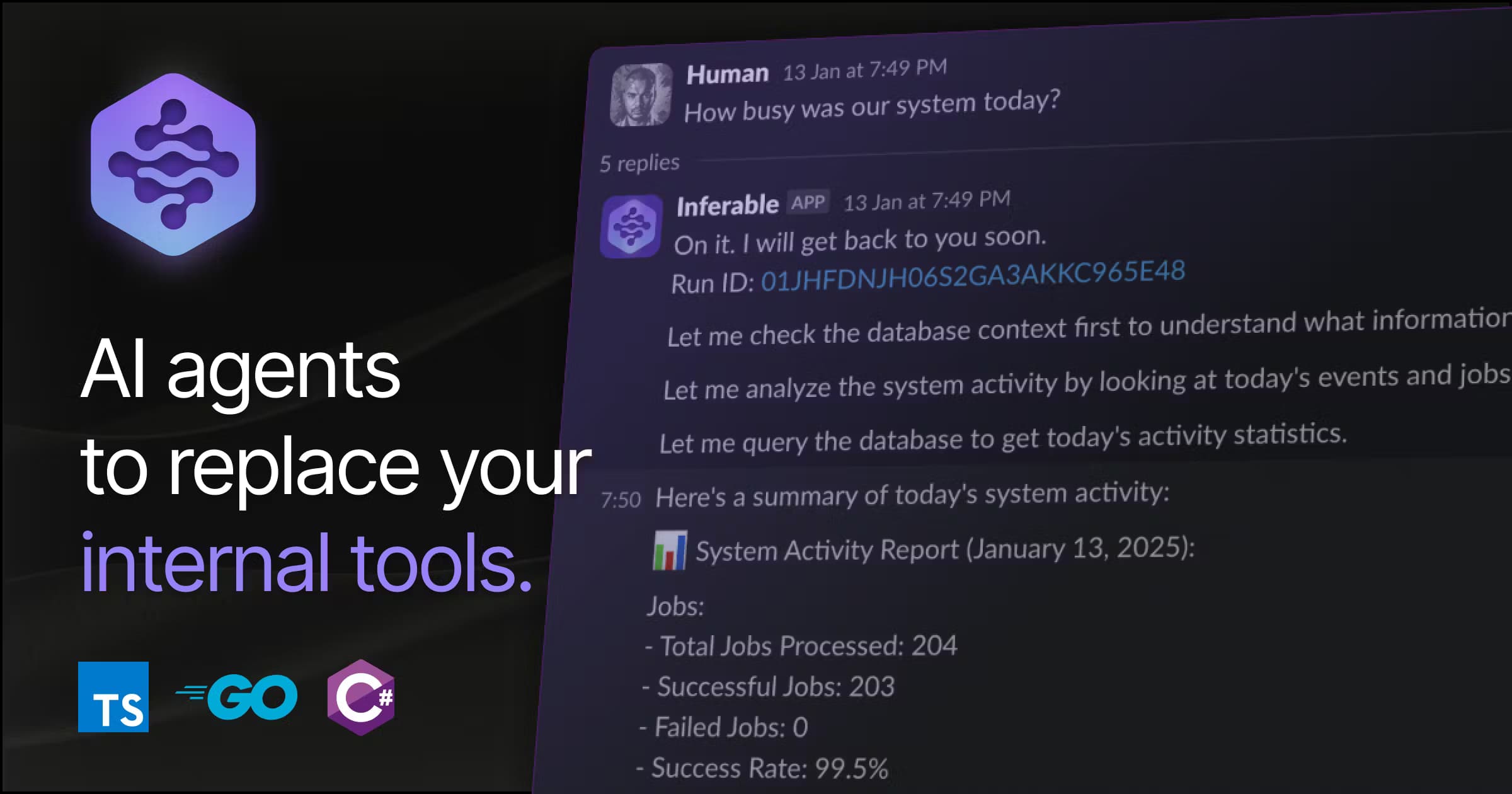
About Inferable
What Is Inferable
Inferable is a runtime for turning AI steps into workflows that finish what they start. You define a workflow in code, register it with the Inferable control plane, and it runs on your own machines, including behind a firewall or inside a private VPC. You don't deploy anything new. The worker connects out through long polling, so no inbound ports need to open.
The problem it targets is the gap between a demo and something you'd let touch production. A single LLM call is easy. A process that spans several model calls, waits on a person to approve a refund, and survives a restart isn't. Inferable handles that middle layer. It caches expensive steps, retries failed runs, validates the shape of each model response, and pauses a workflow until a human answers, no matter how long that takes.
The catch is who it's for. This is a developer tool with SDKs and TypeScript or Go code, not a no-code canvas. If you don't write code, a tool like Zapier or n8n will get you further. If you do, Inferable gives you durable execution and human-in-the-loop controls that those point-and-click builders leave out.
Getting Started
- Create a cluster, either through the hosted control plane at api.inferable.ai or by self-hosting the open source stack
- Install the Node.js or Go SDK and connect it with your cluster's API key
- Define a workflow in code, set its input schema and register versions as your logic changes
- Add structured LLM calls, human approval steps or notifications where the run needs them
- Call workflow.listen() so the worker runs on your own infrastructure and trigger runs from anywhere over the API
Product Information
A quick look at Inferable's pricing, supported platforms, and performance.
Best for
The users, tasks, and scenarios where this tool fits best.
Users
- Backend and platform engineers
- Teams with strict data rules
- Small product teams
- Automation builders moving past no-code tools
Tasks
- Human approval steps
- Structured data extraction
- Multi-step agent tasks
- Backend automation behind an API
- Long-running processes
Scenarios
- An approval lands hours later
- A worker restarts mid-run
- A support queue needs triage
- A regulated team can't use a hosted SaaS
- A team iterates on an agent's logic
Key features
Workflows That Run in Your Own Infrastructure
Workflows execute on your machines, even behind a firewall or inside a private VPC, with no deployment step to manage. The worker reaches the control plane through long polling, so you never open inbound ports or configure a load balancer. For teams that can't move workload off their own network, that design is the difference between this tool and a hosted alternative.
Versioned Workflows for Backward Compatibility
When the input schema or the logic changes, you define a new version of the workflow instead of editing the old one. Inferable keeps version affinity for runs already executing, so you roll out a change gradually and existing jobs finish on the code they started with. That removes the usual fear that a small edit will break something a customer is waiting on.
Human-in-the-Loop Approvals
A workflow can pause itself and ask a person to approve or reject the next step, over Slack or email, with full context carried along. The run holds until the answer comes back, whether that's a minute or a week, then picks up where it left off. You get human control over the exact steps that carry risk, like a data deletion or a payment, without building the waiting logic yourself.
Structured Outputs with Validation and Retries
The runtime parses and checks every structured model response against a schema, and retries a run when the output doesn't fit. Instead of parsing free-form text and hoping it holds together, you get typed fields you can hand straight to the next step. Support ticket triage, menu scraping and form extraction all depend on this working reliably.
Durable Execution with Memoized Results
Expensive or side-effecting steps can be memoized and cached in a distributed store, so a restart or a retry doesn't re-run them. A multi-step job that fails at step nine resumes at step nine, with steps one through eight intact. That turns long-running AI processes into something you can afford to run in production.
Agents and Observability
Beyond single workflows, Inferable supports agents that use tools to reach a goal. Every run shows up in a timeline view that traces each step, and you can plug the same events into your own observability stack. When an agent takes a wrong turn, the timeline is where you find out which call caused it.
Open Source and Self-Hosting
The control plane, the playground, the CLI and the SDKs are all open source under the MIT license. You can self-host the entire stack on your own infrastructure for full control over data and models, with no vendor lock-in. Self-hosting is the path for teams whose security review rules out a managed service.
Pros and cons
Pros
- Runs workflows inside your own infrastructure, so data and model calls never have to leave your network
- Human-in-the-loop approvals pause and resume cleanly, over Slack or email, no matter how long the wait
- Versioned workflows keep running jobs on their original code while you roll out changes gradually
- Structured output handling validates every response and retries on a bad one, so downstream steps get clean data
- The whole stack is open source under MIT, so you can self-host and avoid vendor lock-in
Cons
- It's a developer tool that needs TypeScript or Go and SDKs, so no-code users won't get far
- Official SDKs cover Node.js and Go, with the .NET SDK marked experimental, so other languages mean waiting
- There's no visual workflow builder for non-developers, unlike no-code automation platforms
- Public documentation is thinner than that of larger rivals, so expect to read the source in places
Frequently asked questions
Inferable is an open source runtime for building AI workflows and agents. You define workflows in code, and they run on your own infrastructure with durable execution, structured outputs and human-in-the-loop approval steps. A single API key connects your worker to the control plane.
Related content
Explore related tools, skills, and articles for Inferable.
Inferable Alternatives

Base Code
Base44 (Wix) · Coding · ProductivityBase Code is a shared cloud development environment from Base44. Teammates describe changes to an existing GitHub codebase in chat, preview them live and send them back as pull requests.

Google EmbeddingGemma 2
Google DeepMind · Writing · Image · CodingGoogle EmbeddingGemma 2 is a 740M-parameter open model that turns text, code, images, audio, and video frames into vectors in one 768-dimension space, running on phones and laptops.

GitGlow
GitGlow · Coding · ProductivityGitGlow is a local-first desktop Git client that lets independent developers review their own code and their AI agents' changes in one place before shipping.