

InJob.AI
Pelephant GmbH · Other
InJob.AI is a job search automation platform that scans job boards and company career pages, scores each opening against your profile, writes a custom cover letter, and applies on your behalf.
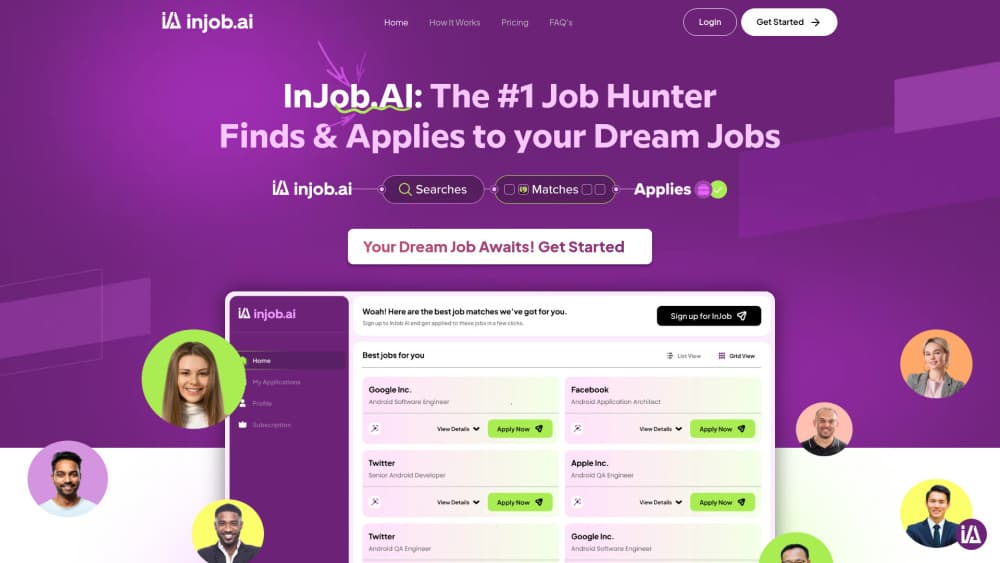
About InJob.AI
What Is InJob.AI
InJob.AI is a web app from Pelephant GmbH, a company based in Zurich, Switzerland. It handles the repetitive part of a job hunt: finding openings, judging fit, and producing the paperwork for each application. The product entered public beta in July 2024 and still carries a beta label on its site.
The pitch is straightforward. You describe the job you want in a chat, upload a resume, and the system builds a profile from both. It then runs a continuous search and presents scored matches, with a cover letter ready for each one.
The limits matter as much as the features. InJob.AI works from text, so it can miss roles described in unusual formats or posted behind a login. Its own FAQ marks automated applying and employer feedback as features shipping in an upcoming update, while the marketing pages already describe them as live. Check what your account can actually do before you rely on it for a real application.
Getting Started
- Create an account with an email address, or join the waitlist if signups are closed in your region.
- Chat with InJob.AI about the roles you want, then set your industry, experience level, location, job type, skills, keywords, and target salary.
- Upload a resume in PDF or DOCX format, up to 10 MB, and confirm the parsed work history, education, and skills.
- Review the scored job matches, open any listing, and generate a cover letter for it.
- Track applications and employer responses from the dashboard.
Product Information
A quick look at InJob.AI's pricing, supported platforms, and performance.
Best for
The users, tasks, and scenarios where this tool fits best.
Users
- Active job seekers applying to many roles at once
- Career switchers exploring an unfamiliar industry
- Recent graduates on a tight budget
Tasks
- Writing a tailored cover letter
- Filtering a long list of openings
- Tracking an application pipeline
Scenarios
- A week of intensive applying after a layoff
- Job hunting while employed
- Relocating to a new city
Key features
Chat Based Profile Building
You build your profile by talking to the assistant rather than filling in a long form. It picks up skills, seniority, and preferences from the conversation, then merges that with the details it reads from your resume. The result is a working profile in a few minutes, and you can edit any field afterward.
Search Across Job Boards and Career Pages
InJob.AI pulls listings from LinkedIn, Indeed, hundreds of other job boards, and the career pages of individual companies in your target industry and location. The site says the index refreshes every minute. That breadth is the main reason to use it over a single job board, since company sites often carry roles that never get syndicated.
Match Scores From 1 to 10
Every opening gets a score that reflects how well your profile and resume line up with the posting, and that job matching runs on the profile you built in the chat. Sorting by score makes a list of 200 openings manageable, and the low scores tell you where not to spend time. Treat the number as a ranking aid, not a verdict, because a score can't capture hiring manager preferences.
Custom Cover Letters for Each Job
For any listing, the platform drafts a cover letter aimed at that employer's stated requirements. You can download it as a PDF or plain text, edit the wording, and reuse the structure for similar roles. The draft is a starting point, so read it for tone before it goes out under your name.
Automated Job Applications
The company markets 24/7 applying: the system visits company sites, fills in forms, and submits on your behalf. Its FAQ describes this as arriving in an upcoming update, so confirm the feature is active on your plan before counting on automated job applications. When it works, it removes the slowest step of a job hunt.
Application Dashboard and Employer Feedback
A dashboard lists every job the platform applied to, along with the current status. It also collects employer responses in one place, including rejections, so you can see which roles progressed. This is the part that makes an automated job search feel manageable instead of opaque.
Pros and cons
Pros
- The free tier is usable on its own, with unlimited job searches, resume analysis, and 10 exclusive opportunities.
- Entry pricing is low and short term, at $1 for a single cover letter, $3 for 24 hours, and $10 for seven days.
- Cover letters are written per listing instead of from one template, which cuts the drafting work on every application.
- The search reaches company career pages, so you see roles that never appear on major job boards.
Cons
- The product is still labeled beta, and automated applying was announced as a future update in the official FAQ, so availability can differ from the marketing pages.
- You need to verify submissions yourself, because a form filled by software can fail on custom application systems without telling you.
- Pricing is sold as short passes rather than a monthly plan, so a long search means repeated purchases at $3 or $10 each time.
Frequently asked questions
InJob.AI is a web platform that automates the job search: it finds listings, scores them against your profile, writes cover letters, and aims to submit applications for you. It's built by Pelephant GmbH in Zurich and has been in public beta since July 2024.
Related content
Explore related tools, skills, and articles for InJob.AI.
InJob.AI Alternatives

Odyssey 3
Odyssey · OtherOdyssey-3 is Odyssey's foundation world model. It simulates physics in real time, turns a prompt into an interactive environment, and adapts to robots, cars and games.

JarvisCore
Prescott Data · Coding · Productivity · OtherJarvisCore is an open source Python runtime where AI agents work as equal peers on an agent mesh, claim tasks from a shared ledger, and reach external services through a zero-trust broker.
Clef
Cloudflare · Business · OtherClef is Cloudflare's open-source decision model for Workers AI. It returns calibrated probabilities for typed questions, not generated text, so agents can classify, route, and act fast.