

inPowered
inPowered AI · Other
inPowered AI is a sell-side decisioning platform that runs custom bidding models inside ad exchanges to tune every impression across display, video, and CTV.
About inPowered
What Is inPowered AI
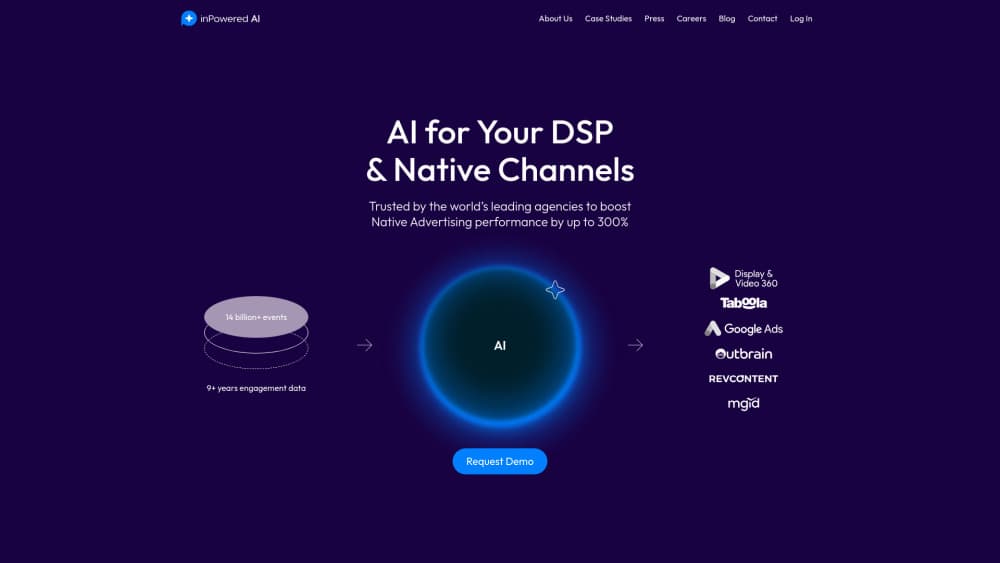
inPowered AI is an advertising platform that places machine learning models on the supply side of programmatic advertising. Its models sit inside the exchange and score each impression before a bid is made, rather than waiting for a demand-side platform to sort audiences into broad buckets. The company was founded in 2014 by brothers Peyman and Pirouz Nilforoush, after they sold their earlier ad network, NetShelter, and it is now built around what the company calls sell-side AI decisioning.
The problem it targets is wasted reach. Most campaigns set one bid and one audience definition, then serve the same message to everyone who matches. inPowered AI instead trains custom bidding algorithms on outcome data, including brand lift studies from Kantar and Cint, attention and search signals from EDO and Adelaide, and foot traffic from PlaceIQ, plus a brand's own first-party data. Those models then pick which impressions to buy through PMP deals across display, video, and CTV.
The limits are real. This is an enterprise product sold through a sales team, with no self-serve signup and no published rate card. You need a working programmatic setup, a measurable goal, and enough volume for a model to learn from. Smaller advertisers with a few thousand dollars a month will not get much out of it.
Getting Started
- Talk to the inPowered AI team and describe the campaign goal, whether that is brand lift, search lift, store visits, installs, leads, or customer value.
- Share first-party data and any existing measurement partners so the models have outcome labels to train on.
- Agree on a PMP deal structure with your exchange or supply partner, then map it into your DSP as a deal ID.
- Launch, let the model run long enough to collect signal, and review performance against the agreed outcome instead of clicks alone.
Product Information
A quick look at inPowered's pricing, supported platforms, and performance.
Best for
The users, tasks, and scenarios where this tool fits best.
Users
- Brand marketers with a hard outcome to hit
- Media agencies running retail and CPG accounts
- Ad ops and analytics leads
Tasks
- Brand lift campaigns
- CTV and video completion
- Driving store visits or qualified leads
Scenarios
- A retailer wants more visits per dollar before a seasonal push
- A soft drink brand needs reach among a narrow audience
- An agency has to prove a campaign worked
Key features
Impression-Level Decisioning
The core of the platform is a model that scores a single ad impression in real time, before the bid is submitted. It looks at the impression's context, the audience signals available on the exchange, and the trained outcome model, then decides whether this impression is worth buying and how much it is worth. That is a finer unit of control than audience segments or line items.
Custom Bidding Algorithms
Each advertiser gets a model trained on its own goal and its own data, not a shared lookalike model. The company builds these custom bidding algorithms with the client during onboarding, using first-party data and third-party outcome feeds. As results come back, the model keeps adjusting, so the bidding logic reflects what actually drove the chosen metric.
PMP Activation Across Display, Video, and CTV
Decisioning is activated through PMP deals rather than open auction buying. That gives buyers a defined inventory pool and a direct line to the supply partner, and it keeps the model inside a controlled environment. The same setup covers display, online video, and CTV advertising, which means one strategy can run across all three without separate campaigns.
Outcome Data From Measurement Partners
The models learn from outcome data supplied by Kantar, Cint, EDO, Innovid, PlaceIQ, and Adelaide, along with the advertiser's own first-party data. Brand lift, search lift, attention, foot traffic, and customer value all serve as training labels. The company says this mix is what separates its platform from bid shading or simple audience targeting.
DecisioningOS
DecisioningOS is the company's operating layer for running these models, launched with the agency PMG. It packages the model training, deal setup, and reporting into one workflow, so an agency can apply the same decisioning approach across several clients without rebuilding the plumbing each time.
On-Exchange Integration
inPowered AI says it was one of the first platforms integrated with Index Exchange's on-exchange AI. Running inside the exchange rather than on top of it cuts the latency between scoring an impression and bidding on it, and it lets the model see supply signals that never reach a DSP.
Pros and cons
Pros
- Decisioning happens per impression: the model judges each opportunity on its own merits, which is more precise than audience-level bidding.
- Outcome-based training: brand lift, foot traffic, and search data can all be the target, so the campaign is tuned to a business result rather than a proxy.
- Works with existing DSPs: teams keep their buying platform and add PMP deal IDs, which shortens the switch compared with replacing the whole stack.
- Covers display, video, and CTV: one decisioning layer spans the three formats instead of three separate optimization projects.
- Independent validation partners: measurement comes from firms the advertiser may already trust, which makes the results easier to defend internally.
Cons
- No published pricing: you have to go through sales to learn whether the platform fits your budget, and enterprise contracts are typically annual.
- Enterprise-only onboarding: there is no self-serve tier or free trial, so a small team cannot test it without a conversation and a contract.
- Needs volume and measurement: models need enough impressions and clean outcome data to learn. Thin campaigns or messy tracking will limit what it can do.
- Dependent on supply partnerships: the approach relies on exchange integrations and PMP inventory, so reach is narrower than open auction buying in some markets.
Frequently asked questions
inPowered AI is an advertising technology company that runs AI decisioning models inside ad exchanges. It scores individual impressions against a chosen business outcome and buys the good ones through PMP deals across display, video, and CTV.
Related content
Explore related tools, skills, and articles for inPowered.
inPowered Alternatives

Odyssey 3
Odyssey · OtherOdyssey-3 is Odyssey's foundation world model. It simulates physics in real time, turns a prompt into an interactive environment, and adapts to robots, cars and games.

JarvisCore
Prescott Data · Coding · Productivity · OtherJarvisCore is an open source Python runtime where AI agents work as equal peers on an agent mesh, claim tasks from a shared ledger, and reach external services through a zero-trust broker.
Clef
Cloudflare · Business · OtherClef is Cloudflare's open-source decision model for Workers AI. It returns calibrated probabilities for typed questions, not generated text, so agents can classify, route, and act fast.