

Inscribe
Inscribe · AI Detection
Inscribe is an AI document fraud detection platform for banks, lenders, and fintechs. It scans bank statements, pay stubs, and IDs for tampering and AI-made fakes, then explains each finding.
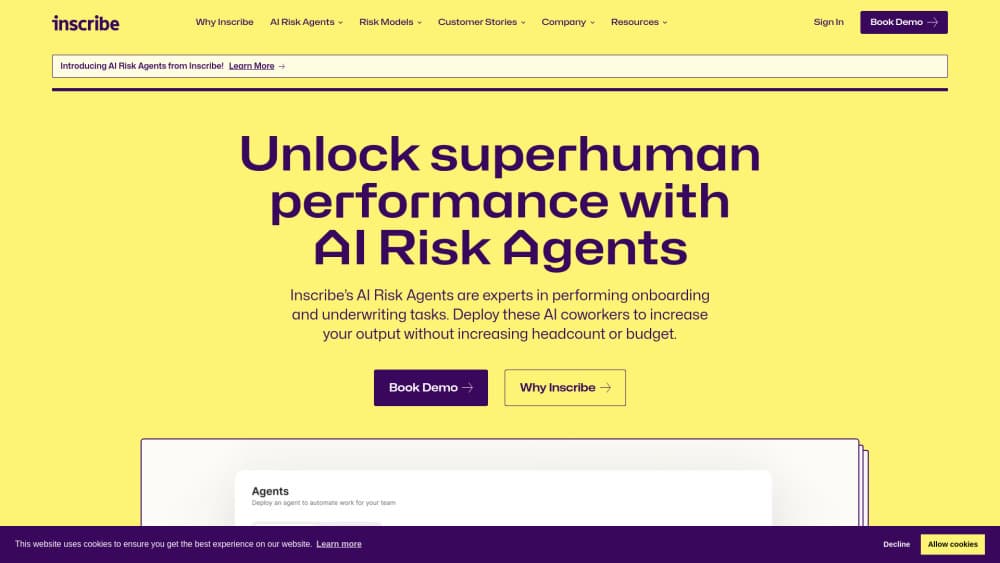
About Inscribe
What Is Inscribe
Inscribe is a fraud risk intelligence platform that reads the financial documents behind a loan or account application and tells your team which ones look forged. It is sold as AI document fraud detection software, which sounds broader than it is. The company started in 2017, is based in San Francisco with a second office in Dublin, and was founded by Ronan Burke and Conor Burke. It has raised roughly $38 million, including a $25 million Series B led by Threshold Ventures, and sells mainly to banks, credit unions, lenders, and fintechs in the United States.
The problem it targets is a review queue that no longer scales. Analysts open a bank statement, eyeball the fonts, check a few totals, and move on. A forger with a generative model can now produce a convincing statement in seconds, and the copy that slips past review turns into a direct loss. Inscribe automates the first pass: file structure, metadata, visual edits, content consistency, and the relationship between documents in the same application.
The limit is who it fits. This is enterprise software with API and loan origination system integrations, custom pricing, and no self-serve signup. A solo applicant or a small business cannot buy it off the shelf, and a team without an underwriting or KYC workflow to plug it into gets little value. It also flags risk rather than replacing judgment, so someone still owns the final call.
Getting Started
- Book a demo and a pilot, then agree on the document types and success criteria you want measured.
- Send a sample of real applications, or connect Inscribe to your loan origination system so documents flow in automatically.
- Configure the checks and risk thresholds that match your standard operating procedure, so low-risk files clear and odd ones surface.
- Review findings in the web app, where each one carries a severity ranking and a plain description of what was detected.
- Move to production with API calls, single sign-on, and role-based access for your analysts and managers.
Product Information
A quick look at Inscribe's pricing, supported platforms, and performance.
Best for
The users, tasks, and scenarios where this tool fits best.
Users
- Fraud and risk analysts at banks and credit unions
- Underwriting teams at online lenders
- Compliance and KYC teams
- Fintech product and engineering leads
Tasks
- Bank statement fraud detection
- Pay stub verification
- Deepfake document detection
- Application-level review
Scenarios
- A lending pipeline that grew past the point where analysts can read every page
- A fraud ring hitting the same template repeatedly
- A bank account verification step before a disbursement
Key features
Layered Fraud Signals
Inscribe runs forensic, network, semantic, perceptual, public data, and custom checks over the same document. Forensic work looks at file structure and metadata, perceptual work looks for copy-paste edits and generated pixels, and semantic work asks whether the numbers add up. One method misses things the others catch, which is why the platform leans on all of them instead of a single score.
Agentic Reasoning Across an Application
Most tools score documents one at a time. Inscribe reasons across the whole application and connects signals between files, roughly the way an experienced analyst lays pages side by side. A statement that looks clean in isolation can still fail once its deposits stop matching the invoice attached to it.
The Assistant
When a case needs a closer look, the built-in Assistant explains what it found and answers follow-up questions in plain language. That cuts the time an analyst spends rebuilding the story from raw output, and it gives less experienced reviewers a way to check their own read of a file.
Configurable Risk Levels and Decisioning
Every finding arrives with a risk level, a description, and insights ranked by severity. Teams set the thresholds themselves, so a strict lender and a lenient one can run the same detectors and still get decisions that match their own policy. Precision and recall are tuned per workflow rather than fixed by the vendor.
Document Collection
The Premium plan includes document collection, which asks applicants for the file you need and handles the back and forth in one place. Fewer emails and fewer abandoned applications, and the document that finally arrives lands in the same review queue as everything else.
Integrations and a Document Fraud Detection API
Inscribe plugs into loan origination systems, orchestration platforms, and your own stack through a documented API. Teams keep their existing workflow, send documents programmatically, and get structured results back. Single sign-on, role-based access, and audit logs cover the security review that banks usually run before go-live.
Pros and cons
Pros
- Purpose-built for the documents that decide money movement, so detectors are tuned on bank statements and pay stubs rather than adapted from generic document AI.
- Layered analysis catches forgeries that a single check misses, including AI-generated files that look flawless to a human reviewer.
- Findings come with readable explanations, which shortens analyst time per case and makes the output easier to defend in an audit.
- Covers underwriting, account opening, KYC, and bank account verification with one platform and one API.
Cons
- No public pricing and no self-serve plan, so you cannot test it without talking to sales and running a pilot.
- Setup assumes an existing document workflow and some engineering time for the API, which rules out small teams without either.
- It surfaces risk rather than making the final decision for you, so analyst headcount does not drop to zero.
- Coverage is strongest on US financial documents, and unusual formats outside that set may need custom work.
Frequently asked questions
It analyzes financial documents submitted with an application and reports which ones show signs of tampering or fabrication. The output is a set of findings with risk levels, not a simple pass or fail, so your team decides what to do with each file.
Related content
Explore related tools, skills, and articles for Inscribe.
Inscribe Alternatives
Isgen AI
Isgen · AI DetectionIsgen AI is a web-based AI detector that scores text for machine authorship and shows you which sentences and phrases push the number up. It's built for teachers, editors, students, and writers. Their question is simple: did this draft come from ChatGPT, GPT-5, Claude, Gemini, DeepSeek, or another model? You paste or upload content, run a scan, and get a Human, AI, and Mixed breakdown in seconds. There's also a companion editor that scores text while you write it.
Humanizeai Tools
Humanizeai Tools · Writing · AI DetectionHumanizeai Tools is a web-based AI humanizer that rewrites machine-generated text so it sounds like a person wrote it, which is the whole point of the category it belongs to. Paste a draft from ChatGPT, Claude, or Gemini, run it through the tool, and it swaps out the phrases and sentence patterns that AI detectors flag. If your goal is to make AI text sound human before you publish it, this is the kind of tool built for exactly that. It suits students, bloggers, and marketers who need copy that reads naturally and clears tools like GPTZero, Copyleaks, and Winston AI after a single pass.

Hidemyai
Hidemyai · Writing · AI DetectionHidemyai is an AI content humanizer. It rewrites text from ChatGPT, Jasper, and similar tools so the result reads like a person wrote it. You paste your draft, pick a document type and tone, and the service returns a version meant to bypass AI detectors such as Originality.ai, Turnitin, and ZeroGPT. It targets writers, marketers, and students who lean on AI drafts but can't ship copy that sounds robotic. The promise is simple: make AI content undetectable.