

Instalog
Instalog · Coding · Marketing
Instalog is an AI code review tool that comments on pull requests only when a finding is confirmed, and it ships mobile SDKs for crash reporting, event logs, and in app feedback.
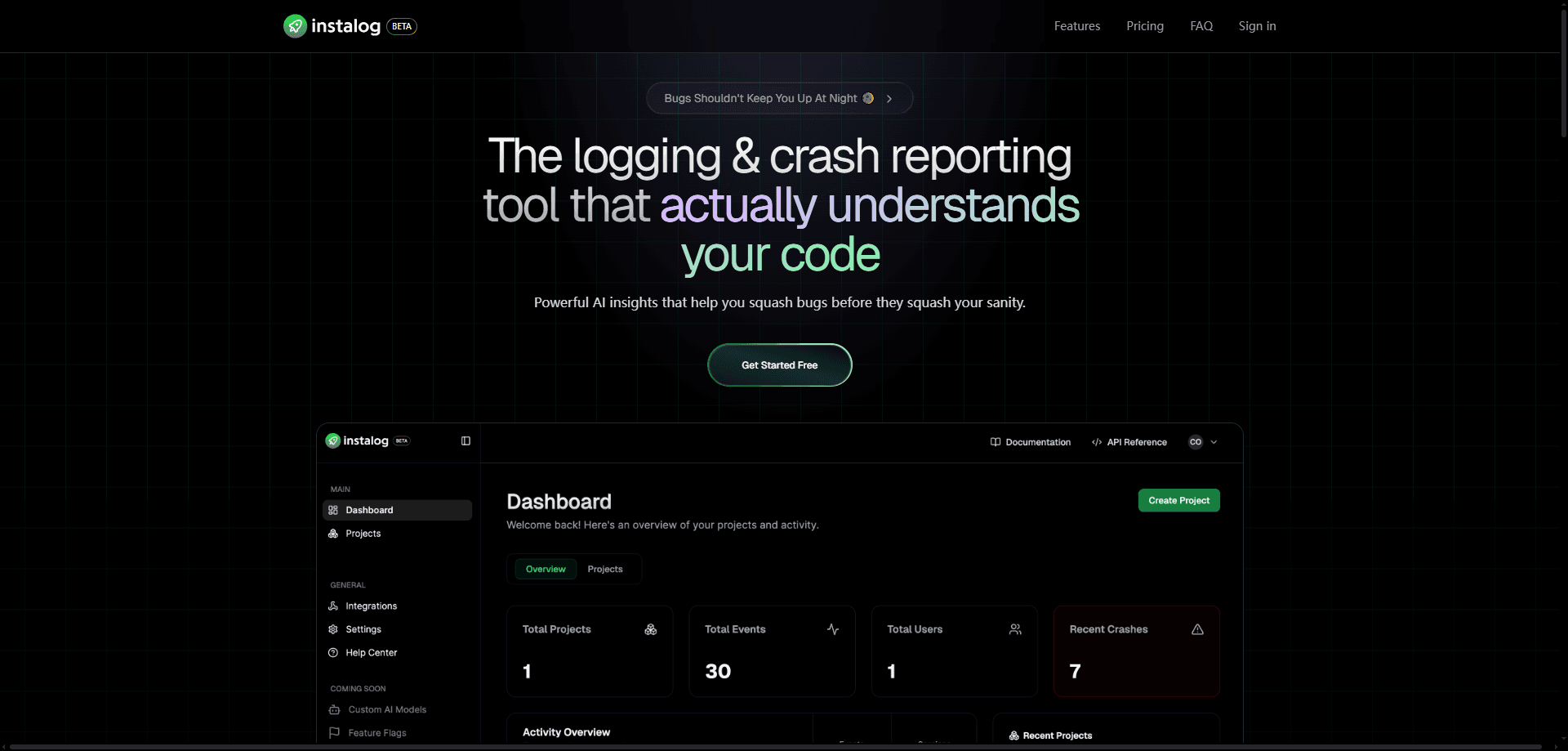
About Instalog
What Is Instalog
Instalog is an AI code reviewer built for teams that got tired of noisy bots. Most AI reviewers leave 20 to 40 comments on a single pull request, and after a week or two engineers mute them. Instalog takes the opposite route: it raises the bar for what earns a comment instead of chasing coverage.
Every pull request runs through Semgrep code analysis, codebase context from embeddings, agentic exploration, and a second model that validates each finding. Only what survives gets posted, and the default cap is five comments per pull request. A dashboard shows every finding the bot generated, including the ones it dropped and why, so a team can trust what it skips.
Beyond review, Instalog ships mobile SDKs for Android, iOS, React Native, Expo, and Flutter that handle event logging and crash reporting, plus a REST API and an MCP server. The main limits are scope and setup. The hosted version is aimed at GitHub teams, self hosting needs a VPC and your own LLM endpoint, and the precision first design means fewer comments, so teams that want exhaustive feedback have to lower the confidence threshold and accept more noise.
Getting Started
- Install the GitHub App at github.com/apps/instalog and pick the repositories you want reviewed.
- Open a pull request. The instalog/review check appears within seconds, and the first comment usually lands in about 60 to 90 seconds.
- Read the summary comment for the finding count and drop rate, then check any inline comments on the lines that survived filtering.
- Drop an optional instalog-ai.yaml at the repo root to tune the confidence threshold, comment cap, and rules.
- Sign in at app.instalog.dev to see every finding, the dropped ones, and your acceptance rate over time.
Product Information
A quick look at Instalog's pricing, supported platforms, and performance.
Best for
The users, tasks, and scenarios where this tool fits best.
Users
- Engineering teams tired of noisy review bots
- Solo developers and indie apps
- Mobile teams shipping native or cross platform apps
Tasks
- Pull request review
- Crash reporting and event logging
- Tuning review strictness
Scenarios
- Catching regressions before merge
- Investigating a production crash
- Cleaning up alert fatigue
Key features
Low noise review by design
The reviewer runs every finding through Semgrep, codebase context, agentic exploration, and a second model before anything is posted. The default cap is five comments per pull request, and the bar is acceptance rather than coverage. That inversion is what separates Instalog from reviewers that post whatever a single pass returns.
Grounded findings
Every comment cites a Semgrep rule or a specific file and line, so engineers don't have to guess where a problem lives. A high severity Semgrep result is treated as a fact rather than an opinion, which means it skips the confidence filter entirely.
Mobile SDKs for five platforms
Official SDKs cover Android, iOS, React Native, Expo, and Flutter from a single API key per app. Each one handles event logging, crash reporting, manual error reporting, and a prebuilt in app feedback form with screenshot attachment. The same dashboard collects everything.
AI crash analysis
Crash groups get a plain English explanation of the failing path, so a non specialist can read what broke. The dashboard can follow up with suggested fixes that patch your real code instead of offering generic advice.
Ask your logs in natural language
You can query millions of log lines in plain language and get grounded answers, so a vague bug report turns into a specific session fast. The result references concrete sessions and builds rather than a wall of raw log rows.
Team integrations and self hosting
Crashes route to Slack, findings open issues in Linear, and shared rules keep a whole team aligned. Regulated teams can run the reviewer entirely inside their own VPC with a self hosted LLM endpoint, so no code or diffs leave the network.
Pros and cons
Pros
- Free for public repositories, which lets open source maintainers try the review before paying.
- Capped output means a pull request won't get buried under dozens of comments.
- The dashboard shows dropped findings and the reason, so filtering is auditable instead of a black box.
- Mobile SDKs and a REST API ship in the same product, so a team can cover code review and app telemetry together.
Cons
- Precision first means fewer comments, so teams that want exhaustive feedback must lower the confidence threshold and accept more noise.
- Self hosting needs a VPC and a self hosted LLM endpoint, which is real infrastructure work for a small team.
- Flutter and React Native coverage centers on events and crashes, so native only features have no direct equivalent.
- The $29 per developer per month price for private repositories is per seat, so cost scales with headcount.
Frequently asked questions
It reviews pull requests and posts only the findings that pass a static analysis and multi pass validation pipeline, and it also ships mobile SDKs for crash reporting, event logging, and in app feedback. The goal is a review bot a team won't mute.
Related content
Explore related tools, skills, and articles for Instalog.
Instalog Alternatives

Base Code
Base44 (Wix) · Coding · ProductivityBase Code is a shared cloud development environment from Base44. Teammates describe changes to an existing GitHub codebase in chat, preview them live and send them back as pull requests.

Google EmbeddingGemma 2
Google DeepMind · Writing · Image · CodingGoogle EmbeddingGemma 2 is a 740M-parameter open model that turns text, code, images, audio, and video frames into vectors in one 768-dimension space, running on phones and laptops.

GitGlow
GitGlow · Coding · ProductivityGitGlow is a local-first desktop Git client that lets independent developers review their own code and their AI agents' changes in one place before shipping.