

Shown
Shown · Marketing
Shown is an AI ad platform for small businesses. It builds campaigns, writes copy, generates creatives, and optimizes ads across Google, Microsoft, Meta, TikTok, and Twitter.
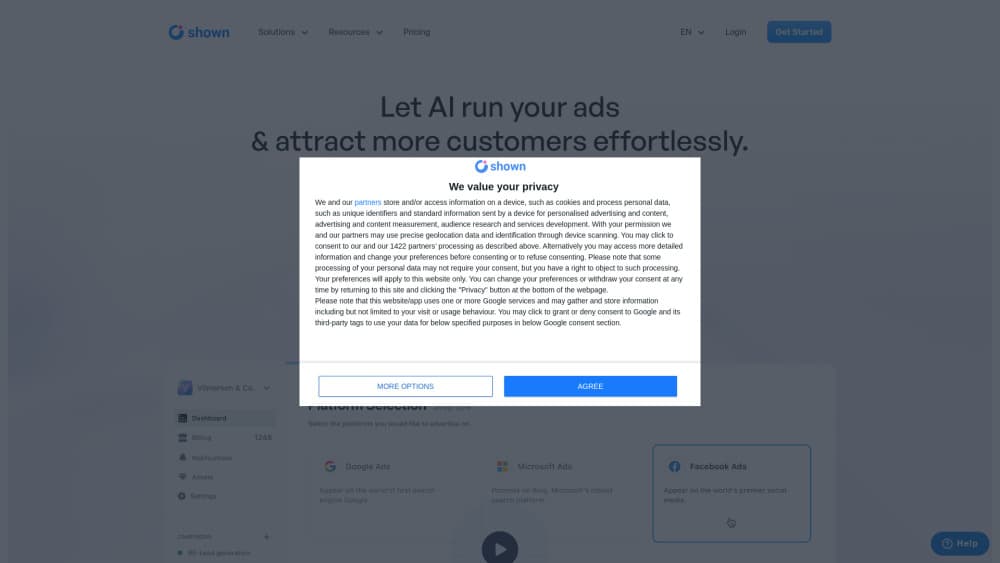
About Shown
What Is Shown
Shown is an AI ad platform built for small and medium businesses that want paid traffic without hiring an agency. It treats small business advertising as a job the software can run end to end. You describe the business, and the system assembles a campaign: audience targeting, ad copy, banner and image creatives, and the bidding setup. It then publishes to the major ad networks and keeps adjusting the account while you get on with running the company.
Ad automation sits at the center of the product, and it feels closer to a managed service than to a self-serve ads editor. Shown is a Google Premier Partner, and it can either run your ads through its own ad accounts or connect the accounts you already have. The difference matters for cost: Shown takes a 20% commission on media budget when it handles the accounts, and 0% when you link your own.
The main limitation is control. Everything runs on automated decisions, so granular manual tweaks are limited, and you trade fine-grained oversight for time saved. Businesses with an in-house performance marketer may find the automation too broad. Companies without one usually find that trade worth it.
Getting Started
- Create a free account at shown.io. No credit card is required for the trial, and setup takes a few minutes.
- Describe your business, what you sell, and who you want to reach. Add an email list or product list through the integrations if you have one.
- Review the generated campaign. Shown writes the copy and produces the banner and image creatives, and you approve or ask for changes.
- Choose how to pay for media. Use a Shown ad account for a single budget across channels, or link your own Google, Microsoft, Meta, TikTok, or Twitter account.
- Launch and monitor. The dashboard shows spend and results per channel, and the system keeps pausing weak keywords and testing new ads on its own.
Product Information
A quick look at Shown's pricing, supported platforms, and performance.
Best for
The users, tasks, and scenarios where this tool fits best.
Users
- Small business owners
- Solo founders and freelancers
- Marketing generalists in small teams
Tasks
- Launching a first Google Ads campaign
- Producing ad creative without a designer
- Running one budget across channels
- Importing campaigns you already run
Scenarios
- A local service business with no marketing hire
- A seasonal promotion with a short window
- Testing whether paid ads work for a product
Key features
Campaign Build from a Short Brief
You describe the business and the goal, and Shown assembles the campaign structure, audience targeting, and bidding approach. Copy and creatives come from the same brief, so the pieces match instead of being stitched together by hand. The result is a campaign you can review in minutes rather than a blank ads interface.
AI Copy and Creative Generation
The platform writes ad copy and generates banners and images for each campaign. That covers the routine production work that slows small teams down, especially when a single campaign needs multiple sizes and variants. You still review the output, since generated copy reflects what you told it about the business.
Publishing Across Major Ad Networks
Campaigns can run on Google, Microsoft, Meta, TikTok, and Twitter from the same account. Shown handles the setup differences between search and social placements, which is the part most non-specialists get wrong. One campaign can reach search traffic and social feeds without separate builds.
Always-On AI Ad Optimization
Optimization runs continuously rather than in weekly review sessions. The system pauses underperforming keywords, creates new ads to A/B test, and suggests new targeting as data comes in. For a small account, that means the daily maintenance happens without anyone logging in.
Chat-Based Campaign Control
Three AI assistants handle different jobs. Mary covers marketing strategy, Sean works on Google and Microsoft search ads, and Sophie handles Meta and TikTok social ads. You ask for a change in plain language, and the assistant edits the campaign rather than sending you to a settings menu.
Unified Dashboard and Budget Credits
Every campaign and channel reports into one dashboard, including imported campaigns you already run elsewhere. Shown credits let you fund media budgets across platforms from a single balance, and spending earns bonus credits. Comparing channels side by side gets easier when the numbers sit in the same place.
Pros and cons
Pros
- Campaign assembly, copywriting, and creative production sit in one workflow, which removes the usual handoffs for a small team.
- Continuous optimization handles keyword pausing and A/B testing without daily manual checks.
- You can link your own ad accounts and pay 0% commission on media budget, keeping platform costs transparent.
- Publishing covers Google, Microsoft, Meta, TikTok, and Twitter, so one setup reaches both search and social inventory.
- The 7-day trial needs no credit card, and the $29 Starter plan keeps the entry cost low for a single offer.
Cons
- Using a Shown ad account adds a 20% commission on ad budget, which is a real cost for anyone spending heavily.
- The Starter plan allows only 3 campaigns and 30 creatives, so a business testing several offers will hit the ceiling fast.
- Automated decisions leave limited room for granular manual control, which frustrates marketers who want to tune bids and audiences themselves.
- There's no documented public API, so teams that want to pull ad data into their own reporting stack have to work from the dashboard.
Frequently asked questions
Shown runs paid advertising for small businesses. You describe the business, and it builds campaigns, writes the ad copy, generates banners and images, publishes to major ad networks, and keeps adjusting bids and keywords as results come in. It replaces the manual work of setting up and maintaining ads across several platforms.
Related content
Explore related tools, skills, and articles for Shown.
Shown Alternatives

ngram 2.0
ngram · Video · Marketingngram 2.0 is an AI video generator for teams. It turns a prompt, a screen recording, or a product URL into a narrated explainer, product demo, or AI avatar video, and every scene stays editable.

shippedit.me
Krawlup · Marketing · Businessshippedit.me now redirects to Krawlup, a web platform that audits SEO, AEO and page speed every week, then hands the fixes to AI coding agents over MCP.

MePersona
MePersona, Inc. · Writing · Productivity · MarketingMePersona is an AI unified inbox for creators. It learns your voice, drafts replies to fan messages from 12 platforms, and sends only what you approve.