

Intervo
Intervo · Voice & Language · Chatbot
Intervo is a voice AI agent platform for building open-source chat and voice agents that answer calls, qualify leads and handle AI customer support, with a self-hosted core and a free plan.
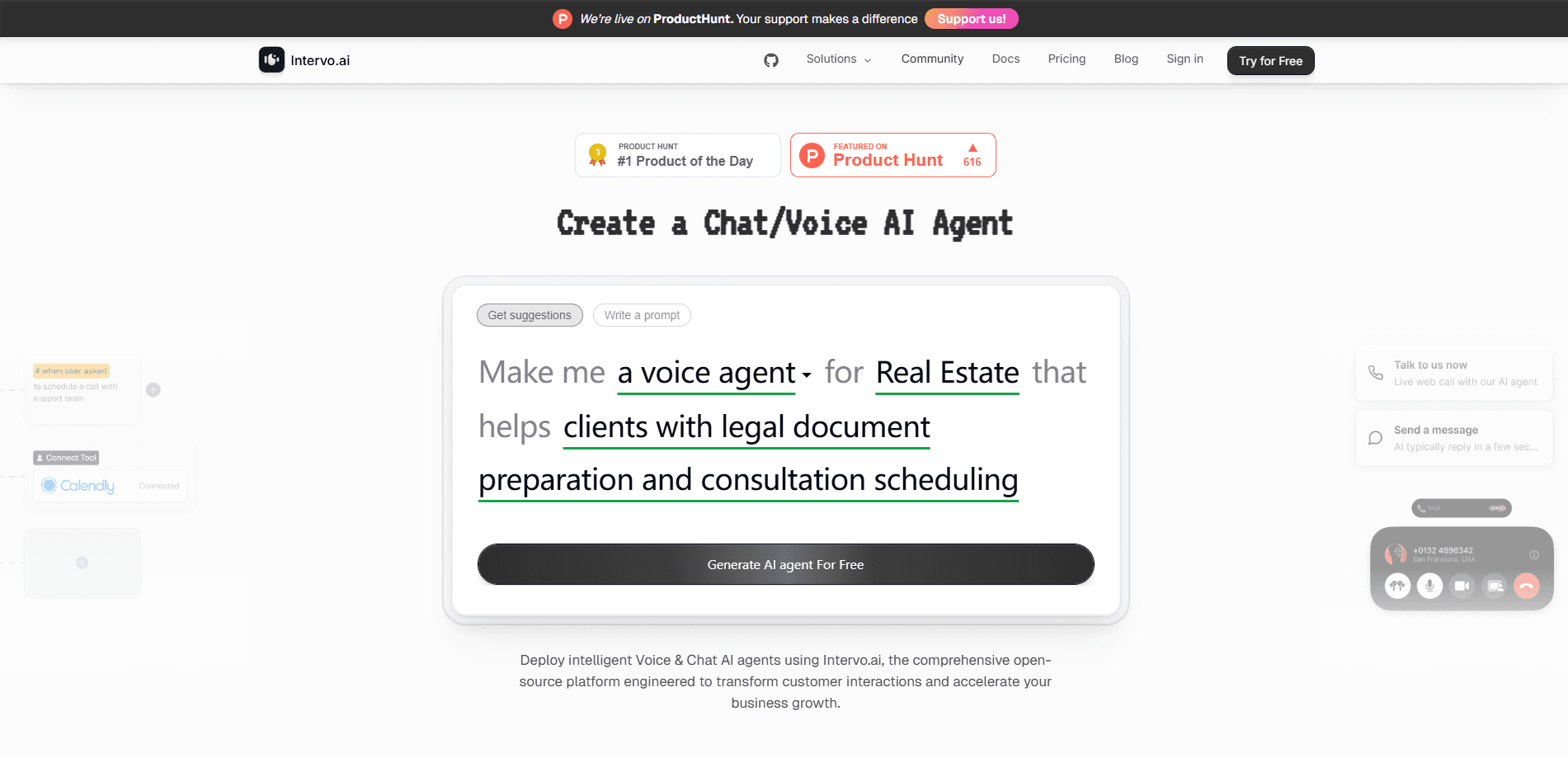
About Intervo
What Is Intervo
Intervo is a platform for building voice and chat AI agents aimed at businesses. The product runs on intervo.ai, with the core also available as open source you can host yourself. You describe what the agent is for, load it with your own documents, pick a voice and publish it to a website widget or a phone number. The company leans hard on two words in its own pitch: open-source and self-hosted. That means teams can run the core themselves instead of renting a closed black box, which matters if you handle customer data or want to swap in your own models.
The product covers both channels from one place. A chat widget sits on a website and handles text conversations. Voice agents pick up and place calls through a Twilio integration, so the same assistant that answers questions on your site can also handle a phone line. The site frames this around a simple claim: you build a working agent in five minutes without writing code.
There are real limits to go in with your eyes open. The voice recognition is reported at 90 to 95 percent accuracy in ideal conditions, and that number drops with background noise, accents or complex language. The platform also says plainly that a human still needs to step in for questions outside the agent's knowledge, so this replaces routine work rather than a whole support team.
Getting Started
- Sign up and describe the agent's purpose in a prompt, which generates a starting workflow for your use case
- Add knowledge by uploading your own documents and files so the agent answers from your material
- Choose a voice from the ElevenLabs or Azure options, then review how it sounds on a call
- Publish with one click and embed the widget on your site or route it to a Twilio phone number
Product Information
A quick look at Intervo's pricing, supported platforms, and performance.
Best for
The users, tasks, and scenarios where this tool fits best.
Users
- Customer support teams
- Sales teams
- Small and growing businesses
- IT and HR teams
- Developers and self-hosters
Tasks
- Automating tier-1 support
- Lead qualification
- Onboarding users
- Internal help desk
- Multilingual calls
Scenarios
- A support line floods at launch
- A lead fills a form after hours
- A new customer signs up
- A remote team needs IT help
- A global customer calls in
Key features
Voice and Chat in One Platform
Intervo runs the two channels most businesses actually use. A chat widget handles text conversations on your website, while voice agents take and place calls. The company notes that voice agents and chatbots behave differently, since one talks and the other types, and says it covers both so you aren't stitching together two vendors. For a support desk, that means a customer can start in a chat window and later call the same line without you rebuilding the knowledge base.
Self-Hosted and Open Source
The core is open source, and the site points to a Git repository you can clone, customize and deploy yourself. That is the part that separates Intervo from most voice-agent SaaS tools, which keep everything on their own servers. Self-hosting appeals to teams with data rules or a preference for owning their stack. The site is upfront about the tradeoff: running it yourself means setup, hosting and scaling fall to your own technical staff.
Build an Agent in Four Steps
The build flow is short and written for non-developers. You define the agent's purpose with a prompt that generates a workflow, add knowledge by uploading documents, pick a voice and publish. The company bills this as no-code, and the four steps map to how a small team would actually get an agent live without a project manager. Templates and orchestration frameworks are there if you want a faster start than building from scratch.
Voice Options via ElevenLabs and Azure
Voice quality is where a voice agent lives or dies. Intervo draws on established providers rather than build its own. You choose from a range of voices powered by ElevenLabs or Azure, then hear how the agent sounds before it faces a customer. Since the voice is the most audible part of every call, the ability to audition and change it without touching code is a practical detail, not a footnote.
Twilio Phone Integration
A connected phone number turns an agent from a website helper into something anyone can dial. Intervo uses a Twilio integration to manage calls and engage customers in real time, so a support line or a sales callback number can run on the same agent that answers your chat. For businesses whose customers prefer the phone, this is often the feature that decides whether the product fits at all.
Real-Time Translation and Lead Scoring
Two features push past basic Q&A. Real-time translation lets the agent understand, translate and respond across languages. That helps global teams avoid hiring bilingual staff for every market. On the sales side, the agent scores each interaction against custom criteria like budget, project needs and timeline. It then adapts its questions to pull out the details that matter. Both are the kind of capability that shows up once an agent has real conversations to learn from.
Pros and cons
Pros
- Open-source core you can clone, customize and self-host, which is rare among voice-agent platforms
- Covers both chat and phone from one agent instead of two separate tools
- Four-step, no-code build flow that a small team can run without a developer
- Voice options from ElevenLabs and Azure, with real-time translation across languages
- Free plan with three agents lets you test before paying
Cons
- Self-hosting puts setup, hosting and scaling in your hands, so you need technical staff on hand
- Voice accuracy of 90 to 95 percent only holds in ideal conditions, and drops with noise or heavy accents
- The agent still needs a human for questions outside its knowledge, so it replaces routine work rather than a team
- Some site details, such as launch timing and update history, aren't clearly published for every plan
Frequently asked questions
Intervo is an open-source platform for building voice and chat AI agents for businesses. It lets you create an agent from a prompt, train it on your own documents, give it a voice and deploy it as a website widget or a phone line through Twilio. The core is self-hosted, so teams can run it on their own infrastructure.
Related content
Explore related tools, skills, and articles for Intervo.
Intervo Alternatives

Off the Record
Weird Machines · Voice & Language · ProductivityOff the Record is a macOS app from Weird Machines that reshapes your voice in real time to block AI transcription, so people hear you normally and notetakers get nothing usable.
Cekura Bench
Cekura · Voice & Language · BusinessCekura Bench is a public benchmark that runs speech-to-speech models and deployed voice agents through 82 simulated phone calls, three times each, then publishes pass rates, latency and cost.
Griffin by Tavus
Tavus · Voice & Language · Video · ChatbotGriffin by Tavus is the first Human Interaction Model: a full-duplex, video-to-video system that watches, listens, and answers during a live video call in real time.