

Inworld
Inworld AI · Writing · Chatbot
Inworld AI is a realtime voice AI platform that combines text-to-speech, speech-to-text, and an OpenAI-compatible model router into one pipeline for building apps that talk.
About Inworld
What Is Inworld AI
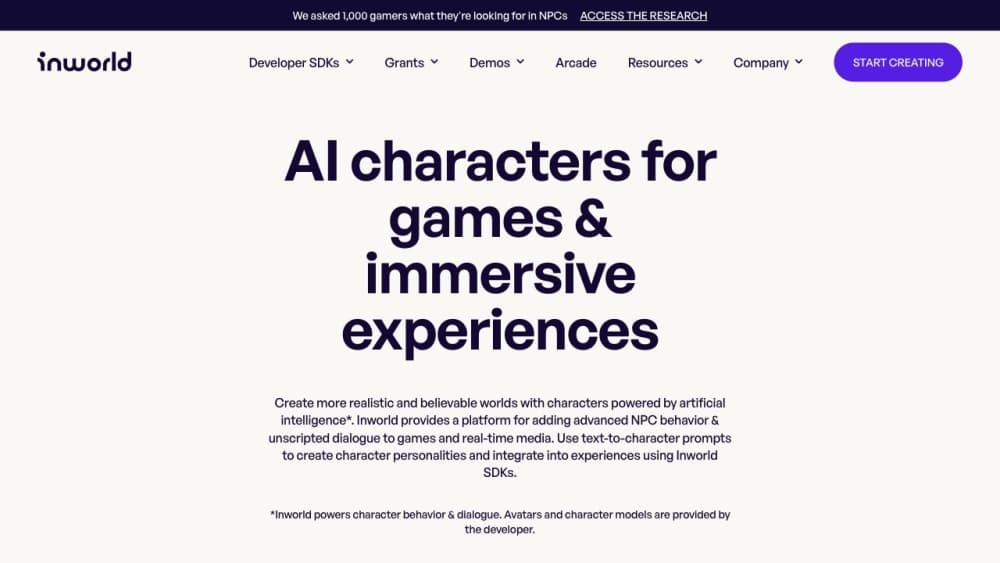
Inworld AI started as a research lab building AI characters for games. Today it sells a conversational AI platform: the speech, listening, and language models that keep a voice agent talking without awkward pauses. The pitch is simple. Instead of stitching together a text-to-speech vendor, a speech-to-text vendor, and a separate language model, developers wire up one platform and get a full voice loop.
The company ships six products. Realtime TTS turns text into expressive speech and ranks first on Artificial Analysis for voice quality. Realtime STT transcribes what users say, including how they say it. The Realtime Router sends requests to more than 100 language models through one OpenAI-compatible endpoint. Realtime Inference runs Inworld-tuned open models, the Realtime API bundles listening, thinking, and speaking into a single WebSocket session, and Compute offers dedicated GPUs for heavy traffic.
The main limitation is the audience. This is a developer platform, not a consumer app. There's no drag-and-drop editor for non-coders, and the free tier is built for evaluation rather than production. Teams that just want a finished chatbot or a simple voiceover tool will find more than they need here.
Getting Started
- Sign up at platform.inworld.ai and create a workspace.
- Generate an API key, then store it somewhere safe. Server-side calls authenticate with it directly as a Basic token.
- Pick a product for your use case, such as Realtime TTS for voiceover or the Realtime API for a full back-and-forth conversation.
- Send your first request. REST text-to-speech uses the voice and model fields, while the WebSocket Realtime session uses a different set, so keep them separate.
- Clone a custom voice if you need one, then build it into your app.
Product Information
A quick look at Inworld's pricing, supported platforms, and performance.
Best for
The users, tasks, and scenarios where this tool fits best.
Users
- App developers
- Indie studios
- Product teams at larger companies
Tasks
- Building a full-duplex voice agent
- Cloning a brand or character voice
- Routing requests across language models
- Generating narration at scale
Scenarios
- Shipping a language learning app
- Running a phone support line
- Testing an idea before committing
Key features
Realtime TTS With Voice Cloning
Inworld's text-to-speech models turn text into speech that's meant for live conversation, not batch narration. The flagship TTS-2 targets expressiveness, while TTS-2 Flash pushes latency down to about 20 milliseconds for the first audio byte. Both cover more than 200 languages and keep a voice sounding like the same person across languages. Instant voice cloning needs only 5 to 15 seconds of reference audio, and streaming output can return word and phoneme timestamps for lip sync.
Full-Duplex Realtime API
Most voice agents are three products glued together, and every seam is a place to fail. The Realtime API collapses listening, thinking, and speaking into one persistent WebSocket session that follows the OpenAI Realtime protocol, so teams can bring their own language model through the Router. It includes voice activity detection and a turn detector, which is what lets a user cut in mid-sentence without the agent steamrolling them.
Multi-Model Router
The Router exposes more than 100 language models from OpenAI, Anthropic, Google, Meta, Mistral, DeepSeek, and others through a single OpenAI-compatible endpoint. It runs two tracks. The third-party track passes requests to external providers, and the first-party track serves Inworld-tuned open models. Switching models is a config change rather than a rewrite, which matters when pricing or quality shifts.
Speech-to-Text With Voice Profiling
Realtime STT doesn't just transcribe words. It reads how they were said, capturing cues like pitch, pace, and emotion so an agent can respond with context instead of a flat reply. It pulls from multiple providers, including Inworld's own speech model, Groq Whisper, AssemblyAI, and Soniox, so teams can trade off accuracy, speed, and cost per call.
Realtime Inference
As a first-party LLM router track, Inworld hosts its own optimized open-source models, like Gemma and DeepSeek, tuned to run at consumer-scale cost with realtime latency. The point is the free tier. Running an open model cheaply enough to serve millions of free users is the hard part of any voice app, and this track is built for exactly that pressure.
Managed Compute
For teams past the shared-inference stage, Inworld offers dedicated GPU capacity. It sits under the speech and inference products and holds latency steady when traffic outgrows the default pool. This is aimed at committed, high-volume customers rather than teams still prototyping.
Pros and cons
Pros
- One platform covers text-to-speech, speech-to-text, language models, and the realtime session, cutting the number of vendors a voice app depends on.
- Text-to-speech holds the top spot on Artificial Analysis, and the Flash model reaches roughly 20 milliseconds to first audio byte.
- The Router speaks the OpenAI API, so existing code and tooling often work with minimal changes.
- Voice cloning from a short clip and support for 200+ languages make localization and branded voices practical.
- A free evaluation tier and usage-based credits let a team test latency and quality before committing to a paid plan.
Cons
- It's built for developers. Anyone without API experience will need a coder on the team, since there's no no-code builder.
- On-demand LLM calls are billed at provider cost on top of your plan, so a high-traffic app can spend well past the monthly credit.
- The free tier is meant for prototyping. Pushing a real audience through it means moving to a paid plan quickly.
- The company pivoted from game characters to voice infrastructure, so older tutorials and NPC-focused docs no longer match the current product.
Frequently asked questions
It provides realtime voice infrastructure. That includes text-to-speech, speech-to-text, a multi-model router, and a full-duplex realtime API for building voice agents. The earlier focus on game characters is a smaller part of the business today.
Related content
Explore related tools, skills, and articles for Inworld.
Inworld Alternatives

Claude for Google Workspace
Anthropic · Writing · Productivity · BusinessClaude for Google Workspace puts Claude in a sidebar inside Google Docs, Sheets, and Slides, where it reads the file you have open and edits it in place.

Claude Haiku 5.5
Anthropic · Writing · Coding · ChatbotClaude Haiku 5.5 is Anthropic's fastest and cheapest small model, built for high volume tasks at $0.10 per million input tokens with a 1M token context window.
NoteWorthy
Suman Hansada · Writing · Productivity · AI AssistantNoteWorthy is a notes app for iPhone, iPad and Mac that writes titles, tidies formatting, summarizes long notes and files each one with on-device AI. No account, no upload, no network requests.