

Islam & AI
Islam & AI · Coding · Chatbot
Islam & AI is a study chatbot that answers questions about the Quran, authentic Hadith, and Islamic history, citing verses by number instead of quoting Arabic.
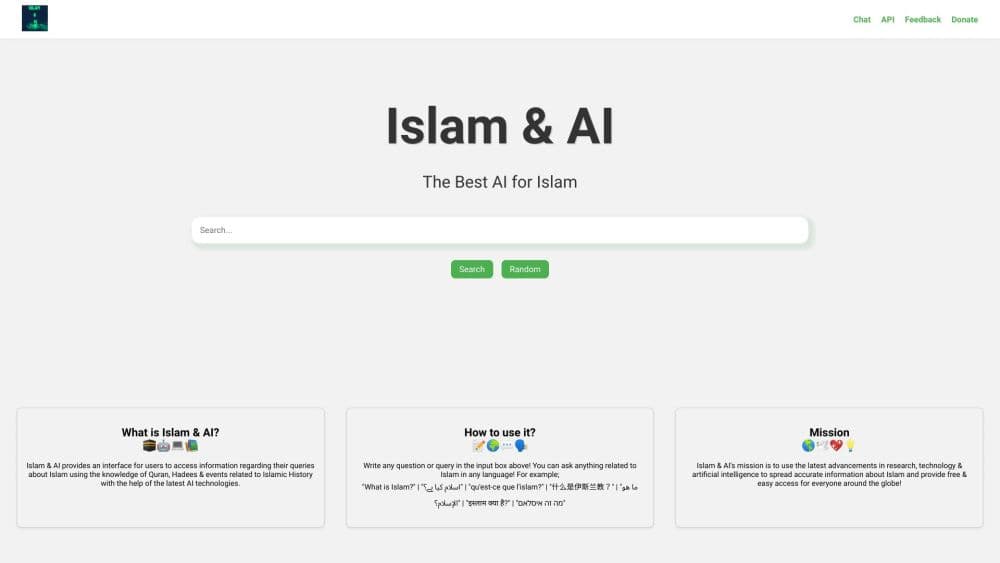
About Islam & AI
What Is Islam & AI
Islam & AI is a Quran study tool for the web and Android, built for researching Islam. You type a question, and it answers in your own language with numbered references you can look up: a surah name and verse number, or a hadith collection and entry number. The point is that you can check the answer instead of taking it on faith.
What separates it from a general chatbot is what it will not do. It never writes out Quranic or Hadith Arabic, not even a single word, because a generated letter in the wrong place changes a sacred text. It also refuses to issue fatwas and refuses to pick sides between schools of thought. Those refusals shrink what the tool can do, and they're the reason it's safe to use as a starting point for study.
Islam & AI runs on the DeepSeek model, instructed specifically for Islamic study, and its FAQ states that answers draw on the Quran and the authentic Sunnah, citing collections such as Sahih al-Bukhari and Sahih Muslim. The site has been used across 191 countries according to its about page, and the free chat needs no account to start.
One limit deserves emphasis. This is a research aid, not a scholar. For worship, family matters, contracts, or anything you intend to act on, the tool itself tells you to ask a qualified scholar.
Getting Started
- Open islamandai.com and type your question into the search box on the home page, or tap Start chatting. No account is needed for the first conversation.
- Read the answer and follow its reference. Note the surah and verse number or the hadith number, then open Quran.com or a trusted collection to read the exact wording.
- Sign in with Google if you want the chat saved. Signed-in users get history across sessions, and Lite and higher plans add cloud memory for longer studies.
- Ask follow-up questions in the same thread. Asking in another language is fine, because the assistant answers in the language you write in.
- Set up a study circle under Groups if you're learning with others. Answers and their citations are shared with the circle so everyone sees the same sources.
Product Information
A quick look at Islam & AI's pricing, supported platforms, and performance.
Best for
The users, tasks, and scenarios where this tool fits best.
Users
- Muslims who want a quick answer with a source
- Parents and teachers explaining basics
- Non-Muslims researching Islam for school, work, or curiosity
- App developers and site owners
Tasks
- Checking a claim you heard in a video or a group chat
- Understanding a surah you're reading
- Learning a dua or a prayer step by step
- Preparing a khutbah, lesson, or study note
- Building an Islamic Q&A feature
Scenarios
- A late-night question with nobody to ask
- Studying in a second language
- Family study time
- Shipping an app on a tight schedule
Key features
Numbered citations instead of quoted Arabic
Every answer points to a location: a surah and ayah such as Surah Al-Baqarah 2:153, or a hadith number in a named collection. The tool deliberately never reproduces the Arabic, so there's no risk of a missing diacritic or a shifted letter reaching you. You read the sacred text from a vetted source and use the chat for the context around it.
Built-in refusals that protect the study
Three things are off the table: issuing fatwas, favoring one sect over another, and generating or transliterating Quranic and Hadith Arabic. That makes the tool narrower than a general assistant. It also means you won't get a verdict on your specific situation, and you'll be told to take that to a scholar.
Free core chat with no sign-up
The main chat is free and needs no card, with a daily allowance of 30 messages. You can ask questions without creating an account, which matters if you're simply curious or comparing tools. Signing in unlocks saved history, and paid plans raise the daily limit.
Conversation memory across sessions
Signed-in users on paid plans get cloud memory, so a study thread on one topic doesn't have to be restarted each time. The chat keeps track of what you've covered, which helps when you're working through a long surah over several weeks. Free users keep a shorter history tied to the account.
Group study circles
Groups are private, invite-only spaces where questions and the cited answers appear for every member. A teacher and a class, or a family spread across countries, can work through the same questions and see the same references. Access is by invitation code, so circles stay closed.
Hadith tree for chain of narration
As an Islamic research AI feature, the Hadith tree lays out the isnad, the chain of narrators, for sample hadiths, from the Prophet to the collector. Following a chain makes it obvious why a hadith's authenticity is graded rather than assumed. It's a teaching tool more than a research database, useful for showing how transmission works.
White-label API for developers
The developer API covers health checks, entitlement lookup, and streaming chat over Server-Sent Events, with Bearer authentication and a single key per tenant. Responses cite sources and never mention Islam & AI, so the tool disappears into your interface. Plans run from a free 50k token tier to $149/mo for 30M tokens, each with a hard monthly cap that prevents overage charges.
Pros and cons
Pros
- Every answer comes with a location you can check, so you're one tab away from the primary source.
- Refusals are explicit, and they cover the three cases where a chatbot does the most damage: invented rulings, sectarian bias, and misquoted Arabic.
- The free tier is genuinely usable at 30 messages a day, and no account is required to start.
- The API carries the same guardrails as the consumer app, which is unusual for a small platform.
- One account covers chat, saved history, groups, and the API, so you're not juggling separate services.
Cons
- The tool will not answer "is this halal for me" type questions, so a large share of real-world use ends with "ask a scholar."
- Answers come from the model's training knowledge rather than a live database lookup, so a citation still has to be checked before you trust the exact wording.
- The interface is English-first, and only the replies adapt to the language you ask in.
- Group search and the hadith tree hold only sample content, so heavy research still needs Quran.com and the full collections.
Frequently asked questions
As an Islamic study app, Islam & AI answers questions about the Quran, the authentic Sunnah, and Islamic history. You ask in plain language, and it replies with an explanation plus numbered references, so the answer can be checked against Quran.com or a hadith collection instead of trusted as-is.
Related content
Explore related tools, skills, and articles for Islam & AI.
Islam & AI Alternatives

Base Code
Base44 (Wix) · Coding · ProductivityBase Code is a shared cloud development environment from Base44. Teammates describe changes to an existing GitHub codebase in chat, preview them live and send them back as pull requests.

Google EmbeddingGemma 2
Google DeepMind · Writing · Image · CodingGoogle EmbeddingGemma 2 is a 740M-parameter open model that turns text, code, images, audio, and video frames into vectors in one 768-dimension space, running on phones and laptops.

GitGlow
GitGlow · Coding · ProductivityGitGlow is a local-first desktop Git client that lets independent developers review their own code and their AI agents' changes in one place before shipping.