

Jackpot Genius
JackpotGenius.ai · Coding · Marketing
Jackpot Genius is an AI lottery generator that reads years of draw history to build balanced number lines for Powerball, Mega Millions and other games. The AI tools cost €4.99/mo after a 14-day trial.
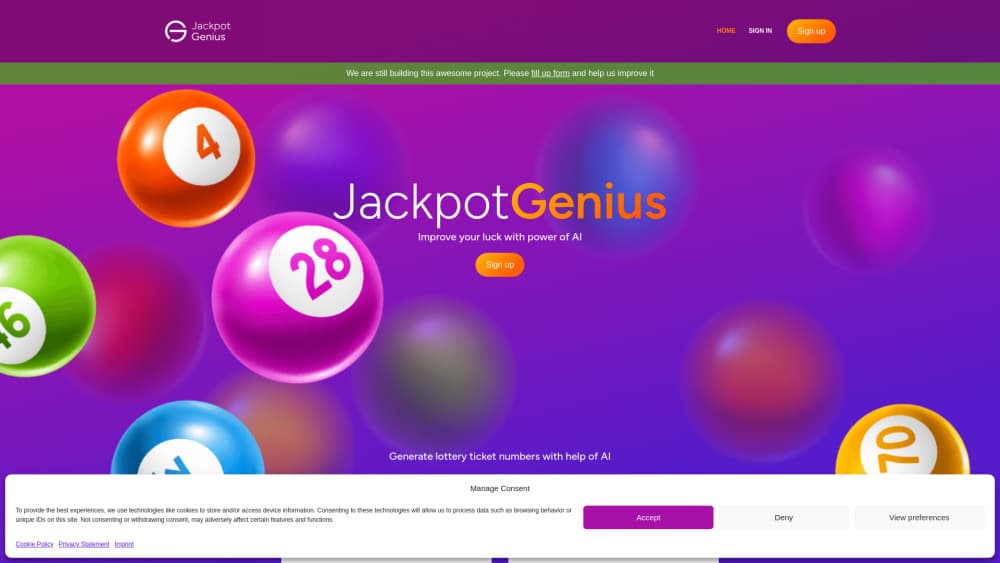
About Jackpot Genius
What Is Jackpot Genius
Jackpot Genius is a web tool that generates lottery numbers from historical draw data rather than from a blank random picker. You choose a game or set your own number range, and the engine returns lines shaped by past frequency, spacing, and odd/even balance. The team behind it works out of Estonia and states plainly that the draw itself stays random.
That honesty is the useful part. The product doesn't claim to beat the odds. It claims to remove the patterns that humans and lazy quick picks fall into, such as six numbers under 31 or five evens in a row. Whether that changes your results is a separate question, and the site says it can't guarantee a win.
The limits matter as much as the features. There's no ticket buying, no account sync with a lottery operator, and no mobile app. Everything runs in a browser. The AI and the analytics sit behind a subscription, so the free version is closer to a demo than a full tool.
Getting Started
- Open jackpotgenius.ai and pick a lottery from the list, or start a custom generation with your own minimum, maximum, and step values.
- Set how many rows you want, whether repeats are allowed, and which strategy filter to apply.
- Start the 14-day trial if you want the AI engine and the analytical panels. Basic generation works without paying.
- Press Generate and review the lines. Each one comes with the hot and cold context for that matrix.
- Copy the numbers into your ticket, your lottery app, or a shared pool sheet before the draw closes.
Product Information
A quick look at Jackpot Genius's pricing, supported platforms, and performance.
Best for
The users, tasks, and scenarios where this tool fits best.
Users
- Regular lottery players
- Data-minded hobbyists
- Office pool organizers
Tasks
- Building a Powerball or Mega Millions line
- Checking which numbers are running hot
- Producing random numbers for non lottery work
- Comparing a quick pick against an AI line
Scenarios
- The night before a big rollover
- Playing several European draws in one week
- Settling a family argument about lucky numbers
Key features
LSTM Prediction Engine
The v2 engine treats a lottery as a timeline rather than a series of isolated draws. Long short-term memory layers hold on to patterns across months and years of results, then weigh them when a new line is requested. That's the core difference from a random number generator with a lottery skin.
Attention Layer for Relevant Draws
Not every past draw says something about the current cycle. An attention mechanism scores recent results against longer history and focuses the model on the draws that share characteristics with the present moment. Noise from a decade ago carries less weight.
Distribution Matching
Before a line is shown, it passes a custom loss function that checks whether the mix looks like a real winning ticket. Five numbers bunched at one end of the matrix get rejected, as do all even or all low sets. The aim is a plausible spread, not a mystical pattern.
Ensemble Voting
Several models score the same request and the output comes from their combined vote. One outlier model can't drag the result with it, which keeps lines stable between sessions.
Game-Specific Matrices
Powerball, Mega Millions, EuroMillions, Eurojackpot, SuperEnalotto, VikingLotto, Veikkaus, and La Primitiva each carry their own rules and bonus ball logic. The generator applies the right range and separate output heads for the extra ball, so a Powerball pick never includes 27.
Hot and Cold Number Trackers
Every game page lists the most and least frequent numbers, with windows of three months, six months, a year, and all time. Last drawn dates sit beside each ball. The engine blends hot and warm numbers rather than filling a line with the top six.
Manual Range and Step Controls
You can ignore the preset games and set your own minimum, maximum, step, and count. Fractional steps such as 0.1 or 0.5 work, which makes the tool usable for simulations and design work as well as lottery lines.
Pros and cons
Pros
- States clearly that it can't change the odds, which makes the rest of the claims easier to judge.
- Game pages carry real draw counts and sync dates, so you can see how fresh the data is.
- Filters calendar bias, which lowers the chance of sharing a jackpot with a crowd of birthday pickers.
- Bonus ball handling is separate from the main pool, a detail many generators get wrong.
- Runs in the browser with no install and no account requirement for basic use.
Cons
- The AI engine and analytics need a €4.99/mo subscription, so the free tier is thin.
- No ticket purchase, no results checker, and no integration with lottery operators, which means a second app for the actual play.
- No public API, so developers can't pull the generator into their own tools.
- A statistically balanced line is still a losing line most of the time, and the interface can't soften that.
Frequently asked questions
No. The odds of any single combination are fixed by the game's matrix. What the tool changes is the shape of the line, steering away from combinations that many other players also choose. That can affect how much you'd share if you won, not whether you win.
Related content
Explore related tools, skills, and articles for Jackpot Genius.
Jackpot Genius Alternatives

Base Code
Base44 (Wix) · Coding · ProductivityBase Code is a shared cloud development environment from Base44. Teammates describe changes to an existing GitHub codebase in chat, preview them live and send them back as pull requests.

Google EmbeddingGemma 2
Google DeepMind · Writing · Image · CodingGoogle EmbeddingGemma 2 is a 740M-parameter open model that turns text, code, images, audio, and video frames into vectors in one 768-dimension space, running on phones and laptops.

GitGlow
GitGlow · Coding · ProductivityGitGlow is a local-first desktop Git client that lets independent developers review their own code and their AI agents' changes in one place before shipping.