

JigsawStack
JigsawStack · Coding
JigsawStack is an API suite of purpose-built small AI models for developers. It handles web scraping, OCR, speech to text, search and classification through typed SDKs.
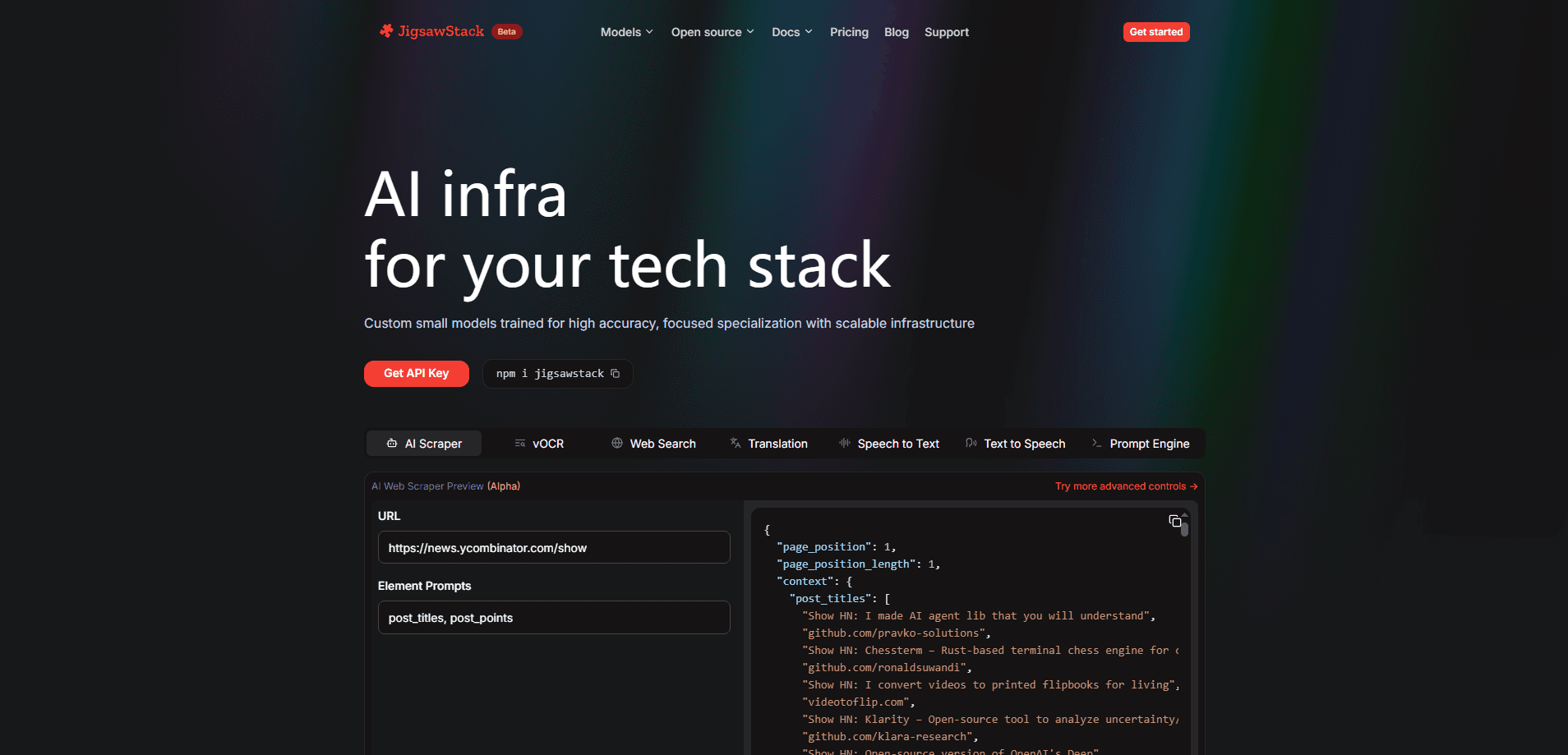
About JigsawStack
What Is JigsawStack
JigsawStack is a developer platform that packages small, task-specific AI models behind clean APIs. Instead of calling one giant language model and hoping the output holds its shape, you call a dedicated model for each job: reading a document, scraping a page, transcribing audio or tagging content. The company built these models itself and trains them on three ingredients, a classic machine learning base, a small language model and a pile of custom labeled data. The pitch is consistency. Every run returns the same structure, which is what backend work actually needs.
The product targets a specific frustration. Backend developers spend a large share of their time maintaining services like scraping, OCR and translation, and those pipes break often, since a site redesign or a security update can take out a scraper overnight. JigsawStack wants to absorb that maintenance into an SDK you install and forget. The company frames the whole suite as the missing piece of a modern backend, and the models feed into Interfaze, its own chat model built on the same infrastructure.
The tradeoff sits in what the suite is not. It is a developer tool with an API key, not a no-code app, so you need to write code to use it. Most models charge on a token meter, and small projects that only need one model may find a single-purpose vendor simpler. The free tier is real but capped, and the log history on it is short.
Getting Started
- Create an account at jigsawstack.com and pull an API key from the dashboard
- Install the SDK with
npm install jigsawstackorpip install jigsawstack, or call the REST endpoints directly - Pick the model you need, such as AI web scraper or vOCR, and pass your input with the matching parameters
- Read the structured output in your app, and watch usage and errors in the observability dashboard
Product Information
A quick look at JigsawStack's pricing, supported platforms, and performance.
Best for
The users, tasks, and scenarios where this tool fits best.
Users
- Backend and full-stack developers
- AI application builders
- Startup and indie developers
- Automation and no-code operators
Tasks
- Web scraping at scale
- Document data extraction
- Speech to text
- Content classification
- Web search for AI
Scenarios
- A scraper breaks after a site redesign
- Running a KYC check at signup
- Captioning a backlog of recorded interviews
- Moderating user content
- Prototyping on a budget
Key features
Purpose-Built Small Models
JigsawStack's models are trained for one task each, and the company says they run faster and more consistently than a general model prompted to do the same job. A scraper model knows how to read a page. An OCR model reads a document. You get a dedicated API and dedicated infrastructure for each one rather than a shared endpoint that does everything. The practical effect is that output shape stays stable across runs, which cuts the validation code you would otherwise write.
Structured Output by Default
Every model returns the same structured response on every call, and you can define the structure yourself for tasks that need it. That consistency comes from how the models were trained, not from a schema you bolt on afterward. For backend work this matters more than raw cleverness, since downstream code depends on predictable fields. The OCR and web scraping pages both highlight high accuracy on user-defined structured output as a headline claim.
AI Web Scraper and Web Search
The AI web scraper extracts specific data from a URL by prompt, so you can pull prices or reviews from a page without knowing its HTML. It handles dynamic sites and can browse through proxies in a chosen country, which helps with regional pricing and travel sites. The web search API returns structured, contextualized results built for AI consumption rather than a list of links, and it adds location data and search suggestions for autocomplete boxes.
vOCR and Object Detection
vOCR reads text from any document type and returns it in a consistent structure, backed by fine-tuned vision models. The company lists KYC automation, fraud detection, accessibility and sensitive healthcare or legal documents as its main uses. Object detection covers images and screens, and it also targets computer use, where the object detection API looks at a GUI and finds the buttons and fields an agent needs to click. Construction safety and retail inventory are two of the listed use cases.
Broad Language and Audio Coverage
The suite claims support for more than 160 languages across models, with the speech to text API covering over 100 for transcription via Whisper large v3. Multilingual is treated as a first-class feature rather than a bolt-on, and the training data is collected globally so accuracy doesn't collapse on less common languages. For teams shipping outside English, that reach is the whole reason to pick the suite.
SDKs, Integrations and Observability
JigsawStack ships fully typed SDKs for Python and JavaScript/TypeScript, along with snippets for PHP, Ruby, Go, Java, Swift, Dart, Kotlin, C#, and plain cURL. It connects to Vercel AI SDK, LangChain, Zapier, n8n, Google Sheets, Postman, Hugging Face and Replicate, so it slots into a stack you already run. The dashboard adds real-time logs and analytics, including sessions, countries, IPs and other data points, plus API key permissions for access control.
Scaling and Enterprise Options
The infrastructure runs serverless and claims to handle billions of concurrent requests in under 200ms, with smart caching to cut cost and latency and access to 90+ distributed GPUs. Enterprise plans add a 99.9% SLA, SOC 2, unlimited log retention, a dedicated support manager, custom deployments and a self-hosted option. That last point matters for teams that can't send documents to a third party.
Pros and cons
Pros
- One SDK and one bill replace several single-purpose vendors, which cuts integration and procurement work
- Models return a consistent structure on every run, so you write less validation and parsing code
- Free tier includes all models with 1M tokens a month, enough to test the suite before paying
- Typed SDKs for Python and TypeScript plus wide integration coverage fit most existing stacks
- Enterprise tier offers SOC 2, a 99.9% SLA and self-hosting for teams with strict data rules
Cons
- It is an API product, so there is no visual builder and you must code to use any model
- Token-based metering means cost scales with volume, and heavy document or audio loads burn through the included tokens fast
- The free plan only keeps two days of logs, which makes debugging a production issue harder
- Pro includes 10M tokens and then charges $0.99 per million, so high-volume users should model the bill first
Frequently asked questions
JigsawStack is a developer platform offering a suite of specialized small AI models behind APIs. It covers web scraping, vOCR, object detection, speech to text, web search, classification and more, and it ships SDKs so you can add those tasks to an app with a few lines of code.
Related content
Explore related tools, skills, and articles for JigsawStack.
JigsawStack Alternatives

Base Code
Base44 (Wix) · Coding · ProductivityBase Code is a shared cloud development environment from Base44. Teammates describe changes to an existing GitHub codebase in chat, preview them live and send them back as pull requests.

Google EmbeddingGemma 2
Google DeepMind · Writing · Image · CodingGoogle EmbeddingGemma 2 is a 740M-parameter open model that turns text, code, images, audio, and video frames into vectors in one 768-dimension space, running on phones and laptops.

GitGlow
GitGlow · Coding · ProductivityGitGlow is a local-first desktop Git client that lets independent developers review their own code and their AI agents' changes in one place before shipping.