

JudgeAI
JudgeAI · AI Assistant
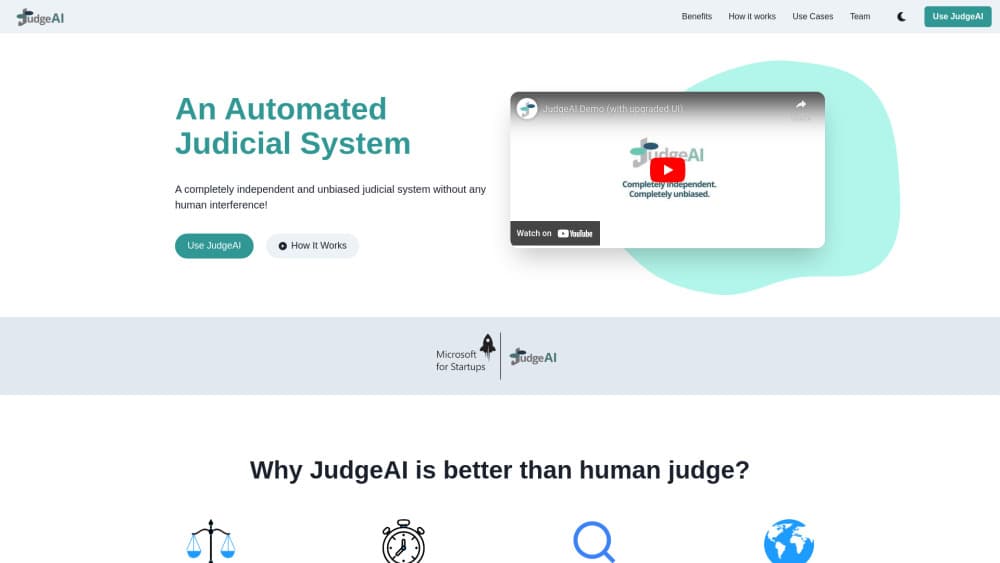
JudgeAI is a research platform that computes legal and regulatory decisions from a model of people, rules, and consequences. It powers action review, AI arbitration, and AI lawmaking.
About JudgeAI
What Is JudgeAI
JudgeAI is a legal decision engine built by a small research team around one idea, computable law. The project runs under the banner "Law as Computation." You describe a situation, the system builds a structured model of who is involved and how they depend on each other, then calculates what each possible action would do to those people. The output is a decision with grounds you can inspect, not a paragraph of advice.
The unusual part is the claim underneath it. JudgeAI states its normative premise openly: every participant should keep the capacity to act. Decisions get scored by how much they protect that capacity across everyone affected, with the worst threat to any single person weighted first. The team calls the approach autonomous normative decision-making because nothing in the chain pauses for a human to pick between options.
Three modes ship on the same computational layer. One reviews a planned action before it happens. One runs an arbitration from filing to draft award. One writes a full bill from a regulatory problem. All three are prototypes. The public demo on the site is a lightweight version, and the company treats pilots and partnerships as the route in.
Two limits matter before you get excited. There is no published price list, and there is no public API. Access runs through a call with the team. The other limit is conceptual: the whole result depends on the normative ontology being right for your jurisdiction, so a thin model of a community produces a confident answer built on weak ground.
Getting Started
- Book a 30 minute intro call through judgeai.space, or open the public platform demo to see the interface first.
- Choose the mode that matches the job: action review, AI Arbitration, or AI Lawmaking.
- Load the situation. That means either a written description of the actors and duties, or, for arbitration, a data room with the request, the answer, submissions, and exhibits.
- Run the analysis and watch the engine map actors, project alternative legal worlds, and compute how consequences move between them.
- Read the traceable grounds behind the pick, then export the artefact you need: a normative decision, an arbitral award, or a bill with its validation log as a PDF.
Product Information
A quick look at JudgeAI's pricing, supported platforms, and performance.
Best for
The users, tasks, and scenarios where this tool fits best.
Users
- Regulatory and policy teams
- Arbitration practitioners
- Legal researchers
Tasks
- Stress testing a draft rule
- Running a document heavy arbitration
- Drafting a bill from a policy goal
Scenarios
- A regulator weighing a factory closure
- A dispute over a faulty product
- A research team auditing an AI decision
Key features
Three Modes on One Engine
Normative action review, AI Arbitration, and AI Lawmaking share a single computational layer and differ only in what they assemble at the end. That means a team can move from reviewing a policy to drafting the bill behind it without switching tools or rebuilding the model. The output types are a verifiable normative decision, a full arbitral award, and a complete bill, each exportable as a PDF.
Normative Ontology
At the base sits a structured model of people, roles, capabilities, and dependencies. One person can be an employee, a parent, a property owner, and a patient at the same time, and the ontology keeps those roles linked, so a change in one shows up in the others. Companies and institutions enter through the relationships between their employees, owners, customers, and citizens. That shared vocabulary is what lets the system compare two very different situations on the same footing.
Alternative Worlds, Compared
For each option under consideration, JudgeAI projects a separate possible world from a shared starting state. Closing a factory, adding a transition period, or paying compensation each produce a different world with different consequences. The engine computes how those consequences propagate among connected participants and ranks the worlds, then puts the most severe threat to any participant first. This is why the team's own study reports that removing relationships between participants flipped the preferred option in 176 of 700 tested scenarios.
Empirical Evidence Room
JudgeAI publishes its internal studies rather than only its conclusions. The evidence room lays out the tested scenarios, the alternatives examined, and the comparisons against language models, judicial decisions, and existing legislation. One study covered 3,456 scenarios and found that expanding the set of interventions produced a strictly preferred option in 128 of them. Numbers like these are the company's own measurements, and they show a research program at work rather than a finished benchmark.
Grounds You Can Recheck
Every decision carries its reasoning: which circumstances were represented, which alternatives were compared, and which computation settled the result. Because the chain stays intact, the result becomes something to investigate. A researcher can ask how the choice depends on one data point, which disagreement between sources actually matters, and whether the answer survives a changed assumption. Recalculation then shows if the decision moved and why.
Drafts the Paperwork
The arbitration mode closes a record and produces an award with procedural history, issues for resolution, evidentiary assessment, applicable law, reasoning, and an operative part. The lawmaking mode goes further and piles up a legislative report, a drafting blueprint, strict bill text, a validation pass, and a methodological appendix. Both outputs arrive as documents a lawyer can mark up, which is the realistic use: a strong first draft, not a filing.
Jurisdiction Atlas
The public Legislative Atlas indexes regulatory material across the United Arab Emirates, Ireland, the United Kingdom, the Netherlands, the United States, and China, with RSS and JSON feeds for tracking changes. It works as a lightweight research surface for anyone who wants to see how the same policy question gets handled in different legal systems before committing to a model.
Pros and cons
Pros
- Every decision arrives with its grounds attached, so a reviewer can trace which data and which comparison produced the result.
- Three document types come out of one engine, which cuts the rebuilding work when a policy question turns into a drafting job.
- The team publishes its methods, papers, and test scenarios, and the papers date back to 2024 on SSRN with DOIs.
- The public prototype and the atlas can be opened before any conversation with sales, so you can judge the interface yourself.
Cons
- There is no published price and no self-serve signup, so a solo practitioner has no way to try the full platform without booking a call.
- The engine answers to one stated premise, preserving each participant's agency, and a jurisdiction that weighs other values will not get a neutral referee.
- Outputs are drafts and decisions without legal force. A court, a legislator, or an arbitral institution still has to adopt them.
- Calibration is comparative, by the team's own admission, so a 0.65 score means "more likely than in the other scenario," not a 65 percent chance.
Frequently asked questions
It computes a decision from a modelled situation. You give it the actors, the rules, and the data, and it builds alternative outcomes, compares the consequences for the people involved, and returns one choice with its reasoning. The three modes apply that to action review, arbitration, and bill drafting.
Related content
Explore related tools, skills, and articles for JudgeAI.
JudgeAI Alternatives

Hark
Hark · Productivity · AI Assistant · China AIHark is a personal AI assistant that books, buys, and organizes things for you. It runs on web, iOS, and Android, remembers your preferences, and hands bigger jobs to a computer-use agent.

Rhem Labs
Rhem Labs · AI Assistant · China AIRhem is a tabletop health assistant robot from Rhem Labs that takes blood pressure and other wellness readings, runs reminders, makes calls, and sends fall alerts to family.

Wabi
Wabi, Inc. · Productivity · AI Assistant · ChatbotWabi is a messenger-style AI assistant for iOS, Android and Mac. It sorts your life into shared threads, builds small apps inside each one, and handles email, calendar and errands after you approve.