

Prism
Karla Information Systems LLC · Writing
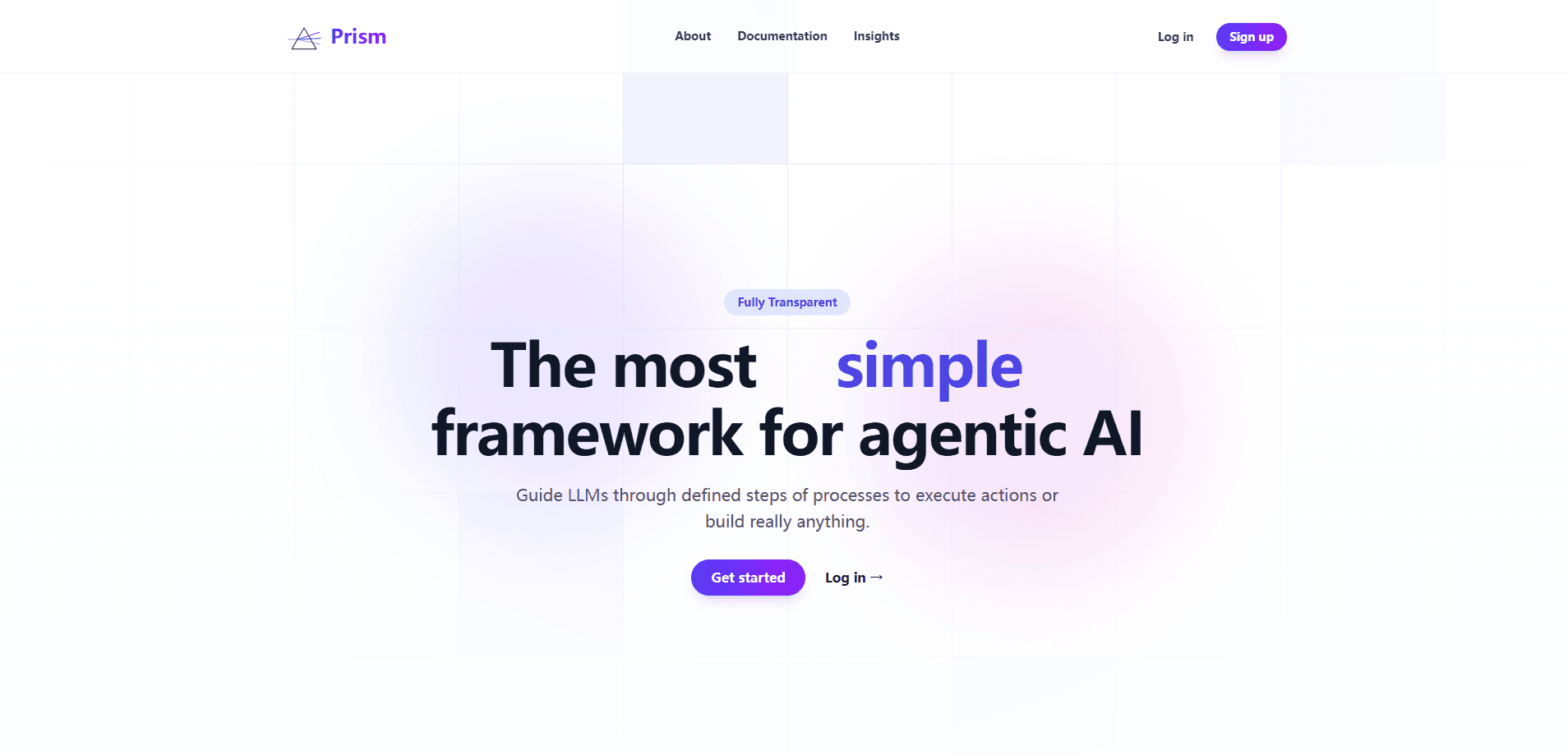
Prism is an AI workflow automation platform built on the DAF standard. It turns plain prompts into step-by-step agentic processes that research, write, send emails, and edit files.
About Prism
What Is Prism
Prism is a framework for running agentic AI workflows. It implements DAF (Defined Action Framework), an open format that describes what an AI should do and in what order, using nothing but plain text. A user writes steps as prompts, and Prism executes them against a model while firing real actions such as web searches, file edits, and email sends.
The product grew out of Karla, a company that first built journalism tools and then rebuilt itself around a broader idea: that AI workflows shouldn't be locked inside one vendor's app. That's why the workflow format is open and published separately, and why Prism describes itself as an implementation rather than the only way to run a DAF harness.
Its main limit is that the product lives closest to developers and technical teams. Workflows are defined as JSON, and getting value out of Prism means thinking in steps, actions, and variables rather than clicking through drag-and-drop blocks. Non-technical users can still read the format, but they'll lean on ready-made functions instead of building from scratch. Prism also depends on third-party models from OpenAI, Anthropic, Google, and others, so workflow quality tracks closely with the model chosen.
Getting Started
- Sign up at prismrun.ai. The free tier includes a monthly token allowance, so no card is needed to start.
- Describe a process as a series of prompt steps. A step can be plain instruction or call an action with the
$ACTIONsyntax. - Run the harness and watch each step execute. When the model emits an action call, Prism runs it and feeds the result back into the conversation.
- Add variables, loops, and conditions to handle repeatable tasks like scraping a list of sites or processing a batch of files.
- Move the finished workflow into your own app through the Prism API or keep running it inside the Prism web app.
Product Information
A quick look at Prism's pricing, supported platforms, and performance.
Best for
The users, tasks, and scenarios where this tool fits best.
Users
- Developers and technical founders
- Operations and content teams
- Teams experimenting with agentic AI
Tasks
- Multi-step content creation
- Company research
- News aggregation
Scenarios
- Replacing a manual data pipeline
- Publishing a daily newsletter
- Prototyping an AI feature before full build
Key features
Prompt-defined workflows
Prism lets users define a workflow with plain prompts and no code. Each step is written in ordinary language and the framework sequences them, which means anyone who can describe a task in words can sketch out an agentic process.
Open DAF standard
The workflow format is DAF, an open standard published separately from Prism. Because no single vendor owns the format, a harness written in DAF can run on Prism, in your own app, or on other implementations, which reduces lock-in for teams that don't want their automation tied to one platform.
AI actions that touch real systems
A step can trigger actions such as web search, file editing, database writes, or sending email. The model signals intent by emitting a small JSON action call, Prism executes it, and the result returns to the conversation so the next step keeps full context. That's what separates Prism from a chat window that can only talk.
Model flexibility across providers
Workflows aren't tied to one model. Prism supports routes through OpenAI, Anthropic, Google, Mistral, xAI, and DeepSeek, so a team can pick a fast model for simple steps and a stronger reasoning model where accuracy matters more.
Prism API and bring-your-own keys
Developers can run workflows inside their own applications through the Prism API. Paid plans also allow bringing your own API keys from model providers, which removes Prism's usage markup and lifts the built-in limits for higher-volume work.
Variables, loops, and control flow
Reusable workflows need more than a single prompt. Prism supports variables injected with $VAR syntax, loops that repeat a step or stop on a keyword, and branching logic, so a process can handle a list of inputs rather than one item at a time.
Pros and cons
Pros
- Open workflow format: DAF is published separately, so the processes you build aren't locked to Prism alone.
- Transparent by design: every step is defined by the user, and the model's action calls are visible rather than hidden inside a black box.
- Free start: a monthly token allowance and a one-time compute bonus let users run real workflows before paying.
- Broad model support: OpenAI, Anthropic, Google, Mistral, xAI, and DeepSeek are all available, so users aren't stuck with one provider.
- API access on every tier: even the free plan can call the Prism API and bring your own model keys.
Cons
- Developer-oriented: workflows are JSON and the concepts assume comfort with steps, actions, and variables, so non-technical users face a learning curve.
- No visual drag-and-drop builder: building a workflow means writing it out, which is slower for people who prefer clicking through a canvas.
- Third-party model dependency: output quality and cost move with whichever provider's model a workflow relies on.
- Small footprint: as a newer platform, it has fewer community templates and integrations than established automation tools.
Frequently asked questions
Prism is used to build and run AI workflows, called harnesses, that research, write, send emails, and edit files in a defined order. It turns a prompt into a repeatable, step-by-step agentic process.
Related content
Explore related tools, skills, and articles for Prism.
Prism Alternatives

Google EmbeddingGemma 2
Google DeepMind · Writing · Image · CodingGoogle EmbeddingGemma 2 is a 740M-parameter open model that turns text, code, images, audio, and video frames into vectors in one 768-dimension space, running on phones and laptops.

MePersona
MePersona, Inc. · Writing · Productivity · MarketingMePersona is an AI unified inbox for creators. It learns your voice, drafts replies to fan messages from 12 platforms, and sends only what you approve.

Fluence
Yay Software (Yannick Huchard) · Writing · Voice & Language · ProductivityFluence is an Android app that reads PDFs, EPUBs, Word files and web articles aloud, follows each sentence as it speaks, and answers questions about the text on the phone itself.