

Katteb
Katteb · AI Detection
Katteb is a goal driven AI agent that takes one sentence with a number and a deadline, then works in your own browser every day and reports each morning.
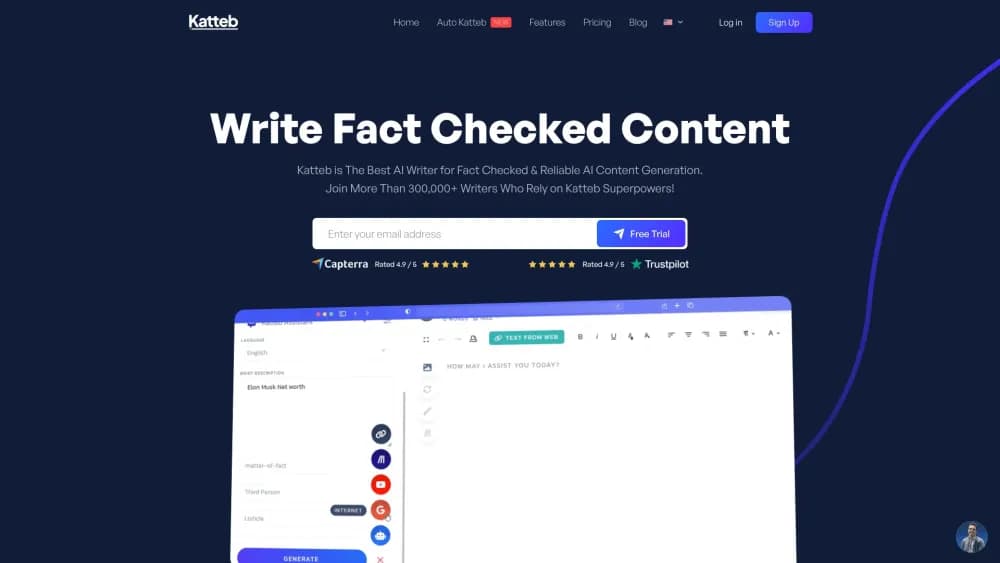
About Katteb
What Is Katteb
Katteb is an AI agent platform built around goals rather than one-off tasks. You describe the outcome you want, add a number to move and a deadline of 14 to 180 days, and the agent writes a plan, then runs it on a schedule in the accounts you already use. A sales goal, a subscriber goal, or a revenue goal all start from the same one-sentence brief.
The core idea is that a task ends and a goal keeps going. Give an agent a task and it does the work once and stops. Give it a goal and it runs every day, tracks a number read from your own tools, and sends a report at 8am until the deadline. That daily loop is what separates Katteb from a chat assistant that only answers when you ask.
Two limits are worth stating plainly. Goals are not guaranteed, and Katteb says so itself: the agent works until the deadline and then marks the goal Reached or Not reached with a final report. The agent also runs in a real browser signed in as you rather than through an API key, so it works inside the tools you connect and nowhere else.
Getting Started
- Create a free account at katteb.com and open the chat workspace.
- Pick one of the 100 ready goals from the library or write your own outcome, number, and deadline.
- Read the plan the agent writes for free, adjust it, then press Start.
- Connect the accounts the agent should work in, such as your email, Google Calendar, or social profiles.
- Check the morning report, reply in the goal thread to change the plan, and pause or stop at any time.
Product Information
A quick look at Katteb's pricing, supported platforms, and performance.
Best for
The users, tasks, and scenarios where this tool fits best.
Users
- Solo founders
- Small sales and marketing teams
- Creators building an audience
- Consultants and agencies
Tasks
- Daily outreach and follow-ups
- Pipeline and revenue tracking
- Ad campaign testing
- Content and SEO work
Scenarios
- A quarterly sales push
- An audience launch
- A recurring reporting routine
Key features
Goals Instead of One Off Tasks
A goal is an outcome with a number and a deadline, and the agent keeps working toward it for 14 to 180 days. Unlike a single instruction that runs once and stops, a goal runs on a schedule every day, tracks the number from your own tools, and moves toward it in steps. That shift is the whole point of the product: you set the destination and the agent handles the daily work.
Free Plan Writing
Before anything runs, the agent studies your market and writes a plan: the outcome, the number it will move, milestones with dates, and up to three workflows that repeat every hour, day, week, or month. Writing the plan costs nothing on any account. You read it, change it, then press Start, so nothing runs until you agree with the approach.
A Real Browser Signed In as You
Runs open a real browser and work inside the accounts you connected, not through an API key. The agent can sign up for a service, fill a form, or send a message the way you would. Because it keeps to a daily sending limit and remembers every contact, the same person is never approached twice.
Numbers Read From Your Tools
Progress is measured from your own tools, never guessed. If the goal tracks revenue, the figure comes from your store; if it tracks clients signed, it comes from your pipeline. The agent reports only numbers it could see, which keeps the daily report honest and makes the count trustworthy.
Morning Reports and Memory
At 8am in your time zone the agent sends one report: what it did, what it learned, what is blocking progress, and what it needs from you. A quiet day sends nothing, so every report is worth opening. What worked and what failed go into memory, so day 20 starts where day 19 left off.
Steering and Safety Controls
You can change a goal in a sentence and the agent rewrites the plan while keeping everything it has learned. Pause, resume, and stop are single clicks or a typed command. If a run fails three times in a row, the goal pauses itself and tells you why, which keeps a long running agent from burning through a budget unnoticed.
Pros and cons
Pros
- The goal model fits outcomes that take weeks, where a one shot task would need constant re-prompting.
- Writing and reading the plan is free, so you can judge the approach before paying.
- Numbers come from your own tools, which makes the daily progress report verifiable.
- A real browser signed in as you reaches services that an API key cannot, such as sites with no public interface.
- The 100 goal library gives a concrete starting point instead of a blank prompt.
Cons
- No outcome is guaranteed, and a goal can end Not reached after the deadline passes.
- Running goals needs a paid plan, since Lite starts at $19 a month for a single agent, which rules out a fully free test.
- Because the agent works through your own accounts, it needs access to those logins, which raises data and account safety questions.
- The hourly schedules and the 10 agent limit sit on the $99 plan, so heavier use gets expensive fast.
Frequently asked questions
A task is one piece of work the agent does once and hands back as a result. A goal is an outcome with a number and a deadline, and the agent plans it, works on it every day in your tools, remembers what worked, and reports each morning until the deadline.
Related content
Explore related tools, skills, and articles for Katteb.
Katteb Alternatives
Isgen AI
Isgen · AI DetectionIsgen AI is a web-based AI detector that scores text for machine authorship and shows you which sentences and phrases push the number up. It's built for teachers, editors, students, and writers. Their question is simple: did this draft come from ChatGPT, GPT-5, Claude, Gemini, DeepSeek, or another model? You paste or upload content, run a scan, and get a Human, AI, and Mixed breakdown in seconds. There's also a companion editor that scores text while you write it.
Humanizeai Tools
Humanizeai Tools · Writing · AI DetectionHumanizeai Tools is a web-based AI humanizer that rewrites machine-generated text so it sounds like a person wrote it, which is the whole point of the category it belongs to. Paste a draft from ChatGPT, Claude, or Gemini, run it through the tool, and it swaps out the phrases and sentence patterns that AI detectors flag. If your goal is to make AI text sound human before you publish it, this is the kind of tool built for exactly that. It suits students, bloggers, and marketers who need copy that reads naturally and clears tools like GPTZero, Copyleaks, and Winston AI after a single pass.

Hidemyai
Hidemyai · Writing · AI DetectionHidemyai is an AI content humanizer. It rewrites text from ChatGPT, Jasper, and similar tools so the result reads like a person wrote it. You paste your draft, pick a document type and tone, and the service returns a version meant to bypass AI detectors such as Originality.ai, Turnitin, and ZeroGPT. It targets writers, marketers, and students who lean on AI drafts but can't ship copy that sounds robotic. The promise is simple: make AI content undetectable.