

KiloClaw
Kilo · Coding
KiloClaw was Kilo's managed OpenClaw hosting service. It put a secure agent online in under a minute with 500+ models, then stopped accepting new users in August 2026.
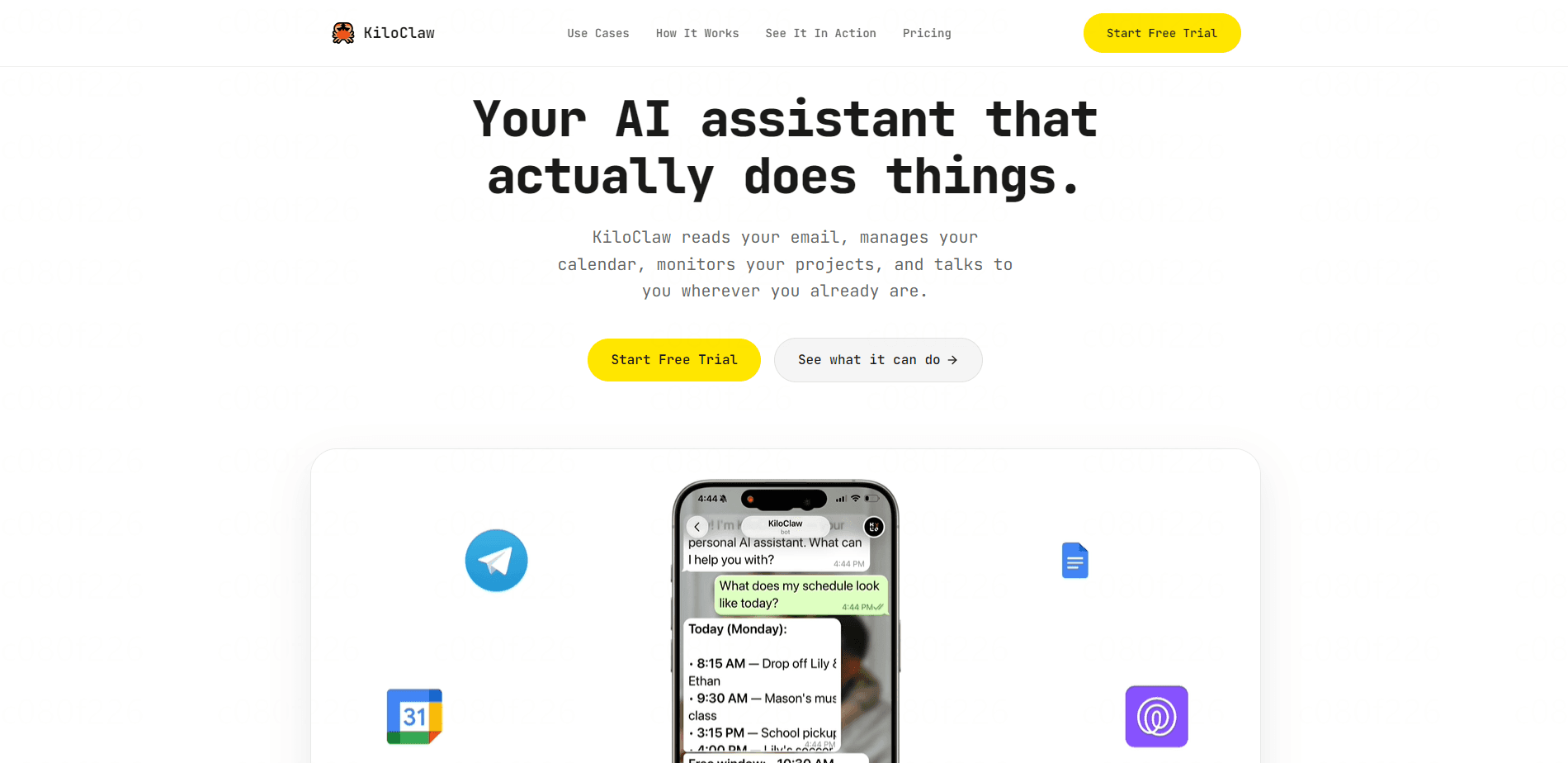
About KiloClaw
What Is KiloClaw
KiloClaw was a hosted OpenClaw agent from Kilo, the company behind the Kilo Code coding assistant. You picked a chat app, chose a model, and got a running agent on a dedicated virtual machine. No server to rent, no Docker image to build, no YAML file to edit.
OpenClaw itself is free and open source, and that was never the hard part. Keeping a Node.js agent alive at 3 a.m., patching it after every release, and wiring OAuth for four chat platforms is the work that stopped most people. KiloClaw sold that work as a subscription. AI agent hosting meant Kilo handled updates, backups and network isolation, and routed model calls through Kilo Gateway.
The service is no longer sold. Kilo withdrew KiloClaw on 30 August 2026, and the product page now redirects to the Kilo homepage, which announces that Kilo has been acquired by Anaconda. The documentation and the security whitepaper are still online, so an existing instance may keep running, but there is nothing left to sign up for. Anyone starting today needs a different route.
Getting Started
- Sign in at app.kilo.ai with GitHub or Google. An existing Kilo Code account already carried the credits and billing.
- Open the Claw tab and select Create Instance.
- Pick a default model from the Gateway list. Free options were available at the time.
- Connect Telegram, Slack or Discord, or skip the step and add bot keys later in instance settings.
- Press Create and Provision, then Start. The first visit needed an Access Code, a one-time token that verified the device.
Product Information
A quick look at KiloClaw's pricing, supported platforms, and performance.
Best for
The users, tasks, and scenarios where this tool fits best.
Users
- Solo builders who wanted an always-on assistant
- Teams without an operations engineer
- People holding API credits elsewhere
- Compliance-minded buyers
Tasks
- Inbox and calendar triage
- Scheduled research
- Repository upkeep
- Browser and file work
Scenarios
- Running an agent on a laptop that sleeps
- Handing an agent live credentials
- Testing several models on the same workload
Key features
A Dedicated Firecracker VM per Agent
Each instance ran in its own Firecracker micro-VM, the isolation technology behind AWS Lambda. One customer's runaway agent could not touch another's, and a full VM restore was available from backup. Storage was encrypted with AES-256, traffic used TLS, and there was no direct SSH port open.
Chat Integrations Wired at Setup
Telegram, Slack, Discord, email, calendar and GitHub connected through a button rather than an afternoon of OAuth debugging. The same agent kept context across channels, so a question asked in Slack picked up a thread started in Telegram an hour earlier. This was the strongest practical argument for paying, since multi-channel setup is where most self-hosted installs stall.
500+ Models Through Kilo Gateway
Model choice lived in a dropdown backed by Kilo Gateway, which exposed more than 500 models from Anthropic, OpenAI, Google and open-weight providers. Kilo charged no markup on tokens, and bring-your-own-key let a customer bill calls to an existing provider account. Swapping models for a task took one setting, not a rewrite.
Scheduled Automations and Persistent Memory
Cron jobs, heartbeats and sub-agent orchestration were built into the runtime, so the agent could work while nobody watched. A memory system stored project context in structured Markdown files inside the instance, which meant state survived a model change. Reports, repository checks and morning briefings were the common uses.
ClawBytes Recipes and the ClawHub Marketplace
Kilo shipped a library it counted at more than 610 prebuilt automation recipes under the name ClawBytes, plus ClawHub, a marketplace for agent skills. The library covered everyday jobs such as inbox sorting and research digests. Counting recipes is easy. Judging them is not, which is why the trial mattered more than the catalogue size.
Enterprise Controls Without a Security Project
Organizations got SSO and OIDC, SCIM provisioning, granular policies on which tools the agent could call, and centralized usage analytics. A published security whitepaper signed by an outside researcher backed the claims. For a regulated team, that package was the difference between approving an agent and banning it.
Pros and cons
Pros
- Setup took about a minute on the vendor's stopwatch, with no SSH, Docker or YAML involved at any point.
- The dedicated VM, daily backups and closed SSH port removed the most common self-hosting mistakes.
- Kilo Gateway gave one bill for 500+ models at provider list price, and BYOK worked alongside it.
- The agent answered in Telegram, Slack or Discord with shared context, so the chat app became the interface.
- Enterprise features such as SSO, SCIM and tool policies were checkboxes, not a build.
Cons
- The service closed to new users on 30 August 2026, so nobody can buy it now and support is ending.
- KiloClaw pricing went from $9 a month to $55 a month in mid-2026 while the trial shrank from seven days to one.
- There was no SSH access and no filesystem control, so anything outside the product limits stayed impossible.
- Model usage was billed on top of hosting, and a busy agent could cost more than the subscription itself.
Frequently asked questions
No. Kilo stopped selling KiloClaw on 30 August 2026, and kilo.ai/kiloclaw now redirects to the Kilo homepage. Documentation and the security whitepaper remain online for existing customers, and there is no signup path for new users.
Related content
Explore related tools, skills, and articles for KiloClaw.
KiloClaw Alternatives

Base Code
Base44 (Wix) · Coding · ProductivityBase Code is a shared cloud development environment from Base44. Teammates describe changes to an existing GitHub codebase in chat, preview them live and send them back as pull requests.

Google EmbeddingGemma 2
Google DeepMind · Writing · Image · CodingGoogle EmbeddingGemma 2 is a 740M-parameter open model that turns text, code, images, audio, and video frames into vectors in one 768-dimension space, running on phones and laptops.

GitGlow
GitGlow · Coding · ProductivityGitGlow is a local-first desktop Git client that lets independent developers review their own code and their AI agents' changes in one place before shipping.