

Kimi K2
Moonshot AI · Other
Kimi K2 is Moonshot AI's open-weight model with 1 trillion parameters, built for coding, tool use, and agentic tasks. It ships as Kimi-K2-Base and Kimi-K2-Instruct.
About Kimi K2
What Is Kimi K2
Kimi K2 is a large language model from Moonshot AI, released in July 2025 under a modified MIT license. It uses a mixture-of-experts (MoE) design: 1 trillion total parameters, but only 32 billion active for any single token. That setup keeps running costs reasonable while the model draws on a much larger pool of learned knowledge.
What sets it apart is the focus on agentic work. Moonshot built K2 for tool use, multi-step reasoning, and coding rather than for long chains of visible thinking. The Instruct version is explicitly a "reflex-grade model without long thinking," so it answers quickly and calls tools well without deliberating for pages first. If you want the visible reasoning traces, that arrived later with Kimi K2 Thinking, not the original K2.
The main catch is hardware. The full 1T weights need serious infrastructure to self-host, and the model doesn't handle images. You need a separate vision model such as Kimi-VL for anything visual. Most people will use it through the API rather than running it locally.
Getting Started
- Create a Moonshot AI account at platform.moonshot.ai
- Open the API Keys section and generate a key
- Pick a model in the dashboard, either Kimi-K2-Instruct or a newer K2 variant
- Send your first request through the OpenAI-compatible endpoint, or point an Anthropic-compatible tool like Claude Code at the base URL
- For a no-code test, use the chat app at kimi.com
Product Information
A quick look at Kimi K2's pricing, supported platforms, and performance.
Best for
The users, tasks, and scenarios where this tool fits best.
Users
- Developers building agents
- Budget-conscious teams
- Researchers who want to fine-tune
Tasks
- Repository-level coding
- Automated multi-tool workflows
- Math and reasoning problems
Scenarios
- Wiring an open model into a coding assistant
- Running a self-hosted assistant
- Cost-sensitive bulk processing
Key features
Trillion-Parameter MoE Architecture
K2 packs 1 trillion total parameters across 384 experts, but activates only 32 billion per token. You get the knowledge of a huge model at the compute cost of a much smaller one. That's the core reason it can compete on benchmarks while staying affordable to serve.
Built for Tool Calling and Agents
Moonshot trained K2 on large-scale synthetic data covering hundreds of domains and thousands of tools. It handles multi-turn tool use and JSON-style structured output natively, which is what makes it useful inside agent frameworks rather than just as a chatbot.
Strong Coding Performance
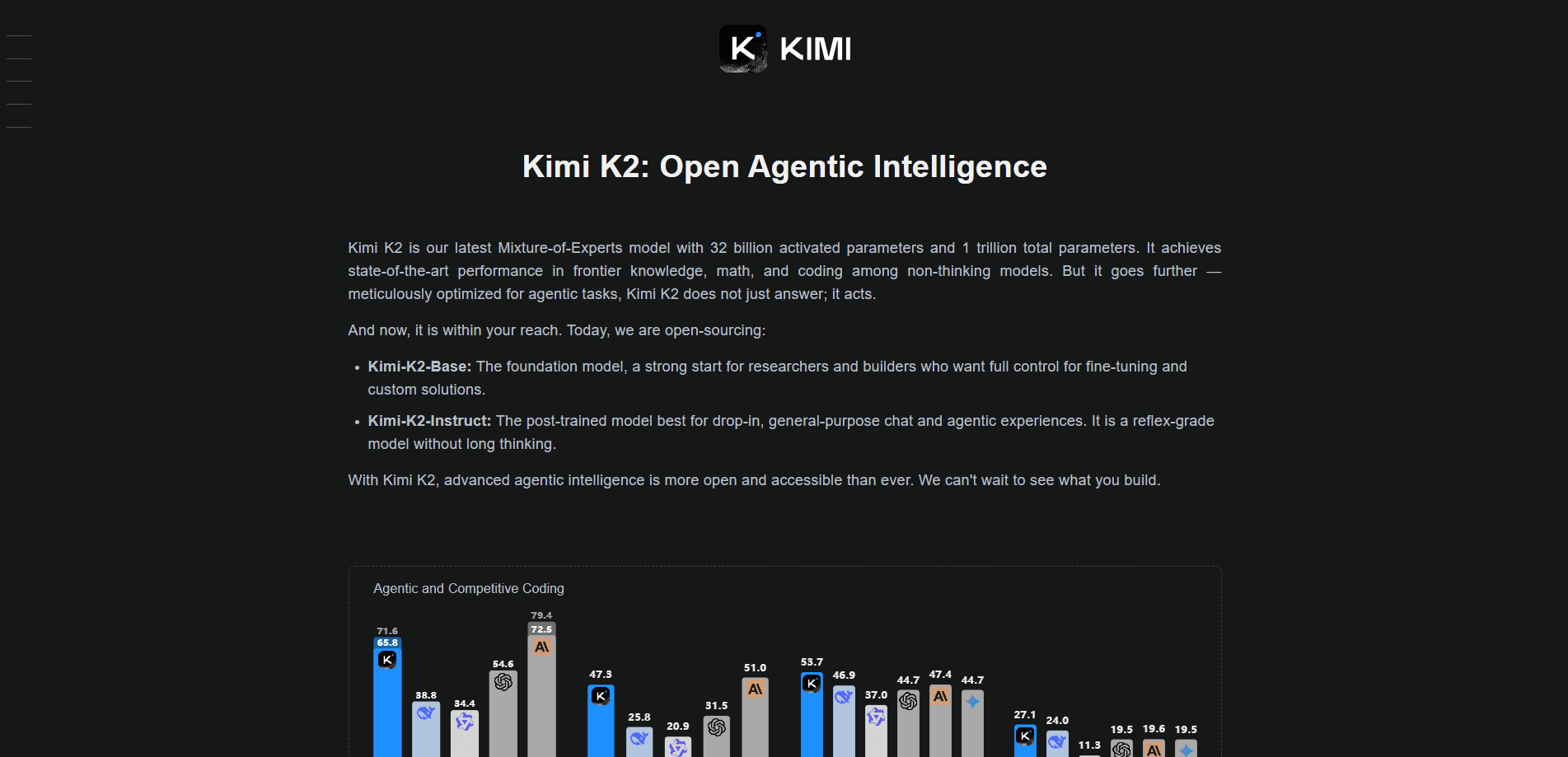
On SWE-bench Verified, Kimi K2 Instruct scores 65.8% in single-attempt agentic mode, ahead of several closed models on the same test. LiveCodeBench v6 hits 53.7%, also a leading figure. These numbers come from Moonshot's own evaluation, so treat them as vendor-reported.
128K Context Window
The original K2 supports a 128,000-token context, enough to load a long technical document or a sizeable code module in one pass. Later variants push this to 256K for even longer tasks.
Open Weights You Can Self-Host
The weights are downloadable from Hugging Face under a modified MIT license, and the model runs on vLLM, SGLang, and TensorRT-LLM. You aren't locked to one vendor, and you can inspect or adapt the model.
OpenAI and Anthropic-Compatible API
The API accepts both OpenAI-style and Anthropic-style requests, so migrating an existing app is mostly a matter of swapping the base URL and key. That lowers the switching cost for teams already running on either protocol.
Pros and cons
Pros
- Open weights with a permissive license, so you can self-host and fine-tune instead of renting access
- Top-tier coding and tool-calling scores among open models at release
- Low API pricing per million tokens, with cache-hit discounts for repeated context
- Two variants (Base and Instruct) cover both research and production use
- Works with both OpenAI and Anthropic API formats, easing migration
Cons
- No image understanding in the base K2, so visual tasks need a separate model
- The full 1T model needs serious hardware to run locally, which rules out casual self-hosting
- Context tops out at 128K on the original release, less than some rivals, and the model doesn't deliberate like a dedicated reasoning model
- Benchmarks are self-reported, so independent verification still matters for your specific workload
Frequently asked questions
Kimi K2 targets agentic work: coding, tool calling, and multi-step task automation. It also handles general chat, math, and writing, but the tool-use and coding abilities are where it stands out.
Related content
Explore related tools, skills, and articles for Kimi K2.
Kimi K2 Alternatives

Odyssey 3
Odyssey · OtherOdyssey-3 is Odyssey's foundation world model. It simulates physics in real time, turns a prompt into an interactive environment, and adapts to robots, cars and games.

JarvisCore
Prescott Data · Coding · Productivity · OtherJarvisCore is an open source Python runtime where AI agents work as equal peers on an agent mesh, claim tasks from a shared ledger, and reach external services through a zero-trust broker.
Clef
Cloudflare · Business · OtherClef is Cloudflare's open-source decision model for Workers AI. It returns calibrated probabilities for typed questions, not generated text, so agents can classify, route, and act fast.