

kodwai
kodwai · Coding
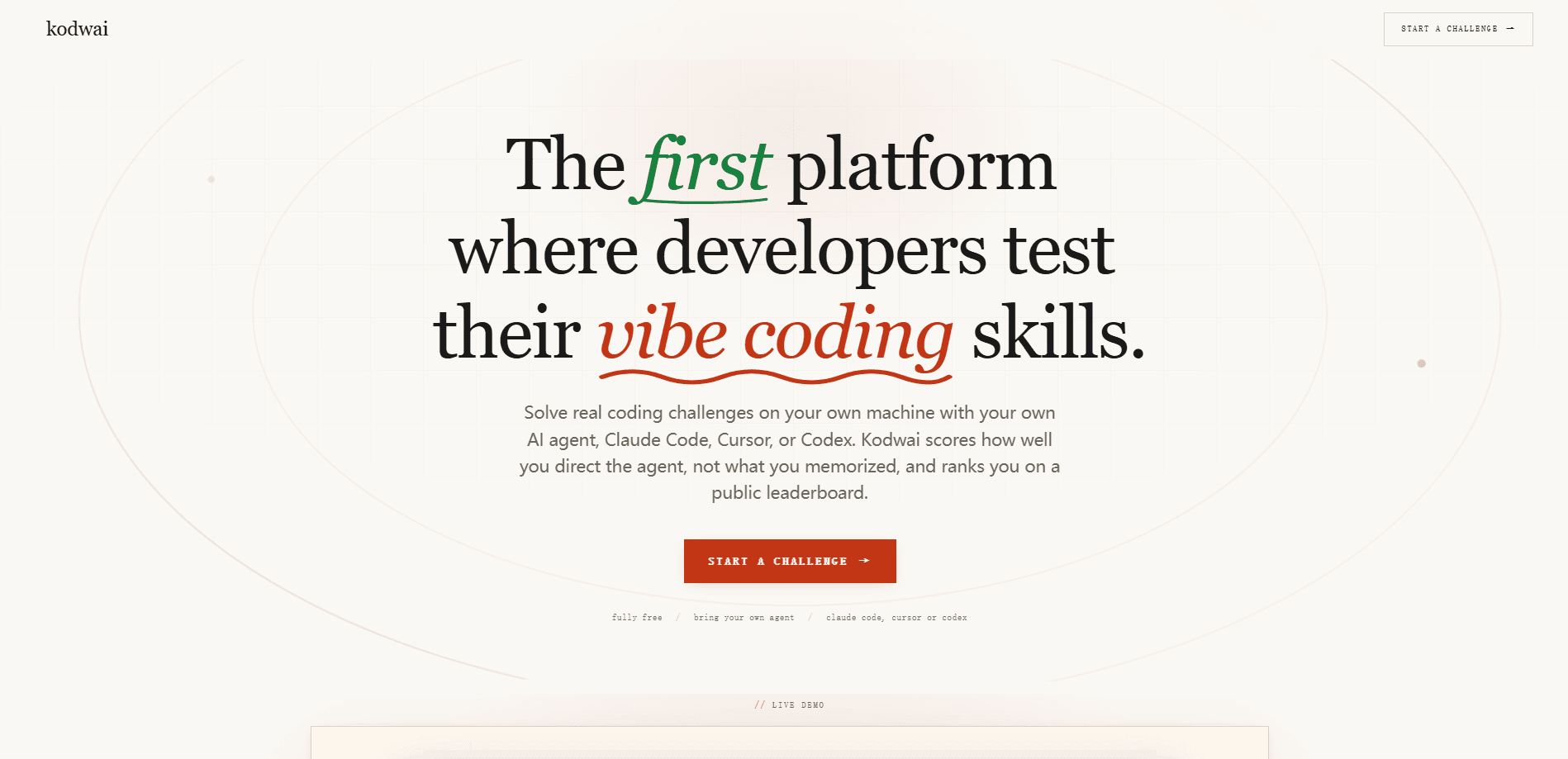
kodwai is a free platform for AI-agent coding challenges. You pick a ticket-sized problem, solve it on your own machine with your own agent, then submit the session for a score. Think of it as a vibe coding platform with a number attached. What sets it apart from a LeetCode-style grind is what gets measured. The platform reads your whole run and grades how you direct, verify, and ship with the agent, not what you memorized. Every result lands on a public leaderboard.
About kodwai
What Is kodwai
kodwai is a challenge platform built around the way coding actually works now. You point an agent at a real problem, catch it when it's confidently wrong, and check what it shipped. The site argues that judgment is the skill worth measuring, and that's exactly what its scoring targets.
The platform positions itself against whiteboard puzzles and old-school algorithm drills. Point a modern agent at one of those and it clears the problem in seconds, so the result tells you nothing about the person behind the keyboard. Passing tests proves even less, since a careless one-shot prompt can turn a suite green while showing no verification, no decomposition, and no recovery when the agent goes off track.
There's a real limit to keep in mind. kodwai doesn't run your code in a sandbox and doesn't host the work. You bring your own agent and your own editor, and the platform only scores the session you send it. Not ideal if you wanted a managed runtime. If you want a managed online judge with a built-in runtime, this isn't that.
Getting Started
- Create an account on kodwai and browse the open challenges by category and difficulty.
- Start a challenge from your terminal and choose your agent, then let the CLI download the problem files, starter code, and tests.
- Solve the problem on your machine with your own agent in your own editor.
- Run the submit command to package your code, git history, test runs, agent transcript, and time.
- Read your score, review the per-signal evidence, and find yourself on the leaderboard.
Product Information
A quick look at kodwai's pricing, supported platforms, and performance.
Best for
The users, tasks, and scenarios where this tool fits best.
Users
- Job seekers who want a score that says more than a solved puzzle
- Working developers who want an honest read on their own habits
- Teams comparing how different engineers direct an agent
Tasks
- Practicing spec writing before you hand work to an agent
- Testing whether you catch an agent's mistakes
- Building a public track record
Scenarios
- Evaluating candidates in a hiring process where agents do part of the work
- Sharpening your own workflow on a quiet afternoon
- Comparing your approach with a teammate's on the same problem
Key features
Agent-Agnostic Challenges
kodwai works with the agent you already use, whether that's Claude Code, Cursor, or Codex. The CLI initializes the challenge, downloads the problem files, and starts the timer, then hands control back to your setup. There's no proprietary agent to learn and no sandbox to fight.
Real, Ticket-Sized Problems
Challenges are modeled on the kind of work you'd actually pick up, not abstract puzzles. Can you solve a problem in the same shape as the tickets you handle all week? That's the bar. You can filter by category and difficulty and choose one that looks like the jobs in your normal queue. The format should feel like the work.
Session-Level Scoring
Instead of a pass or fail, kodwai reads the entire session. It grades Direction, Outcome, and Lift, and hands back per-signal evidence so you can see why each axis scored the way it did. A careless prompt that happens to pass the tests still scores low, because the coding challenge scoring looks at the process, not just the result. Treat it as an AI coding benchmark for how you work, not for what you recall.
A Public Leaderboard
Every scored submission puts you on a public leaderboard. That turns a personal practice run into something shareable, and it gives the platform a way to rank developers on how they work with agents rather than on memorized answers.
One-Command Submission
Submitting is a single CLI command. It packages your code, git history, test runs, agent transcript, and elapsed time into one bundle for scoring. No report to assemble by hand. That's the whole flow.
Works With Your Own Setup
There's nothing to install that fights your editor. You solve the problem on your own machine, in your own environment, using your own tools. kodwai scores the session after the fact. Your real workflow stays intact.
Pros and cons
Pros
- Free to use, with no paid tier gating the challenges.
- Brings your own agent, so you're measured on the tools you actually work with.
- Scores the process, not just whether the tests pass, which is closer to how real work is judged.
- Works with popular agents including Claude Code, Cursor, and Codex out of the box.
- Public leaderboard and per-signal evidence make progress easy to track and share.
Cons
- No sandbox or hosted runtime, so you need a working local environment and an agent subscription of your own.
- Scores depend on a submission bundle that includes your agent transcript, which means some privacy comfort on sharing your session.
- As a newer platform, the challenge library and category coverage are still growing.
Frequently asked questions
Yes. The platform is fully free, and there's no paid tier for the challenges or the leaderboard.
Related content
Explore related tools, skills, and articles for kodwai.
kodwai Alternatives
Forefront
Forefront · CodingForefront is a web platform for building with open-source AI. It lets you fine-tune leading open-source language models on your own data, evaluate how they perform, and run them through an API or export them to host yourself. Developers who want the convenience of a closed-source platform but insist on owning their models and data are the target audience here.

Startkit
StartKit.AI · CodingStartkit is a boilerplate for building AI SaaS and AI wrapper products. Think of it as an AI startup boilerplate with the boring parts already wired up: authentication, Stripe and Lemon Squeezy payments, usage limits, transactional email, and an AI API starter that talks to OpenAI, Anthropic, Groq, or Llama. You clone the repo, set your price, and start on the part of your product that people actually pay for. It's Next.js under React and Tailwind, so most of the boilerplate code already feels familiar.
Testim
Tricentis · CodingTestim is an AI-powered test automation platform for building and running end-to-end tests across web, mobile, and Salesforce applications. It leans on machine learning to keep tests stable when an interface changes, so teams spend less time fixing broken selectors. Not bad for an automated testing tool you can start using today. You create tests by recording actions in a browser, then optionally add JavaScript when you need more control. It's a solid pick for busy QA teams.